


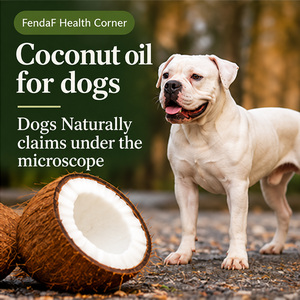
Coconut oil for dogs: examining Dogs Naturally’s claims
Reading time: about 9 min
I love coconut oil. I have used it on my dogs and seen good results, especially in caring for their skin and paw pads. That’s why Dogs Naturally Magazine’s change of stance made me think. They used to recommend coconut oil to dogs quite boldly. But later they started writing that it should not be given because coconut oil can promote inflammation and damage the intestines.
Dogs Naturally is an important source of information for many dog owners. I too read material from integrative veterinarians and advocates of natural approaches with great interest. But authority is not proof. When someone says that coconut oil was great one year and almost harmful the next, I want to know: what exactly changed in the studies and what can we actually conclude from these studies?
What is the main idea behind the Dogs Naturally claim?
The updated DNM approach makes several separate claims. First, it discusses whether coconut oil is a good source of medium-chain triglycerides, or MCTs. Second, it argues that lauric acid may promote inflammatory signaling pathways. Third, it brings into play lipopolysaccharides, or LPS, which travel from the gut into the blood. And finally, it comes to the practical conclusion that it would be better to not give your dog coconut oil or to replace it with purified MCT oil.
These are not the same question. If the first statement has a biochemical basis, it does not prove the validity of all the following statements.
First, fatty acid chains: why is C12 controversial?
The C number used in the name of a fatty acid indicates the number of carbon atoms in its chain. Coconut oil is approximately 45–50% lauric acid (C12), approximately 8% caprylic acid (C8), and 6–7% capric acid (C10). It also contains longer-chain saturated fatty acids, such as C14 and C16.
C6–C12 are often classified as medium-chain fatty acids, and C14 and above as long-chain fatty acids. This makes lauric acid (C12) a medium-chain fatty acid. The DNM also acknowledges that C12 is often officially classified as an MCT, but then states that lauric acid behaves more like a long-chain fatty acid in the body.
There is a nuance here that, if lost, the two schools of thought seem to be at complete odds. Chain length is a chemical property, while metabolic pathway is a physiological property. They are related, but not one and the same.
C8 and C10 are well known for the fact that after digestion, a large part of them travels directly to the liver via the portal circulation. In the case of C12, the picture is more mixed: some is absorbed like this, some is processed and travels through the lymphatic system in chylomicrons. The result is influenced, among other things, by the fat mixture and amount of lauric acid consumed. So it would be inaccurate to say that C12 behaves exactly like C8 or exactly like C16.
Therefore, DNM is correct that coconut oil cannot be equated with purified C8/C10 MCT oil. However, this does not mean that lauric acid is biologically just another long-chain fatty acid, or that coconut oil is therefore harmful to dogs.
Where do the claims about the benefits of MCTs come from?
There have been controlled studies in dogs with specific MCT oil or MCT-containing therapeutic diets. In studies of dogs with epilepsy, some dogs have had reduced seizure frequency; in older dogs with cognitive impairment, symptoms have been seen to improve with a specific diet. These are serious clinical signals, although not a promise for all dogs.
But the specific formulation was important in these studies. If the study was done with a C8/C10-enriched supplement, the results cannot be extrapolated to a can of coconut oil, which is dominated by C12. In the same way, the lack or nature of studies on pure MCT oil does not mean that coconut oil is worthless for other uses.
This goes for both sides. If a coconut oil advocate cites an MCT study, they need to say what was actually given to the dogs in the study. And if an opponent uses the same difference as evidence that coconut oil is harmful, they are making the next, equally unfounded leap.
Does lauric acid cause inflammation?
DNM points to a 2018 review in the journal Nutrients that looked at the relationship between saturated fatty acids and inflammatory signaling. The review described experiments in which lauric acid activated inflammation-related mechanisms in certain immune cells. This is scientifically interesting and there is no reason to deny it.
But here you need to read the methods. An immune cell response in a laboratory setting is not the same as a dog eating a small amount of coconut oil and developing a chronic disease. The concentration of the experimental conditions, the type of cells, the exposure time, and the regulation of the whole organism can change the result. The 2018 article was an overview of mechanisms, not a safety study of coconut oil in dogs.
Also, activation of one signaling pathway associated with inflammation does not always mean disease. Immune system signals are part of the normal defense mechanism. The duration, extent, clinical effect, and patient condition are important for the disease.
What about “leaky gut” and LPS? Let’s look at a 2013 study
One of the central references for DNM is a 2013 study by Mani and colleagues. It was a real scientific study, and it found differences in the transport of endotoxins in the gut with different oils. But first, the experiment was done on pigs, not dogs.
Second, this was not a case of an owner giving a dog a few drops of oil because of dry skin. The study used 50 ml of selected oil with a single meal, and also used isolated intestinal tissue experiments with relatively high oil concentrations. LPS transport and blood parameters were examined over a period of a few hours. The study did not measure the long-term health of the dogs and did not prove the development of chronic intestinal inflammation.
The result is noteworthy, especially when it comes to high fat intake, intestinal inflammation, or a sick patient. However, the claim “this study proves that coconut oil causes leaky gut in dogs” goes beyond the data.
DNM also mentions an additional study allegedly conducted on dogs, which they claim was planned to be published. Without a verifiable publication, methodology, sample, and measurement results, it cannot be considered equivalent to the published dog study. The emergence of such evidence may change the assessment in the future, and it will then need to be reconsidered.
Are the antimicrobial effects of coconut oil real?
Derivatives of lauric acid, such as monolaurin, have been reported to have antimicrobial activity in the laboratory. However, when DNM discusses the possibility that breaking down bacteria may release LPS, two things should be kept in mind. First, the effect depends on the specific substance and concentration. Second, laboratory testing alone does not show that coconut oil added to food either kills unwanted microbes in the gut or causes clinically significant endotoxemia.
Studies in dogs with the appropriate use and dosage are needed for either extreme conclusion.
Which points does DNM get right?
Coconut oil is high in fat and energy. This can cause diarrhea or vomiting in some dogs. If your dog has pancreatitis, high blood fat levels, or is on a special fat-restricted diet, “it’s MCT” is not a sufficient safety argument. And if the goal is to get the effects of C8/C10 that have been studied in clinical trials, a purified MCT preparation is closer to the subject of the study than regular coconut oil.
These are strong arguments that I wouldn’t dispute just because I’ve found coconut oil to be helpful myself.
In what way does DNM’s conclusion go too far in my opinion?
If a short-term pig study, cell studies, and C12 metabolism are to be used to recommend against coconut oil in all dogs, the certainty outweighs the scope of the evidence. The studies address a variety of issues: mechanism, oil composition, lipid transport, and the potential effects of high fat intake. They do not constitute a single dog-based clinical evidence package for the general harmfulness of coconut oil.
I don’t find this conclusion any stronger when it comes from a well-known natural dog-keeping publication. I would be just as critical of an integrative veterinarian’s claim that coconut oil prevents dementia or treats a skin infection if the study used a different formulation or only looked at a laboratory mechanism.
And where is my Ossu here?
I still have a very specific memory of when Ossu’s coat was gray and dull and his skin was flaking. I first used omega-3, and later coconut oil, both in food and topically. After a few weeks, his coat was shiny black again and the flaking was gone. Coconut oil has also helped me with my dogs’ dry paw pads.
This experience does not prove that all dogs should eat coconut oil. However, it does not become irrelevant just because one publication makes a different recommendation. Experience gives reason to ask and investigate. Research helps to assess with what certainty something can be recommended to others.
FendaF’s practical checklist
When you read yet another categorical statement about coconut oil, ask:
Did the study include coconut oil or purified MCT?
Were dogs, pigs, humans, or cells studied?
What dose or quantity was used?
Was a short-term biomarker measured or the dog’s real health outcome?
These four questions take the momentum out of many sensational headlines.
In conclusion
For me, the question here is not whether Dogs Naturally “wins” or integrative veterinarians “win.” The question is what we really know. Lauric acid is C12 and sits at the border of medium- and long-chain fatty acid metabolism. The questions raised by DNM about inflammatory mechanisms and fat tolerance are valid, but some of the conclusions are stronger than the underlying canine-based clinical data.
I will continue to use coconut oil when it is appropriate for my dog for a specific purpose, especially for external care. But I am not presenting it as a safe daily supplement for everyone or as a proven remedy for everything from fungus to dementia. If your dog needs MCT for a medical purpose, you should look for a specific formulation that has been studied and talk to your veterinarian.
You can also read about the practical uses of coconut oil in the FendaFi article "Coconut oil for dogs: when can it be beneficial and when should you be careful?".
Further reading: practical ways to use coconut oil for dogs.
Sources
• Dogs Naturally Magazine / Dana Scott. Dogs and MCT Oil: The Powerful Benefits (updated 12 February 2025). https://www.dogsnaturallymagazine.com/the-health-benefits-of-coconut-oil/
• Dogs Naturally Magazine. MCT Oil for Dogs: A Miracle Supplement? https://www.dogsnaturallymagazine.com/mct-oil-for-dogs/
• Mani, Hollis ja Gabler (2013). Dietary oil composition differentially modulates intestinal endotoxin transport and postprandial endotoxemia. Nutrition & Metabolism. https://doi.org/10.1186/1743-7075-10-6
• Rogero et al. (2018). Obesity, Inflammation, Toll-Like Receptor 4 and Fatty Acids. Nutrients. https://doi.org/10.3390/nu10040432
• Lockyer and Stanner (2016). Coconut oil – a nutty idea? Nutrition Bulletin. https://doi.org/10.1111/nbu.12188
• NCBI Bookshelf. Structured Lipids: A Comparison of Medium- and Long-Chain Fatty Acids. https://www.ncbi.nlm.nih.gov/books/NBK209064/
• Berk et al. (2020). Randomized controlled trial of MCT supplementation in dogs with epilepsy. https://doi.org/10.1111/jvim.15756
• ASPCA Animal Poison Control. People Foods to Avoid Feeding Your Pets. https://www.aspca.org/pet-care/aspca-poison-control/people-foods-avoid-feeding-your-pets
🐾 FendaF believes in informed choices.
We share scientific research, integrative veterinary perspectives and practical experience so that you can make well-informed decisions for your pet. Every animal is unique, and no article can replace veterinary assessment, diagnosis or treatment. If your pet is unwell, consult your veterinarian.
Author: Piret Oper






Leave a Reply