


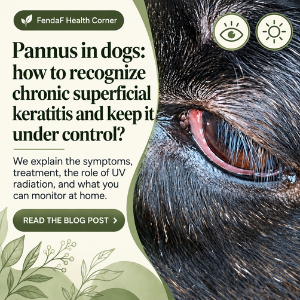
Pannus in dogs: how to recognise and control chronic superficial keratitis
Reading time: about 9 min
Fenton was diagnosed with pannus two weeks before his 9th birthday. My first thought, honestly, was: why now? Pannus is often described as an eye disease that develops in middle age in German Shepherds and other predisposed breeds, but the actual age range is broader. For example, in a retrospective study of 308 German Shepherds, the disease was most common in dogs aged 5–8 years, while clinical studies have also included patients as young as 2 years. So being nine years old is not “impossible” for pannus, nor does it in itself prove that the disease was somehow delayed for years.
Before Fenton’s diagnosis, there had been one extremely difficult period. At the end of November, he had to say goodbye to his almost 14-year-old Labrador friend Peku. Before that, Fenton watched Peku virtually around the clock and alerted Irene whenever Peku needed help. A dog who would normally sleep for much of the day slept very little for a while. This is an important part of our story, and stress does affect the immune system in general, but based on today’s evidence we cannot say with certainty that stress or lack of sleep caused Fenton’s pannus. At the same time, they cannot be removed entirely from the overall picture. The best-established associations in pannus are genetic predisposition, immune-mediated inflammation and UV radiation.
The good news is that pannus often responds well to treatment. The bad news is that treatment is usually not a “course and done” situation. It is a chronic disease, and eye medication generally needs to be continued throughout the dog’s life. The most important message of this article is simple: recognise eye changes early, treat consistently, and do not experiment with various home remedies directly on the eye.
What is pannus?
Pannus, or chronic superficial keratitis (CSK), is an immune-mediated inflammatory disease affecting the cornea. The disease is usually bilateral, although one eye may be clearly worse than the other. The third eyelid may also become thickened or inflamed.
The change typically begins at the outer edge of the cornea, where pink or reddish tissue, often rich in blood vessels, develops. Over time, the inflamed area may expand and the cornea may become pigmented and scarred. If pigment and scar tissue cover a large part of the cornea, vision may deteriorate. Advanced untreated pannus can ultimately lead to complete loss of vision.
Which dogs are at higher risk, and when does pannus develop?
The best-known predisposition is in German Shepherds and their crosses. Pannus is also seen in Belgian Shepherds, Border Collies, sighthounds and other breeds. Differences in risk between breeds support a genetic component, but the disease is not limited to one breed or one age group.
Age should be described accurately. Pannus is often referred to as a disease of middle-aged dogs, but that does not mean only 3–5 years of age. In a 2014 retrospective study of 308 German Shepherds, the highest frequency was found in dogs aged 5–8 years. In younger dogs the disease may be more aggressive, while some dogs are not diagnosed until later in life.
Another important factor is UV radiation. In high-altitude areas and regions with strong sunlight, the disease may be more common or more severe. UV exposure is not the only cause, but it is one of the few environmental factors that has been consistently associated with pannus.
What changes should you watch for in the eye?
- Pink or reddish tissue at the edge of the cornea. It often begins on the outer, or lateral, side of the eye.
- New blood vessels on the cornea. These may look like fine red lines growing into the cornea.
- Brown or dark pigment. Pigmentation may gradually spread and begin to limit vision.
- Changes in the third eyelid. It may become thickened or inflamed, or its pigmentation may change.
- Discharge, redness or changes in vision. Pannus itself may not be painful at first, but squinting, marked pain or a sudden change warrants faster examination because the cause may instead be an ulcer, a foreign body or another eye disease.
You can read more about how to perform a basic health check at home and what to look for in our article “Home health check for dogs”.
Diagnosis: with eye problems, the “try it and see” period should not be prolonged
Pannus can have a fairly typical appearance, but diagnosis should not be based only on a photograph or a home assumption. A veterinarian examines the eye and may use fluorescein staining to rule out a corneal ulcer, measure intraocular pressure and perform other tests to distinguish pannus from other corneal and ocular conditions.
This is where FendaF’s stepwise intervention rule moves quickly to the next level: with the eye, the wrong home treatment can do more harm than good. In particular, corticosteroid eye drops should not be used on your own before a corneal ulcer has been ruled out.
How is pannus treated?
The goal of pannus treatment is to suppress immune-mediated inflammation, stop disease progression and preserve vision. Conventional treatment uses topical corticosteroids such as prednisolone or dexamethasone and immunomodulatory medicines such as ciclosporin. In some cases, other immunomodulatory eye preparations or combination therapy may also be used.
Clinical studies also support the effectiveness of treatment. A randomised study compared ciclosporin and dexamethasone, both of which were used in the treatment of pannus. In a 2021 study, a combination of dexamethasone and ciclosporin reduced the extent of inflammatory tissue and corneal neovascularisation within five weeks. Pigmentation, however, may persist or continue to progress even when active inflammation is better controlled.
In severe cases or when the disease responds poorly to treatment, a veterinary ophthalmologist may discuss surgery or other specialised approaches. These are not the first home “next step”, but specialist decisions when standard topical therapy does not control the disease well enough.
UV radiation: what can actually be influenced in addition to medication?
Once pannus has been diagnosed, reducing UV exposure is one of the most reasonable non-drug measures. In areas with high UV levels, it may help to shorten long periods outdoors during the most intense sunlight and provide more shade. UV-protective dog goggles may also suit some dogs if they tolerate wearing them calmly.
It is important to distinguish the idea from a specific device. In a 2011 study, UV-blocking contact lenses did not improve the course of pannus, and some dogs developed adverse effects. So “UV matters” does not automatically mean that every UV-protective device is effective or necessary. The practical goal is to reduce excessive UV exposure without creating additional risks to the eye.
What about an integrative approach and “supporting the immune system”?
Pannus is an immune-mediated disease, but that does not mean the goal should be to simply make the immune system “stronger”. In an immune-mediated disease, the problem is more accurately an inappropriately directed inflammatory response. It is therefore more precise to talk about supporting overall health and inflammatory balance rather than maximally stimulating immunity.
A balanced diet, appropriate body weight, regular exercise, adequate sleep and reduced stress are sensible for overall health. Omega-3 fatty acids influence inflammatory mediators and can be discussed as part of general nutritional support. They are not, however, a pannus-specific treatment or a reason to reduce prescribed eye medication. If you want the practical side of omega-3 use, read FendaF’s article “Omega-3 fatty acids and how they are used incorrectly”.
Turmeric, probiotics, plant sterols and colostrum can be discussed in the context of general health or integrative support, but based on current knowledge we cannot promise that they delay the onset of pannus or stop the disease. They may nevertheless support the dog’s overall immune function. Turmeric/curcumin has been studied in inflammatory eye diseases, but a uveitis study cannot simply be repurposed as evidence for treating pannus.
The same applies to post-vaccination or monthly “detox” recommendations. FendaF does not currently recommend routine detox courses to prevent pannus, nor do we claim that parasite control or vaccination causes pannus. If a dog develops a reaction after a specific medicine or vaccine, that particular reaction should be assessed rather than turned into a general model for the cause of pannus.
Fenton’s story in light of what we know today
Fenton was diagnosed after a very stressful period, and naturally that timing caught our attention. It is worth remembering because life is not made up of laboratory values alone. At the same time, the honest boundary is this: from one dog we cannot conclude that stress or lack of sleep triggered pannus, nor that his previous lifestyle kept the disease away until the age of nine.
What can we say? Fenton belonged to a genetically predisposed breed, pannus is an immune-mediated disease, and his condition responded to eye treatment. His story is a good reminder that it is worth looking at a dog’s eyes even when the dog otherwise seems completely healthy.
Practical FendaF action plan for pannus
- Check the eyes regularly in the same lighting. If your dog belongs to a predisposed breed, do a quick eye check, for example once a week, and take a photo from the same angle if needed.
- New pink tissue, blood vessels or pigment = get it checked. Do not wait several weeks to see whether it “goes away on its own”.
- After diagnosis, continue treatment consistently. Pannus is chronic, and reducing eye drops on your own can allow inflammation to return.
- Reduce excessive UV exposure. Especially in strong sunlight or at high altitude, favour shade and discuss with your veterinarian whether UV-protective goggles might suit your dog.
- Pain, squinting, sudden cloudiness or heavy discharge needs faster attention. These are not symptoms where you should simply use “a little more” eye drops at home.
- Support overall health, but do not replace eye treatment with a supplement. Omega-3s, good nutrition, sleep and stress reduction may be sensible background support, but the foundation of pannus control is targeted treatment of the diagnosed eye disease.
In summary
Pannus is not a hopeless diagnosis. Most dogs do very well with consistent treatment, and the goal is to keep inflammation under control before corneal pigmentation starts to limit vision. The strongest contribution you can make at home is not an exotic immune-boosting course, but early recognition of changes, correct use of medication and sensible reduction of UV exposure.
An integrative approach is entirely possible here, but its role should remain proportional: support the dog as a whole while treating the eye disease with methods that have direct clinical evidence in pannus. Fenton’s story remains at the heart of this article; we simply need to keep a clear line between established facts and our own experience.
Sources used
- VCA Animal Hospitals – Pannus in Dogs (Chronic Superficial Keratitis) – https://vcahospitals.com/know-your-pet/pannus-in-dogs
- Drahovska Z et al. (2014) – retrospective study of 308 German Shepherds – https://pubmed.ncbi.nlm.nih.gov/25286670/
- Williams DL et al. (1995) – randomised comparison of ciclosporin and dexamethasone – https://pubmed.ncbi.nlm.nih.gov/8693674/
- Balicki I et al. (2021) – dexamethasone + ciclosporin/DMSO clinical study – https://pubmed.ncbi.nlm.nih.gov/34730300/
- Denk N et al. (2011) – study of UV-blocking contact lenses – https://pubmed.ncbi.nlm.nih.gov/21521443/
- Eichenbaum JD et al. (1986) – histological study of the immune-mediated nature of pannus – https://pubmed.ncbi.nlm.nih.gov/3767102/
🐾 FendaF believes in informed choices
The purpose of the FendaF blog is not to tell you what you must do. Our aim is to share knowledge, introduce different evidence-based and integrative perspectives, and help you make more informed decisions for your pet.
Every animal is unique, and no article can replace a consultation, diagnosis or treatment provided by a veterinarian. If your pet has a health concern or you need individual advice, always contact a veterinarian.







Leave a Reply