


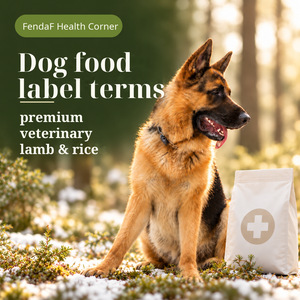
Dog food label terms: what do “premium”, “lamb & rice” and “veterinary” really mean?
Reading time: about 12 min
Dog food label terms can turn a simple shopping trip into quite a puzzle. Buying food for a dog ought to be straightforward: go to the shop, choose something suitable and go home. In reality, standing in front of a single shelf can make you feel as though you need a short course in nutrition first.
One bag says super premium, another lamb & rice, and a third veterinary diet. The packaging features beautiful dogs, appetising pieces of meat and promises that suggest a carefully formulated, high-quality food. But what do those words actually mean? Is super premium better than premium? Does a lamb and rice food consist mainly of those two ingredients? And is a veterinary diet automatically better quality than ordinary dog food?
Over the years I have looked closely at the composition of quite a few dog foods. I have come to realise that the front of the bag and the food inside can tell rather different stories. This does not necessarily mean the manufacturer is hiding something. The front is primarily a place to highlight what the manufacturer wants us to notice. The information that matters to a dog owner is usually on the back.
Premium sounds good, but what does it prove?
The word premium usually suggests something above average. If one manufacturer calls its food premium and another calls theirs super premium, you might expect the latter to meet stricter quality standards. In EU feed law, however, these terms do not have their own harmonised nutritional quality classes. There is no common requirement, for example, that a super premium food must contain a certain percentage of meat, a particular amount of animal protein or be made in a specific way.
That does not mean manufacturers can write whatever they like on a bag. Articles 11 and 13 of EU Regulation 767/2009 cover feed labelling and claims and prohibit misleading information. Claims about particular product characteristics must be objective, verifiable and substantiated. If a manufacturer promises a certain origin for its ingredients or a particular production method, there must be more behind that promise than attractive advertising.
For me, this distinction matters. I do not think the word premium is bad, or that a manufacturer using it is automatically doing something wrong. But consumers should not be led to believe that it represents an independently verified quality grade. Some premium foods may be excellent; others may be fairly ordinary recipes in more impressive packaging. And a manufacturer that never uses these terms may still make very good food.
So the question is not whether the bag says premium. It is what the manufacturer can show to support its quality claims.
Lamb and rice may mean less than we first assume
Imagine a bag with a large picture of a dog and the words Lamb & Rice. If I am looking for a lamb-based dry food, that naturally catches my eye, particularly if I want to avoid chicken or know that my dog tolerates some protein sources better than others.
But the front of the bag does not always answer an important question: how much lamb-derived material is actually in the food, and are other animal ingredients included too?
FEDIAF’s pet food labelling code gives quite specific examples of wording used to highlight ingredients. For a claim about a major component, with lamb means at least 4% lamb-derived feed material. In the code’s example, with lamb and rice requires at least 4% of each. Rich in lamb raises the minimum lamb-derived content to 14%. Where an ingredient is used as the main product designation or in a dinner/menu claim, the code also describes a minimum level of 26%.
Precision matters here. The FEDIAF code is an industry labelling guide, not a simple dictionary that lets us automatically assign one percentage to every Estonian or English product name. How the particular ingredient is presented on the label and its actual declared content matter just as much.
Another detail is easily overlooked. A declaration of 4% lamb-derived feed material does not necessarily mean 4% pure lamb muscle meat. Different permitted animal materials can come from the named species, and their precise description depends on the composition declaration. Nor does a 4% claim mean that everything else in the food is cereal or another plant ingredient.
And something particularly important to me: a food containing lamb is not automatically a single-animal-protein food. The recipe may also contain another animal protein, fat or egg. That does not necessarily make it poor food, but it may make it unsuitable for a dog that needs to avoid particular ingredients.
That is why I always read the entire ingredient list, rather than only the front of the bag. If I am buying lamb food for a dog with a suspected adverse food reaction to chicken, I want to know whether the recipe contains chicken or other potentially relevant ingredients. A diagnostic elimination diet also raises questions about cross-contamination and the production process.
Does the ingredient list tell the whole story?
Reading the composition matters, but the first three ingredients alone are not enough to make a decision. Two apparently similar recipes may differ in ingredient processing, digestibility, amino acid profile or manufacturing controls. The analytical crude protein percentage does not tell us how much of a food is meat either. A figure of 28% crude protein means measured protein content, not 28% lamb.
WSAVA’s food-selection resources point out that an ingredient list alone cannot establish the overall quality of a food. We should also know who formulated it, which guidelines were used to balance it and what quality controls the manufacturer applies.
I agree with that principle. But to me it does not mean that the ingredient list should become secondary. Quite the opposite: it is one of the first things I look at, especially when a manufacturer highlights a particular ingredient or promises exceptional quality. It is simply that no single indicator gives the whole answer.
I have previously compared dry food compositions at FendaF (in Estonian), but this article is not intended to pit one manufacturer against another. I want to show why an appealing name cannot replace meaningful information.
Veterinary: a quality mark or a specific nutritional purpose?
Veterinary foods make this subject even more interesting to me. The word veterinary creates a strong association with trust. If a food is intended for veterinary use or recommended by a vet, it can feel as though it must be better quality than ordinary dry food.
But a veterinary nutritional purpose and the overall quality of ingredients are not the same thing.
The EU has specific requirements for feeds intended for particular nutritional purposes. Commission Regulation 2020/354 covers those purposes and their associated nutritional conditions. A food intended for a dog with kidney disease, for example, may need restricted phosphorus and carefully controlled protein. Its purpose is to support the metabolic needs associated with a disease, rather than necessarily to contain as much meat as possible.
This matters. For a dog with chronic kidney disease, pancreatitis or another health problem, an appropriately selected therapeutic diet can be very valuable. Controlled studies in dogs have also shown benefits of renal diets for the clinical course of kidney disease.
At the same time, I do not think we should set aside this question: does meeting a particular nutritional purpose automatically mean that the best possible ingredients and production method have been chosen?
Several integrative veterinarians have been much more critical on this point than conventional nutritional guidance tends to be.
Why is Judy Morgan so critical of veterinary diets?
Integrative veterinarian Dr Judy Morgan has been strongly critical of prescription veterinary diets for years. In her article “Is There Proof Prescription Diets Really Work?”, she questions their ingredients, high prices, manufacturers’ influence on veterinary nutrition education and the strength of the evidence behind specific products’ therapeutic claims.
Morgan believes that, wherever possible, a sick animal should be supported with a diet made from high-quality whole foods. In her view, many conventional veterinary diets contain too many heavily processed or poor-quality ingredients. On her website, she clearly states that she no longer recommends such prescription diets when she can formulate a suitable alternative using fresh ingredients.
That is a much stronger position than simply advising owners to read labels more carefully.
Morgan also criticises situations in which manufacturers’ marketing, veterinary practices’ financial interests and actual clinical needs may become entangled. Her point is that a veterinary recommendation or a product’s special status should not exempt the manufacturer from questions about ingredients and evidence.
We should remember, however, that much of Morgan’s criticism concerns the United States prescription-diet market and its regulatory framework. Her assessments do not automatically establish that every dietetic feed sold in the EU is regulated in the same way, or that all veterinary diets are ineffective.
But the question she raises is relevant here too: if a food is intended for a sick dog, should we not be at least as demanding about its composition and quality as we are about food for a healthy dog?
Judy Morgan also discusses the historical background of veterinary diets. According to Morgan, they were originally developed for short-term use to support an animal with a specific health problem. Today, some therapeutic diets are intended for long-term feeding, but that does not make the original purpose any less interesting. Morgan also warns that, in a household with two dogs, one dog’s need for a therapeutic diet does not automatically mean that the same food is suitable for the healthy dog, particularly over the long term.
Karen Becker: a therapeutic purpose does not automatically make ultra-processed food high quality
Dr Karen Becker is also highly critical of veterinary diets. For years she has emphasised species-appropriate, minimally processed food and ranked conventional veterinary prepared foods quite low in her comparisons.
In a lengthy interview, Becker explains that she still sees the ultra-processed nature of veterinary diets and the quality of their ingredients as major problems. Making a nutritional adjustment needed by a sick animal does not, in her view, automatically make that food high quality or species-appropriate.
Interestingly, in the same interview she acknowledges that veterinary diets often have more research relating to specific health conditions behind them than ordinary dog foods. She therefore does not deny that certain formulations can serve a medically important purpose. Her criticism is mainly about the food used to achieve that purpose, and whether a different composition could achieve the same result.
To me, that is a very important question.
Consider a veterinary diet containing hydrolysed protein. Its purpose may be to reduce the immune system’s exposure to particular protein structures and provide a way to investigate an adverse food reaction. That can be entirely justified. But if the recipe relies heavily on starch and a highly processed protein source, its veterinary designation should not stop us asking why those ingredients were chosen or what other options are available.
There is no need to choose between two extremes. There is no basis for saying that all veterinary diets are bad, but equally little basis for automatically treating every one of them as the highest-quality food.
We need to distinguish what a particular diet has demonstrated in clinical studies, what it contains and whether its composition suits the individual dog. A fresh-food alternative must also meet the nutritional requirements associated with the disease. Especially with kidney disease or pancreatitis, it is not enough for homemade food to feel more natural. The recipe must be nutritionally calculated and the dog’s condition monitored.
To me, an integrative approach does not mean opposing veterinary medicine. It means looking at all justified options and choosing what suits the individual animal, instead of deciding solely on the basis of a manufacturer’s or product range’s name.
What do I actually look for on the label?
When choosing between two dog foods, I give an attractive promise on the front little weight until I have looked at what it means.
For premium, I want to know what supports the manufacturer’s quality claims. For lamb and rice, I check which lamb-derived ingredients are used, their proportions and whether the recipe contains other animal proteins or fats. For veterinary, my first question is the specific nutritional purpose, but I still want to examine the whole recipe and the reasons it suits the dog’s health needs.
I also look at the analytical constituents, feed additives and additional information provided by the manufacturer. An important unanswered question does not disappear simply because a reassuring word is printed prominently on the bag.
Of course, I watch the dog too. A food may look excellent on paper, but persistent digestive problems, itchy skin or unwanted changes in body weight need further investigation. At the same time, good stools alone do not prove that the whole diet is nutritionally balanced over the longer term.
All of these things belong to the same picture.
To sum up
I do not think we should completely ignore the words on the front of a dog food bag. They serve a purpose and sometimes have quite specific meanings. Problems arise when we give them more weight than they can actually carry.
Premium is not a nutritional quality grade in its own right. Lamb and rice does not establish, without checking the composition, that a food contains only those two ingredients or a single animal protein. Veterinary can indicate a very important nutritional purpose, but it does not automatically tell us the quality of the ingredients or whether that food is the best possible choice for this particular dog.
The criticism of integrative veterinarians, including Judy Morgan and Karen Becker, reminds us that food with a veterinary purpose deserves meaningful scrutiny too. At the same time, we should acknowledge situations in which the benefits of a particular dietary formulation have been demonstrated clinically. These positions are compatible.
What matters most to me is that dog owners can look beyond the packaging and feel able to ask questions, even when the food comes from a well-known manufacturer or is recommended by a vet.
Because, in the end, a dog does not eat the words on the packaging. A dog eats what is inside the bag.
Sources
- Regulation (EC) No 767/2009 of the European Parliament and of the Council, particularly Articles 11 and 13. Feed labelling and claims.
- FEDIAF Code of Good Labelling Practice for Pet Food, 2019, particularly Annex 5. Ingredient claims and percentage examples.
- FEDIAF Nutritional Guidelines, 2025. Nutritional guidance for complete and complementary pet foods.
- Commission Regulation (EU) 2020/354. Requirements for feeds intended for particular nutritional purposes.
- WSAVA Global Nutrition Guidelines. Guidance on assessing pet foods and their manufacturers.
- Dr Judy Morgan. Is There Proof Prescription Diets Really Work?, 2016. Criticism of the evidence, ingredients and marketing of prescription diets.
- Dr Judy Morgan. Why Practice Holistic Medicine? The author’s views on veterinary diets and whole-food alternatives.
- Dr Karen Becker. The Forever Dog, interview with Melanie Avalon. Discussion of veterinary diets, processing, ingredients and research.
- Jacob et al. Clinical evaluation of dietary modification for treatment of spontaneous chronic renal failure in dogs, 2002. Randomised controlled trial of a renal diet in dogs with chronic kidney disease.
- Dr Judy Morgan. The Pet Care Future We’re Fighting For, interview on Dr Lily Chen’s My Dog Is Better Than Your Dog podcast, 22 March 2026. Morgan’s position on short-term use of prescription diets.
🐾 FendaF believes in informed choices
The purpose of the FendaF blog is not to tell you what you must do. Our aim is to share knowledge, introduce different evidence-based and integrative perspectives, and help you make more informed decisions for your pet.
Every animal is unique, and no article can replace a consultation, diagnosis or treatment provided by a veterinarian. If your pet has a health concern or you need individual advice, always contact a veterinarian.










Leave a Reply