


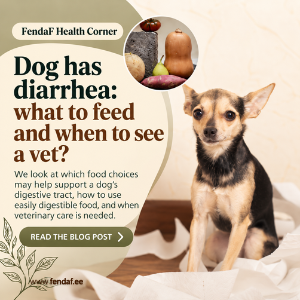
Dog diarrhea: what should you feed and when should you see a vet?
Reading time: about 11 min
Diarrhea is one of those dog problems where the owner’s first question is very practical: what should I feed now? For years, the standard answer has been “chicken and rice.” Integrative veterinary medicine often suggests pumpkin, sweet potato or other squash instead, together with a well-tolerated lean protein. Both approaches have their logic, and it is important not to reduce the discussion to “rice is bad” or “rice is always best.”
For mild, uncomplicated acute diarrhea, the three most important things are fluids, well-tolerated food and monitoring. Well-cooked white rice can be a perfectly reasonable part of a temporary, easily digestible diet. Pumpkin and sweet potato, however, provide a different fibre profile in addition to energy, which is why many integrative veterinarians often prefer them to rice when the gastrointestinal tract is irritated. Turkey, chicken, white fish or another lean protein may be suitable if the dog tolerates it. None of these is a universal “diarrhea cure,” and with chronic or severe diarrhea the goal should be to find the cause rather than endlessly rotate add-ons.
A 2026 review emphasizes that most cases of acute diarrhea in dogs are self-limiting and that management focuses on supportive care, including fluids and nutrition. That does not mean every case can simply be watched at home. Puppies, senior dogs, dogs with chronic disease, and dogs with blood in the stool, repeated vomiting, marked lethargy, pain or signs of dehydration warrant a lower threshold for veterinary assessment.
First: is your dog actually suitable for home monitoring?
- Home monitoring is more reasonable when an adult dog is otherwise bright, is drinking, is not vomiting repeatedly and the diarrhea has only been present for a short time.
- Your dog should have free access to water. If the dog cannot keep water down, drinks very little or appears dehydrated, food choice is no longer the main issue.
- With a puppy, a very small dog, a senior dog or a dog with an important underlying condition, seek help earlier because fluid and electrolyte losses can become significant more quickly.
- Prompt veterinary assessment is needed if the stool is black/tarry, there is a lot of blood, the dog is vomiting repeatedly, is markedly lethargic or painful, the abdomen is tense, weakness/collapse develops, or you suspect a foreign body, poisoning or an infectious disease.
For a practical checklist of red flags, see our article “Dangerous symptoms in dogs and cats: when not to wait.”
If you are unsure whether fluid loss is becoming a problem, our article “Dehydration – signs and practical tips for hot weather” explains what to watch for at home.
So are chicken and rice a bad idea?
No. Studies in dogs do not support the claim that properly cooked white rice is generally difficult to digest. Rice and rice flour have been highly digestible starch sources in several digestibility studies. This answers a fairly narrow question, however: how efficiently a dog digests rice starch. It does not prove that rice is the best choice for an irritated or dysbiotic gut in every situation. A homemade chicken-and-rice mixture is also not nutritionally complete for long-term feeding, and some dogs may not tolerate chicken or a high starch load well.
If you use chicken and rice short term during simple acute diarrhea, choose lean skinless chicken, cook the white rice until very soft, and feed small portions. If your dog has reacted to chicken before, has recurrent or chronic diarrhea, or you suspect food sensitivity, there is no reason to force this particular combination. In that situation, the more important question is what the individual dog tolerates and what best supports that dog’s gut.
Pumpkin: a useful tool, not a universal cure
Pumpkin’s value during diarrhea is less about a “therapeutic effect” of beta-carotene and more about fibre. Fibre can influence water-holding capacity, fermentation and intestinal transit. Newer veterinary literature emphasizes that the effect of fibre depends on its type, solubility, viscosity and fermentability. It is therefore not accurate to talk about fibre as a single substance that fixes every digestive upset.
As a practical, low-risk starting guideline, you can try about 1 teaspoon of plain cooked pumpkin purée per 4–5 kg of body weight once or twice daily and monitor stool consistency. This is FendaF’s practical starting guideline, not a treatment dose proven in a clinical trial. Too much fibre can cause more gas, more frequent bowel movements or softer stool in some dogs, so start on the lower side.
Use plain pumpkin, not sweetened or spiced pie filling. If pumpkin makes the stool worse, reduce the amount or stop.
Sweet potato and other squash: why do integrative veterinarians often prefer them?
Cooked sweet potato can be a well-tolerated carbohydrate and fibre source for some dogs. In integrative veterinary medicine, pumpkin or butternut squash together with turkey or white fish is also often suggested when the gastrointestinal tract is irritated. Judy Morgan, for example, uses cooked turkey and pumpkin as a practical short-term option for diarrhea, while Katie Woodley recommends looking beyond the chicken-and-rice diet, particularly in chronic or recurrent digestive problems, and considering options such as white fish with squash. The point of this approach is not that rice is inherently bad. Squash provides soluble and fermentable fibre in addition to energy and may fit better when the aim is also to support stool consistency and the intestinal environment.
It is useful here to distinguish digestibility from gastrointestinal tolerance. White rice can be very digestible in terms of starch digestion, but that does not automatically mean that a high-starch meal is the gentlest option for every inflamed, sensitive or dysbiotic gut. At the same time, we do not currently have a good dog-specific comparison study proving that sweet potato or pumpkin treats acute diarrhea better than rice overall. It is therefore reasonable to view them as different nutritional strategies and monitor the individual dog’s actual response.
Turkey or chicken?
Turkey is not automatically leaner or easier to digest than chicken as a species. Fat content depends on the particular cut and whether the skin is included. During gastrointestinal irritation, choose one lean protein source that is familiar and well tolerated by the dog, remove visible fat and do not season it.
If your dog has previously eaten chicken without problems, there is no need to replace it with turkey simply because it is fashionable. If chicken is a suspected trigger for a food reaction, choose another protein source. With chronic or recurrent diarrhea, a controlled elimination diet or a veterinary hydrolyzed diet may make more sense than randomly rotating proteins.
If food sensitivity is part of the picture, our article “Hydrolyzed-protein food” explains when a hydrolyzed diet can be useful and what it can and cannot tell you.
Should a dog with diarrhea be fasted?
In the past, withholding food for 12–24 hours was commonly recommended for diarrhea and vomiting. The modern approach is less automatic. The gastrointestinal lining receives energy from nutrients, and early enteral feeding may support gut function. If the dog is not vomiting, wants to eat and is otherwise well, a healthy adult dog does not routinely need to be starved for a full day. Instead, offer small, frequent portions of easily digestible food.
If vomiting is also present or the dog cannot keep food down, the situation is different and veterinary assessment may be needed. Puppies should not be subjected to a prolonged fast; at most, skip one meal if there is a clear reason to do so.
What should you actually feed?
If the diarrhea is mild, acute and uncomplicated, you have several reasonable options. The goal is not to find one “correct” ingredient but to choose food that is well tolerated, moderate in fat and easy to digest, and to offer it in small portions.
- Option 1: a veterinary or other high-quality, easily digestible gastrointestinal wet food that is labelled as a complete feed. Its advantage is that it is balanced and can also be used for longer than just a couple of days.
During diarrhea, FendaF prefers wet food to dry food in this context because it adds fluid with the meal. This does not mean that gastrointestinal dry food is inherently bad or unsuitable.
- Option 2: for a short period, a homemade combination of lean protein + well-cooked white rice, if the dog normally tolerates those ingredients and the digestive upset is simple and acute.
- Option 3: lean protein + cooked pumpkin, sweet potato or another suitable squash if you want more fibre or follow an integrative approach that often prefers these options to rice during gastrointestinal irritation.
- If your dog happily eats its normal food and it does not seem to worsen the symptoms, you do not necessarily need to invent a completely new menu for every mild episode of diarrhea.
Probiotics and other supportive options
There are clinical studies on probiotics in dogs, but the effect is not “probiotics in general”; it is strain- and product-specific. In some randomized studies, certain probiotic combinations have shortened the duration of acute diarrhea. At the same time, AAHA notes that product quality and effectiveness vary. Choose a product that clearly lists its strains and amounts, and do not assume that every jar labelled “billions of CFU” does the same thing.
Certain fibres, clay minerals and other gastrointestinal support products may also help in some situations. Assess them in the same way as food: realistic potential benefit, low risk, a clear monitoring window and clear escalation criteria. “Natural” does not automatically mean safe, and “synthetic” does not automatically mean bad.
For additional low-risk home-support options and their limits, see our article “Diarrhea in dogs – home remedies.”
When diarrhea keeps coming back or persists
With chronic or recurrent diarrhea, the goal is not simply to make the stool firmer. Causes can include parasites, food reactions, chronic enteropathy, pancreatic problems, medication effects, stress and other diseases. If symptoms persist, recur frequently or the dog loses weight, you need a plan that looks for the cause.
A diet trial can be very useful in this situation, but it needs to be controlled. If you change the protein, carbohydrate, treats, probiotic and three supplements at the same time, you will not know afterwards what actually helped.
For a broader step-by-step approach to food tolerance, see “Dog with sensitive digestion: how to support the gut gently?”
For the bigger picture behind recurring digestive signs, also read “Digestive problems in dogs do not develop overnight.”
FendaF practical action plan: mild diarrhea
- Look at the dog before you look at the food: is the dog bright, drinking, not vomiting repeatedly and not showing marked abdominal pain? If the dog is not acting normally, escalate sooner.
- Keep water freely available. If the dog cannot keep water down or signs of dehydration appear, contact a veterinarian.
- Offer 3–5 small portions of a well-tolerated, easily digestible food rather than one large meal.
- If you use pumpkin, start with about 1 teaspoon per 4–5 kg of body weight once or twice daily. If the stool or gas gets worse, reduce the amount or stop.
- Over the next 12–24 hours, look at the direction of change rather than a single bowel movement. Is the frequency decreasing? Is the stool becoming more formed? Is the dog staying bright?
- If there is no clear improvement within 24–48 hours, the symptoms worsen, or blood, repeated vomiting, marked lethargy, pain, or refusal to eat/drink develops, move to the next level and have the dog examined.
What should you actually take away from this article?
- Rice is not automatically difficult for dogs to digest. Properly cooked white rice can be highly digestible, but good starch digestibility does not mean rice is always the best option for every sensitive or inflamed gut.
- Pumpkin and sweet potato can be practical fibre sources, and integrative veterinarians often use them specifically to support the gastrointestinal tract. More is not better: start with a small amount and watch your dog’s response.
- Turkey is not automatically leaner than chicken. The specific cut, fat content and the dog’s individual tolerance matter more.
- For mild acute diarrhea, a sensible first step is fluids + small portions of easily digestible food + suitable fibre if needed.
- With chronic, recurrent or severe diarrhea, look for the cause. Temporarily firming up the stool is not the same as solving the problem.
In summary
When your dog has diarrhea, you do not have to choose between the camps of “chicken and rice” and “rice is bad.” It is more useful to look at the dog’s condition and use a stepwise approach. Well-cooked white rice can be a suitable, easily digestible component, while pumpkin, sweet potato and other squash provide a different fibre and starch profile and are often preferred in integrative veterinary medicine when the gastrointestinal tract is irritated. With mild, uncomplicated diarrhea, start with fluids, small well-tolerated meals and, if useful, a moderate amount of fibre. Watch the trend over 12–24 hours. If it is not improving, do not turn your kitchen into a laboratory; move to the next level.
Pumpkin, sweet potato, rice, chicken, turkey and white fish are all tools. Integrative approaches often give squash a larger role in gastrointestinal support, while conventional bland-diet logic often uses rice. The right choice is the one the individual dog tolerates, that fits the nature of the problem and that produces a genuinely good response.
Sources used
- Amirsultan S, Odunayo A. From Diagnosis to Resolution: A Practical Guide to Acute Diarrhea in Veterinary Patients. Vet Clin North Am Small Anim Pract. 2026. https://pubmed.ncbi.nlm.nih.gov/41763984/
- Holz M et al. Effects of dietary cellulose on clinical and gut microbiota recovery in dogs with uncomplicated acute diarrhea. JAVMA. 2024. https://pubmed.ncbi.nlm.nih.gov/39536440/
- Parker VJ, et al. Therapeutic Applications of Dietary Fiber: Managing Fiber-responsive Gastrointestinal Conditions in Dogs and Cats. 2026. https://pubmed.ncbi.nlm.nih.gov/41748338/
- Carciofi AC et al. Effects of six carbohydrate sources on dog diet digestibility and post-prandial glucose and insulin response. 2008. https://pubmed.ncbi.nlm.nih.gov/18477314/
- Nutritional value of common carbohydrate sources used in pet foods. 2024. https://pubmed.ncbi.nlm.nih.gov/39691608/
- Microbiome, Prebiotics, Postbiotics. https://www.aaha.org/resources/2021-aaha-nutrition-and-weight-management-guidelines/microbiome-prebiotics-postbiotics/
- Merck Veterinary Manual. Disorders of the Stomach and Intestines in Dogs. https://www.merckvetmanual.com/dog-owners/digestive-disorders-of-dogs/disorders-of-the-stomach-and-intestines-in-dogs
- Herstad HK et al. Effects of a probiotic intervention in acute canine gastroenteritis. 2010. https://pubmed.ncbi.nlm.nih.gov/20137007/
- Gómez-Gallego C et al. A canine-specific probiotic product in treating acute or intermittent diarrhea in dogs. 2016. https://pubmed.ncbi.nlm.nih.gov/27938673/
- Judy Morgan DVM. Doggy Diarrhea. https://drjudymorgan.com/blogs/blog/doggy-diarrhea
- Judy Morgan DVM. Gastroenteritis and Colitis in Dogs and Cats. https://drjudymorgan.com/blogs/blog/gastroenteritis-and-colitis-in-dogs-and-cats
- Katie Woodley BVSc, The Natural Pet Doctor. STOP Feeding This If Your Dog Has Diarrhea – Holistic Vet Advice. https://www.thenaturalpetdoctor.com/blog/dog-diarrhea-what-not-to-feed
🐾 FendaF believes in informed choices
The purpose of the FendaF blog is not to tell you what you must do. Our aim is to share knowledge, introduce different evidence-based and integrative perspectives, and help you make more informed decisions for your pet.
Every animal is unique, and no article can replace a consultation, diagnosis or treatment provided by a veterinarian. If your pet has a health concern or you need individual advice, always contact a veterinarian.









Leave a Reply