


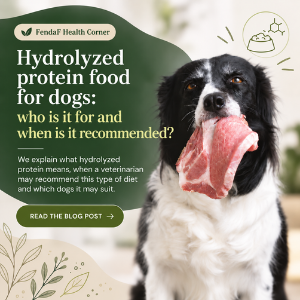
Hydrolyzed protein dog food: is it always the best choice?
Reading time: about 11 min
Hydrolyzed dog food is often discussed as if it were a quality category of its own: if the protein is hydrolyzed and the food comes from a veterinary range, it must therefore be the safest and best option for a sensitive or allergic dog. I do not see it that way.
Hydrolysis is a technology. It can be very useful when we have a specific diagnostic or therapeutic nutrition goal, but on its own it says nothing about the quality of the complete formula. Alongside the hydrolyzed protein, the main ingredients may include large amounts of starch, vegetable oils, isolated or highly processed components, and relatively little of the kind of raw material I would choose as the basis of a dog’s everyday diet.
That is why I deliberately separate two questions in this article: can a hydrolyzed diet work in certain situations, and would I automatically choose it over a better-formulated complete food with non-hydrolyzed protein? The answer to the first is yes. To the second, usually no.
What does hydrolysis actually do?
During hydrolysis, long protein chains are broken down into smaller peptides and amino acids. In the context of food reactions, the aim is to reduce the size and recognizability of protein structures to which the immune system may react. The more extensive the hydrolysis, the smaller the peptides tend to be, but there is no universal cut-off below which every product is guaranteed to be non-allergenic for every dog.
This means that “hydrolyzed” is not the same as “allergen-free”. In a 2020 laboratory study, extracts from two commercial hydrolyzed diets were able to activate T lymphocytes in some dogs suspected of adverse food reactions. This does not prove that these foods do not work clinically, but it does show that the source protein, degree of hydrolysis and the individual dog’s response still matter.
Hydrolyzed does not automatically mean a high-quality formula
A useful place to start is by looking at the actual formulas of common veterinary diets. The picture is often quite different from what marketing phrases such as “specially formulated for sensitive dogs” may imply.
- Royal Canin Anallergenic: the first ingredient is maize starch; the protein source is low-molecular-weight feather hydrolysate. On the manufacturer’s UK page, maize starch accounts for 46.3% and feather hydrolysate for 19.78%.
- Purina Pro Plan Veterinary Diets HA: the formula begins with maize starch and hydrolyzed soy protein; it also contains minerals, coconut oil, sugar, rapeseed oil, soybean oil and cellulose.
- Hill’s Prescription Diet z/d: the main carbohydrate source is corn starch and the protein source is hydrolyzed chicken liver/chicken; the formula also includes cellulose, vegetable oils and several processed fibre sources.
This does not mean these foods are “toxic” or incapable of fulfilling their clinical purpose. For example, extensively hydrolyzed feather protein can provide highly digestible amino acids, and controlled manufacturing can reduce cross-contamination. But that does not make such a formula automatically my first choice for a dog’s long-term everyday diet. Being a complete feed does not automatically mean that a formula is nutritionally the choice I would prefer.
An ingredient list alone cannot measure the full biological value, digestibility or nutrient balance of a food. But we should not make the opposite mistake either and treat the words “veterinary diet” as a guarantee of quality. Hydrolysis solves one technical problem: reducing the antigenicity of protein. It does not turn corn starch into meat or automatically make a processed formula minimally processed or higher in raw-material quality.
When can a hydrolyzed diet genuinely make sense?
The strongest reason is not simply a “sensitive stomach”, but the need for a controlled elimination diet. The gold standard for diagnosing a food allergy or another adverse food reaction remains an elimination period followed, when appropriate, by a challenge. For skin symptoms, a strict trial of around eight weeks is commonly used because most diet-responsive dogs improve within that time. If you want more context on why chicken is often blamed too quickly, see Chicken allergy in dogs: it may not actually be an allergy.
The practical advantage of a hydrolyzed veterinary diet in this context is primarily controllability. Studies of over-the-counter novel-protein foods have found a considerable number of undeclared animal ingredients and cross-contamination. Such discrepancies have been found less often in hydrolyzed veterinary diets. If the goal is diagnosis rather than simply “trying something new”, that difference can matter.
A hydrolyzed diet may also be reasonable when a dog has already eaten many different protein sources and finding a truly novel protein is difficult, or when a well-conducted novel-protein trial has failed. In that situation, the hydrolyzed diet is not chosen because it is necessarily a “better food”, but because it may be a better diagnostic instrument.
Is a hydrolyzed diet better for chronic enteropathy?
This is an area where it is easy to oversell the evidence. In a 2023 Cornell randomized study, 19 of 23 dogs, or 83%, with non-protein-losing chronic enteropathy responded to the first diet. Importantly, there was no difference in clinical response between the hydrolyzed fish diet and the control food containing non-hydrolyzed chicken and fish. The authors concluded that long-term remission was induced by dietary change regardless of antigen restriction or added ingredients. This fits well with the broader FendaF perspective in Dog digestive problems do not develop overnight: chronic digestive disease deserves a wider look than one bag of food.
That does not make hydrolyzed diets useless. The same study showed that dogs that did not respond to the first diet could respond to the second, and hydrolyzed fish diets also supported improvement in dogs with protein-losing enteropathy. The practical message is therefore different from “choose hydrolyzed food for chronic enteropathy”: many dogs respond to a dietary change, and the suitable diet may be hydrolyzed, limited-ingredient or have another specific nutritional profile.
When would I prefer non-hydrolyzed food?
If a dog does not need a strict diagnostic elimination trial, previous reactions have not been severe and we have a well-tolerated complete food with a transparent formula, I generally prefer high-quality non-hydrolyzed animal protein. The reason is not that hydrolysis is inherently harmful. It is simpler: I do not see a need to use a more heavily processed specialist diet when the dog is doing well on a food whose formula and raw-material profile I prefer.
The same applies to a novel protein. If the dog has never eaten a particular animal protein before, the product is a complete feed, the formula is transparent and the manufacturer controls the production process sufficiently well, it can be a perfectly reasonable first step.
For a strict elimination diet, what matters is not only whether a food is hydrolyzed or single-protein, but also how well the actual composition and possible cross-contamination are controlled. A hydrolyzed veterinary diet is not automatically more reliable simply because it belongs to a veterinary range. If the manufacturer cannot show that unwanted proteins are sufficiently controlled during production, cross-contamination is not in itself an argument for preferring the hydrolyzed diet.
For a strict food trial, therefore, the choice should not be “a veterinary diet” as a category, but a specific food whose formula, degree of hydrolysis or genuinely novel protein, and production controls are sufficiently reliable for the purpose.
“Clean ingredients” also need an honest definition
In the FendaF context, “clean ingredients” do not mean a magical label or that every unprocessed ingredient is automatically better. For me, it primarily means transparent raw materials, clearly identified animal protein sources, a macronutrient profile appropriate for the dog, a reasonable degree of processing, and as little need as possible to hide the bulk of the recipe behind generic ingredient names.
The “cleaner” the protein source used, the lower the likelihood that a dog will eventually develop an intolerance to that protein.
Dr. Karen Becker
At the same time, the diet must be nutritionally complete. A beautiful list of meats cannot rescue an unbalanced menu, and homemade or fresh food is not automatically better if essential nutrients are missing. Formula quality and nutritional completeness must be assessed together. This is why the distinction between complete and complementary feed matters.
What can we conclude from studies, and what can we not?
There is genuine clinical evidence for hydrolyzed diets. At the same time, it matters what exactly was studied, what the diet was compared with, and who funded the study or manufactured the products. Industry involvement is common in veterinary nutrition research. That does not automatically make a study worthless, but its conclusions should not be extended beyond what the data support.
For example, if a hydrolyzed diet reduces itching during an elimination trial, this primarily shows that the dog responded to that controlled diet. It does not prove that hydrolyzed food is higher quality than every other food or that the dog should eat it for life. Likewise, failure of one novel-protein diet does not prove that every non-hydrolyzed food is unsuitable for that dog.
A stepwise intervention approach
If the dog is otherwise well and the situation does not require urgent diagnostics, it makes sense to begin with the lowest-burden step that has a realistic chance of solving the problem.
- If the problem is mild and a specific food link is not yet clear, first review the entire diet, treats, chews and recent changes.
- If there is a reasonable suspicion of a reaction to one or more proteins and a suitable novel protein is available, a controlled complete food based on that novel protein can be tried. Also assess the rest of the formula and choose a food with as simple and transparent a composition as possible.
- If the dog has already eaten many proteins, the previous trial was confusing, or diagnostic certainty matters, a tightly controlled elimination diet becomes more justified. This may be a hydrolyzed diet, a genuinely novel-protein food or, where appropriate, a balanced homemade elimination diet. The choice depends on the specific product, production controls and the dog’s previous diet.
- If symptoms are severe, the dog is losing weight, vomiting repeatedly, has blood in the stool, low albumin or a worsening general condition, it is not sensible to prolong a food trial on its own. Diagnostics and, when needed, treatment are required.
This is not a “natural before medication” dogma. It is a principle of proportionality: use as much intervention as the situation actually requires, but do not choose a more restrictive or more heavily processed solution simply because it exists.
Practical FendaF selection rule
- If the dog is healthy or only occasionally has sensitive digestion: do not choose a hydrolyzed diet automatically. Look first at the actual formula and the dog’s response.
- If you need a strict allergy elimination trial: choose a diet in which the protein source and cross-contamination are controlled as well as possible. A hydrolyzed diet can be a very practical tool here.
- If you can use a genuinely novel, well-tolerated complete food with a transparent formula: it can be a completely reasonable alternative.
- If the first diet does not work: first check whether the trial was actually strict. Then change the strategy, not just the colour of the bag.
- If the diet works: do not automatically assume that the same food must remain lifelong. After the diagnostic phase, you can assess in a controlled way what the dog actually tolerates.
What should you actually take away from this article?
Hydrolyzed protein is a useful technological solution, not a quality stamp. Its main strength is that it can reduce the immunological recognizability of protein and make an elimination diet more controllable in some situations.
At the same time, a hydrolyzed veterinary diet can be heavily centred on starches and processed ingredients. If the dog does not need that specific function, there is no reason to assume that such a food is automatically better than a well-formulated complete food with a clear ingredient list and a suitable non-hydrolyzed animal protein.
My choice would therefore be goal-based: do we need a diagnostic tool or a good everyday food? Those two goals do not necessarily meet in the same bag, although sometimes they can.
In summary
Hydrolyzed dog food should not be demonized, but it should not be placed on a pedestal either. If there is a genuine suspicion of an adverse food reaction, a very broad history of previous protein exposure, or a need for a strict elimination trial, a hydrolyzed diet may be justified and useful. If the goal is simply to find a good long-term food and the dog tolerates high-quality non-hydrolyzed protein, I see no reason to prefer hydrolyzed food solely because it carries a veterinary-diet label.
The FendaF principle is simple: look at the ingredient list rather than the front of the bag, do not confuse a diagnostic tool with an everyday quality preference, and always watch the response of the individual dog. Your dog is not the average dog, and your dog may not respond to food in the same way as many others.
Sources used
- Olivry T, Mueller RS. Review of critically appraised topics on adverse food reactions of companion animals. Vet Dermatol. 2020.
- Olivry T, Mueller RS, Prélaud P. Duration of elimination diets in dogs and cats. BMC Vet Res. 2015.
- Masuda K et al. Hydrolyzed diets may stimulate food-reactive lymphocytes in dogs. J Vet Med Sci. 2020.
- Simpson KW et al. Randomized controlled trial of hydrolyzed fish diets in dogs with chronic enteropathy. J Vet Intern Med. 2023.
- Royal Canin Anallergenic, official product composition.
- Purina Pro Plan Veterinary Diets HA Hypoallergenic, official Estonian product composition.
- Hill’s Prescription Diet z/d, official product composition.
- Olivry T, Mueller RS. Discrepancies between ingredients and labeling in commercial pet foods. BMC Vet Res. 2018.
🐾 FendaF believes in informed choices
The purpose of the FendaF blog is not to tell you what you must do. Our aim is to share knowledge, introduce different evidence-based and integrative perspectives, and help you make more informed decisions for your pet.
Every animal is unique, and no article can replace a consultation, diagnosis or treatment provided by a veterinarian. If your pet has a health concern or you need individual advice, always contact a veterinarian.








Leave a Reply