


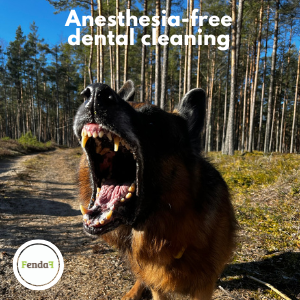
Anesthesia-free dental cleaning: does it really help?
Reading time: about 6 min
I once spoke with a customer whose dog had undergone anesthesia-free dental cleaning about six months earlier. Later, several of that dog’s teeth had to be extracted. This does not prove that the anesthesia-free cleaning caused the problems, but it made me ask even more clearly what such a procedure actually allows us to see — and what it does not.
I have always been somewhat skeptical for a very practical reason: I simply cannot imagine our dogs calmly allowing a stranger to work with sharp instruments in every corner of their mouths while they are fully awake. When I looked more deeply into the subject, I found that this concern is not limited to integrative veterinarians. AAHA and the American Veterinary Dental College (AVDC) are also very clear that scraping tartar from an awake animal does not replace proper veterinary dentistry.
Dental care starts at home
Periodontal disease is one of the most common health problems in dogs, and many dogs develop it already in early adulthood. The risk is higher in smaller and older dogs, but in reality it can affect any breed and any dog.
The most effective home method for reducing plaque is regular tooth brushing. The Veterinary Oral Health Council recommends brushing ideally every day. Not every dog will allow every tooth surface to be brushed, but regular brushing is better than not brushing at all, and the cheek-facing surfaces are especially important because plaque tends to build up there quickly.
Chewing and supportive products
I like to keep the role of chewing in the article because mechanical chewing can genuinely help clean tooth surfaces, and it is a natural activity for dogs. At the same time, no chew or bone can replace diagnosis of disease below the gum line.
If you use chews, choose a product that suits the dog’s size and chewing style and keep tooth-fracture and swallowing risks in mind. Practice around raw meaty bones varies among owners and veterinarians: some dogs use them successfully, while very hard bones can cause dental fractures in others. It therefore makes sense to assess the individual dog rather than impose one universal rule.
Seaweed-based supplements, water additives and other oral-health products may also be helpful, but it is worth checking whether the product actually has evidence for reducing plaque or tartar. The VOHC Seal of Acceptance is one practical way to identify products for which controlled evidence has been submitted.
For more on chewing, see Chews for Dogs: Why Offer Them?.
Why does anesthesia scare people?
The main reason anesthesia-free cleaning sounds appealing is the completely understandable fear of anesthesia. Anesthesia is not a zero-risk procedure. At the same time, modern anesthetic risk is not assessed simply from a dog’s age or a single listen to the heart. The veterinarian considers medical history, overall condition, concurrent disease, medication and physical examination, and then decides which blood tests or other examinations that individual animal needs before the procedure.
Age alone is not a reason to avoid necessary dental care. For an older or ill animal, the anesthetic plan is individualized, with additional diagnostics and closer monitoring where needed. In dentistry, an endotracheal tube protects the airway and allows water, ultrasonic instruments and other equipment to be used more safely.
I was afraid of anesthesia with Oscar too. What helped me most was having a specialist assess him as a whole, listen to his heart, evaluate the risk and calmly explain how he would be monitored during the procedure. That experience does not mean every dog has the same risk, but it made anesthesia feel far less like an abstract fear to me.
What can anesthesia-free cleaning not do?
Visible tartar can be removed from the mouth of an awake dog, and the teeth may look cleaner afterward. The problem is that periodontal disease does not exist only on the visible surface. A large part of the tooth structure and supporting tissues lies below the gum line, where disease cannot be properly assessed with the naked eye.
A complete veterinary dental examination includes measuring periodontal pockets, assessing mobility and supporting tissues of each tooth, and dental radiography. AAHA notes that even a tooth that looks completely normal externally can hide clinically important disease that only becomes visible on X-rays. This cannot be done safely and accurately in a fully awake dog.
Subgingival cleaning is at the heart of periodontal treatment
If only visible tartar above the gum line is removed, the most important disease area — subgingival biofilm and possible periodontal pockets — remains unassessed and untreated. This is why AAHA and AVDC describe anesthesia-free tooth scraping as cosmetic rather than comprehensive dental care.
The problem is not that removing visible tartar fails to make teeth look better. It does make them look better. The problem is that a clean-looking surface can give the owner false reassurance while painful disease remains below the gum line.
Why is polishing important?
After tartar removal, the tooth surface should be polished. Scaling can leave microscopic irregularities in enamel that make it easier for plaque to adhere again. AAHA’s professional dental-cleaning protocol includes polishing after scaling for precisely this reason.
But what if the dog is very calm?
Some dogs really do tolerate mouth handling exceptionally well, and some practitioners are very skilled at handling animals. That can make cleaning visible surfaces easier, but it does not solve the central problem: with an awake animal you cannot perform the same thorough subgingival probing, full-mouth dental radiographs, treatment of painful areas or immediate extraction when a diseased tooth is found.
For that reason, I do not see anesthesia-free cleaning as a “cheaper version” of proper dentistry. They are two different things: one removes visible tartar, while the other allows oral disease to be diagnosed and treated.
What can you watch for at home?
The owner’s job is not to diagnose periodontal pockets at home. It is much more useful to notice signs that tell you the mouth needs professional assessment.
- persistent bad breath
- red or bleeding gums
- dropping food or chewing mainly on one side
- avoiding hard food or chew items
- increased drooling or pawing at the mouth
- a loose or fractured tooth
- swelling around the face or jaw
- a sudden reluctance to have the mouth touched
In summary
If the only goal is to remove visible tartar, an anesthesia-free procedure can change how the teeth look. If the goal is to know whether the dog’s mouth is actually healthy, that is not enough. Disease below the gum line, root problems and many painful dental changes can only be identified with a thorough examination, probing and dental radiography, which requires anesthesia.
This is one of those interesting areas where integrative and conventional viewpoints do not really clash at all. Dr Judy Morgan has described anesthesia-free cleaning as a cosmetic procedure, and official veterinary dental guidance reaches essentially the same conclusion. To me, it makes sense to use every reasonable preventive measure at home so that professional dentistry is needed as rarely as possible. But once disease is present, I want it to be properly seen and properly treated.
Sources
- American Veterinary Dental College – Position Statement on Anesthesia-Free Dentistry
- AAHA – Nonanesthetic Dentistry
- AAHA – Essential steps of dental cleaning and therapy
- AAHA – Dog & cat dental disease: professional cleanings, anesthesia and home care, updated 2026
- Veterinary Oral Health Council – Brushing
- Veterinary Oral Health Council – Accepted Products
- Dr Judy Morgan original video
🐾 FendaF believes in informed choices
The purpose of the FendaF blog is not to tell you what you must do. Our aim is to share knowledge, introduce different evidence-based and integrative perspectives, and help you make more informed decisions for your pet.
Every animal is unique, and no article can replace a consultation, diagnosis or treatment provided by a veterinarian. If your pet has a health concern or you need individual advice, always contact a veterinarian.






Leave a Reply