


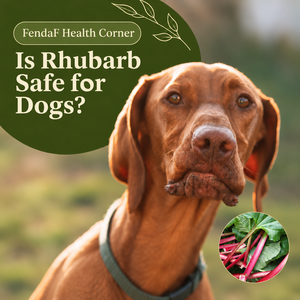
Can dogs eat rhubarb? Stalks and leaves are not the same
Reading time: about 4 min
My dogs have tried all sorts of fruit and vegetables, but rhubarb has never made it into their bowls. I have never felt much need to offer it. Still, if you have a large rhubarb plant in the garden and a dog exploring it nose first, the question is understandable: is rhubarb poisonous to dogs, or can they eat it?
The short answer is that rhubarb leaves and roots can be toxic to dogs, while the edible stalks pose much less risk. A small amount of clean stalk is unlikely to cause poisoning. That does not mean rhubarb is necessary in a dog’s diet or that the entire plant can be offered freely. To understand apparently contradictory advice, we need to look at the different parts of the plant.
Why does one source call rhubarb toxic and another say the stalk is safe?
ASPCA lists rhubarb among plants toxic to dogs. Pet Poison Helpline makes an important distinction: the leaves contain much higher levels of potentially harmful soluble oxalates, whereas the edible stalk contains less and is considered non-toxic in ordinary food amounts. So the apparent contradiction is not quite what it seems. One source discusses the whole plant; the other distinguishes its parts.
Oxalic acid and soluble oxalates can bind calcium in the body and, in larger quantities, cause gastrointestinal problems. Severe poisoning can affect the kidneys. The risk depends on which part was eaten, how much was swallowed and the individual animal. Simply saying “rhubarb” does not tell us enough. First, we need to know what the dog actually ate.
Leaves and roots: I would not feed these to my dog
If a dog eats rhubarb leaves or roots, treat it as a possible poisoning. Symptoms may include excessive salivation, vomiting, diarrhoea, lethargy, weakness or tremors. More serious cases may involve changes in blood calcium and kidney injury. Not all symptoms necessarily appear together, and a dog does not have to look severely ill at first for veterinary advice to be warranted.
If your dog has eaten a leaf, contact a veterinarian promptly. Explain when it happened, which part was involved and the estimated amount. If possible, photograph the plant or bring a sample. Do not induce vomiting at home or try to “neutralise” the plant with milk or other remedies. Treatment depends on the exposure and the symptoms.
People sometimes say that dogs avoid rhubarb leaves because they taste bitter. Some may, but taste preference is not a safety measure. Anyone who has seen what a curious puppy can put in its mouth knows why that is a risky assumption.
What about the stalks? Could you offer a small cooked piece?
The edible stalk is different. Pet Poison Helpline describes rhubarb stalks as non-toxic because they contain considerably less of the harmful soluble oxalates than the leaves. This does not mean stalks are oxalate-free or that large portions make sense. Rhubarb is acidic and contains fibre; larger amounts can cause digestive upset even without serious poisoning.
If a healthy adult dog has eaten a small piece of clean stalk, that is not the same situation as eating the leaves. Usually observation is sufficient, but contact your veterinarian if the dog seems unwell or you do not know how much it ate. If I chose to offer some myself, I would use only a tiny amount of washed, chopped stalk, without leaves, sugar, sweeteners or other additions. This is a cautious practical starting point, not a scientifically established safe daily serving.
I would not add rhubarb to the diet of a dog with kidney disease or a history of calcium oxalate stones without veterinary nutrition advice. The same caution makes sense for dogs with sensitive digestion. We do not have a reliable canine dose that has been shown to deliver a specific health benefit, so there is no need to insist on feeding it.
Does cooking make rhubarb safe?
In an earlier version of this article, I suggested boiling the stalks, perhaps even cooking them in milk after boiling in water. There really is food chemistry research behind this idea. Scientists have studied how boiling and calcium-containing milk change the concentration and accessibility of soluble oxalates in rhubarb, including in models of human digestion. Some oxalates may pass into the cooking water, so discarding that water is sensible if reducing oxalates is the goal.
There is an important limit, however. A change measured in a laboratory does not establish a safe cooking method or a therapeutic benefit for dogs. Cooking rhubarb in milk is neither necessary nor a universal recommendation, because not every dog tolerates dairy. Cooking does not make rhubarb leaves suitable for feeding to dogs.
If rhubarb is offered at all, the amount and the part of the plant matter more than a complicated kitchen procedure. I would leave rhubarb desserts to the human members of the household. Sugar, xylitol-sweetened products and other dessert additives do not belong in a dog’s bowl.
Does rhubarb contain beneficial nutrients?
Yes. Rhubarb contains fibre, various phenolic compounds, and smaller amounts of vitamins and minerals. Its oxalate and polyphenol content has been described in scientific literature, and researchers have explored antioxidant and inflammation-related mechanisms of plant compounds. These are legitimate subjects of research. But we should always ask the next question: if a compound behaves interestingly in the laboratory, will a small piece of rhubarb in a dog’s bowl have the same effect?
We do not have convincing canine clinical evidence for that. We cannot claim that rhubarb treats inflammation, prevents cancer or has been shown to improve a dog’s gut microbiome merely because some of its compounds have shown promise in laboratory experiments. Equally, it would be wrong to conclude that every bioactive compound is useless. We need to distinguish a potential biological effect from the amount consumed, its bioavailability and outcomes actually measured in dogs.
Dogs do not need to obtain their fibre or plant compounds specifically from rhubarb. There are plenty of other suitable foods that do not bring the same concern over toxic leaves. If the main diet is balanced, rhubarb is not a missing piece of the puzzle.
Rhubarb in the garden: a simple safety plan
My most practical rule is to prevent dogs from chewing the leaves and roots. If your dog likes eating plants, fence off the rhubarb bed or grow it somewhere inaccessible. Remove fallen leaves and do not leave harvested leaves next to the compost heap where a dog could reach them. Watch for roots dug out of the ground too.
If a dog eats a small piece of clean stalk and feels well, the risk is generally lower than with the leaves. If it ate leaves or roots, or develops vomiting, unusual salivation, lethargy, tremors or changes in urination, seek veterinary advice promptly. Do not judge the situation only by the fact that your dog seems cheerful and active at first.
In summary
Rhubarb has never been part of my dogs’ menu, and after researching the subject I still see no reason to add it deliberately. That does not mean that one small, clean piece of stalk is automatically poisonous to a healthy dog. Leaves and roots are another matter, and I would not experiment with them.
For me, this is a good reminder that a single word such as “toxic” or “safe” rarely tells the whole story. The part of the plant, the quantity, the dog’s health and what research actually shows all matter. And if rhubarb grows in the garden while the dog simply enjoys sniffing nearby, I am perfectly happy with that.
Sources
- Pet Poison Helpline: Rhubarb
- ASPCA: Rhubarb
- ASPCA: Pie plant
- Oxalate bioaccessibility in raw and cooked rhubarb (2020)
- Oxalate in foods: review (2023)
🐾 FendaF believes in informed choices
The purpose of the FendaF blog is not to tell you what you must do. Our aim is to share knowledge, introduce different evidence-based and integrative perspectives, and help you make more informed decisions for your pet.
Every animal is unique, and no article can replace a consultation, diagnosis or treatment provided by a veterinarian. If your pet has a health concern or you need individual advice, always contact a veterinarian.





Leave a Reply