


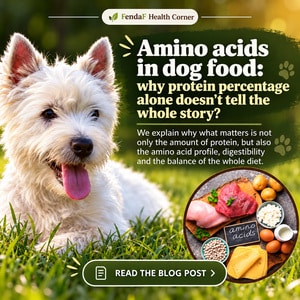
Amino acids in dog food: why protein percentage alone does not tell the whole story
Reading time: about 7 min
The more I learn about canine health and nutrition, the clearer it becomes how many questions can hide inside a single bag of food. The label gives a protein percentage, but that does not yet tell us which amino acids a dog actually receives, how well they are digested or whether the whole diet meets that particular dog’s needs. We often trust the front of the pack because a simple number is convenient. With amino acids, however, the amount of protein is only part of the story: its composition matters too.
I have written before about the importance of good-quality ingredients, and that remains true. Still, the presence of a few particular words on a label does not automatically mean the protein is poor. Quality, digestibility, processing and checks on the finished product matter more than the name of one ingredient. Amino acids illustrate this distinction well.
What are amino acids, and why does a dog need them?
Amino acids are the building blocks of proteins. A dog’s body uses them to make muscles, skin, coat, tendons, enzymes, antibodies and many other compounds. For example, muscles need amino acids to build actin and myosin; making keratin for hair requires sufficient protein and sulphur-containing amino acids. Amino acids also contribute to the synthesis of signalling molecules and certain compounds important to the nervous system.
Dogs do not need to obtain every amino acid from food in the same way. Their bodies can make some from other compounds. Ten are conventionally considered essential for dogs: arginine, histidine, isoleucine, leucine, lysine, methionine, phenylalanine, threonine, tryptophan and valine. A long-term shortage of one is not made up for simply by having plenty of another. Excesses cannot keep protein construction going indefinitely when a necessary building block is missing.
The ten essential amino acids do different jobs
Arginine is important in nitrogen metabolism and the urea cycle, which allows the body to dispose of toxic ammonia. Histidine is found in tissue proteins and is a precursor of histamine. Lysine is important for growth and body-protein synthesis; its actual availability may need particular attention in cereal-based or heavily heat-treated formulations.
Leucine, isoleucine and valine are branched-chain amino acids with a role in muscle-protein metabolism. This does not mean supplementing them separately will make every older dog build muscle. Adequate energy across the whole diet, protein quality, health and appropriate exercise all matter. Methionine, together with cysteine, helps meet sulphur-amino-acid requirements and is important for the coat and normal cellular function, among other things.
The body can make tyrosine from phenylalanine and use it, for example, to synthesise pigment and catecholamines. Adequate tyrosine may be more noticeable in the pigmentation of dark-coated dogs than in light-coated dogs. But this does not create a rule that every dark dog should arbitrarily receive twice as much phenylalanine. Threonine is needed for proteins and compounds associated with mucous membranes. Tryptophan is, among other things, a precursor of serotonin, but behaviour cannot be reduced to the amount of a single amino acid in the bowl.
The previous version of this article also discussed possible deficiency symptoms. Poor growth, muscle loss, a poor coat or reduced appetite can indeed prompt a closer look at diet quality. But these signs are not the fingerprint of one amino acid. Many different diseases can cause the same changes. If a problem persists, assess the dog’s health and overall nutrition first.
Why are two foods with the same protein percentage not necessarily equivalent?
Two foods might both contain 26% crude protein, for example, but that does not tell us how much lysine, methionine or other amino acids each provides, or how digestible they are. Crude protein is usually calculated from nitrogen; it is not a direct measurement of the amount of high-quality animal protein in the bowl. Fat and moisture levels also affect comparisons of percentages. To assess a food properly, consider protein on a dry-matter basis and, where useful, per 1,000 kcal, alongside ingredients, analytical results and the manufacturer’s quality control.
Processing can also affect amino acid availability. Under certain conditions, strong heating can cause Maillard reactions that reduce available lysine even when the total crude-protein percentage on the label remains unchanged. But that does not mean every dry food is deficient in amino acids or every raw diet is perfect. Temperature, time, formulation and manufacturing controls determine the outcome. An unbalanced raw-meat diet can lack several nutrients even when the meat itself is excellent.
I prefer to know which animal or other source the protein comes from. Animal sources such as meat, fish, eggs and organs often provide a useful amino acid profile. Plant ingredients also supply amino acids, but their combinations, digestibility and required amounts need to be considered in the formulation. If a dog eats a complete food suitable for its life stage, the entire finished recipe should meet essential amino acid requirements, rather than relying on the reputation of one ingredient.
What about taurine, and why is it discussed in relation to the heart?
Taurine differs from the usual protein-building amino acids. Cats must obtain it from food because their own synthesis does not meet their needs. Most healthy dogs can produce taurine from methionine and cysteine, but circumstances vary. Certain breeds, medical conditions or unsuitable diets may warrant a separate assessment of taurine status. However, it is not correct to assume that dilated cardiomyopathy is always caused by taurine deficiency. Diet, genetics and other factors can play different roles.
I therefore do not recommend large doses of taurine or any single amino acid simply as a precaution. If a dog has suspected heart disease, muscle loss or signs of a nutritional deficiency, investigate the causes and, where necessary, arrange targeted testing with a vet. One powder is no substitute for a well-planned diet.
Should a dog receive fresh animal foods?
I enjoy offering my dogs a variety of animal foods from time to time, including meat and organs. In earlier articles, I have suggested rotating protein sources, for example using three or four different animal sources. This can add variety and helps me notice which foods suit a particular dog. But rotation is not a mandatory, proven method of preventing amino acid deficiency, and not every ingredient suits every animal.
With puppies in particular, I will not compromise a complete, balanced diet. A growing dog needs more than protein and amino acids: calcium, phosphorus, energy and other micronutrients matter too. Adding a small amount of fresh food can be enjoyable, but if home-prepared or raw food makes up a substantial part of the diet, the entire recipe must be balanced. Raw food also brings bacterial and handling risks.
FendaF’s practical recommendation
When reading a dog-food label, look beyond the protein percentage. Ask about the main protein sources, whether the food is complete for your dog’s life stage, and what the manufacturer can tell you about digestibility, amino acids and production controls. Look at both the food and the dog: body condition, muscle mass, coat, stools and wellbeing. If a deficiency is suspected, I do not start with a random amino acid supplement. I first try to understand why the overall diet may not be working.
Protein quality is more than attractive packaging or a single analytical percentage. The key question is whether, over time, the dog receives the right amino acids and everything else needed to stay healthy.
Frequently asked questions
How many amino acids are essential for dogs?
Conventional nutritional standards identify ten: arginine, histidine, isoleucine, leucine, lysine, methionine, phenylalanine, threonine, tryptophan and valine.
Does a higher protein percentage mean better food?
Not necessarily. The amino acid profile, digestibility, energy and balance of the whole recipe also matter. A higher percentage does not, by itself, demonstrate better available protein.
Does meat meal or fish meal mean poor amino acid quality?
No. The result depends on ingredient quality, processing and the manufacturer’s controls. A high position for fresh meat on the ingredient list does not automatically prove a greater supply of available amino acids either.
Does every dog need added taurine?
No. Most healthy dogs can synthesise taurine, but concerns related to an individual dog’s disease, breed or diet need separate assessment. Dietary taurine is essential for cats.
Can a puppy get the protein it needs from meat alone?
A puppy needs a complete, balanced diet, rather than meat alone. A long-term unbalanced meat diet can cause, among other problems, a dangerous calcium-to-phosphorus imbalance.
Sources
FEDIAF. Nutritional Guidelines for Complete and Complementary Pet Food for Cats and Dogs: https://europeanpetfood.org/self-regulation/nutritional-guidelines/
National Research Council. Nutrient Requirements of Dogs and Cats, including amino acid requirements: https://nap.nationalacademies.org/catalog/10668/nutrient-requirements-of-dogs-and-cats
Van Rooijen et al. The Maillard reaction and pet food processing: effects on nutritive value and pet health: https://www.cambridge.org/core/journals/nutrition-research-reviews/article/maillard-reaction-and-pet-food-processing-effects-on-nutritive-value-and-pet-health/E085D3648D6A209003AB4D0DB72DB8B2
FDA. Investigation into a potential link between certain diets and canine dilated cardiomyopathy: https://www.fda.gov/animal-veterinary/outbreaks-and-advisories/fda-investigation-potential-link-between-certain-diets-and-canine-dilated-cardiomyopathy
WSAVA. Global Nutrition Guidelines: https://wsava.org/global-guidelines/global-nutrition-guidelines/
🐾 FendaF believes in informed choices
The purpose of the FendaF blog is not to tell you what you must do. Our aim is to share knowledge, introduce different evidence-based and integrative perspectives, and help you make more informed decisions for your pet.
Every animal is unique, and no article can replace a consultation, diagnosis or treatment provided by a veterinarian. If your pet has a health concern or you need individual advice, always contact a veterinarian.







Leave a Reply