


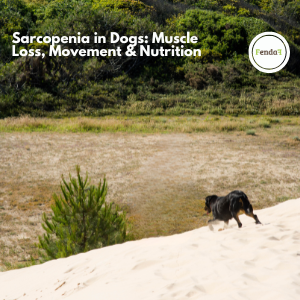
Sarcopenia, or muscle loss, in dogs
Reading time: about 12 min
Aging does not mean a dog has to stay on the sofa. To preserve muscle mass and function, an older dog needs suitable movement, adequate nutrition and a reason to keep taking part in the world around them.
As a dog ages, the body changes. They may sleep more, move more slowly and need more recovery after a longer walk. But one change that is too easily dismissed as simply part of getting older is the loss of muscle mass and strength.
It has a name: sarcopenia.
Sarcopenia is the progressive age-related decline in skeletal muscle mass and function. Muscle is not just what makes a dog’s hindquarters look strong. Muscles allow a dog to stand up, walk, use stairs, maintain balance and preserve independence and quality of life for as long as possible.
Not all muscle loss is sarcopenia
Sarcopenia is primarily an age-related process. Muscle atrophy can also develop when a dog uses a limb less because of pain, injury or surgery. Cachexia, on the other hand, is loss of muscle and often body weight associated with chronic disease. Heart disease, kidney disease and cancer, for example, can alter metabolism and contribute to muscle loss.
In an older dog, these processes can overlap. A dog may have age-related sarcopenia, a chronic disease on top of it and, in addition, reduced activity.
That is why body weight alone does not always tell us enough. A dog may weigh almost the same for years while body composition changes. There may be less muscle and more fat. In another dog, body weight may fall together with muscle mass.
Look at the dog, not only the number on the scale
Do the muscles of the thighs and shoulders seem smaller? Are the spine, hips or shoulder blades more visible than before? Is the hind end narrower? Does standing up take longer? Does the dog avoid stairs or jumping into the car? And does a walk that used to be easy now tire them noticeably more?
These changes deserve attention, not only because the dog looks thinner. Muscle mass is a functional reserve. The less reserve remains, the less capacity a dog may have to cope with illness, surgery or another physical challenge.
For an older dog, however, the goal is not simply a lower number on the scale, but an appropriate body condition with muscle mass preserved as well as possible.
The most dangerous sentence may be: “He’s just old”
Age itself is not a reason to stop moving. Veterinary literature on physical function in aging dogs emphasises preserving strength, balance, endurance and mobility. A 2026 rehabilitation review captured it particularly well in its title: “Movement Is Medicine”.
This does not mean a thirteen-year-old dog should do what they did at three. And it certainly does not mean forcing a dog to walk more despite pain, heart disease or lung disease.
It means something else: movement should be adapted to the dog’s abilities, not automatically removed because of age.
Faddy’s story: balancing safety with living
About six months ago, Faddu started limping badly on one leg and his activity dropped sharply. Our walks became about one to one and a half kilometres because, at that point, he simply did not have the stamina for more. Later, he was diagnosed with heart failure. During this period, he has lost a significant amount of muscle mass. He used to weigh around 46 kg; now he weighs about 38–39 kg.
So Faddy’s story is not an example of lost muscle somehow miraculously coming back. Quite the opposite: his muscle loss is very real. But today he can once again walk around four kilometres at a calm pace without problems.
His cardiologist also stressed that he should keep moving, naturally within the limits set by his heart disease, how he feels and what his body can manage. Faddu’s heart disease cannot be cured, and we do not know how much time he has. It may be three months, six months, a year or longer. No one can say exactly today.
That means my goal cannot be to make his life as risk-free as possible at any cost. My goal is to make the time he has as good as possible. Faddu loves walking. He wants to come along, sniff, move and explore the world. Heart disease carries risk, but if I took his walks away simply to avoid that risk, even though he wants and is able to walk, I would not only be taking away physical exercise. I would be taking away something that genuinely gives him joy.
As long as he wants to walk with me and his body allows it, we go. At his pace.
Inactivity can make the problem worse
If an older dog or a dog with chronic disease is simply left on the sofa to rest because moving is difficult, a vicious circle can develop. Less movement means less stimulus for the muscles. The muscles weaken. Moving becomes even harder. The dog starts moving even less.
Rest can be part of treatment. Inactivity is not the same thing as rest.
The goal is not to make an old or ill dog do more than the body can manage. The goal is to preserve as much safe, manageable movement as possible and, with chronic or incurable disease, to find a balance between safety and living.
Muscle also needs building material
Movement is only one part of the story. The other very important part is nutrition.
An older dog’s energy needs may decrease because they move less and because body composition and metabolism change. It is easy to conclude from this that an older dog simply needs less food or a leaner diet. From the perspective of muscle, that can be an oversimplification.
A dog may need less energy, but the need for high-quality protein and essential amino acids does not disappear. A 2026 review of protein requirements in dogs notes that sarcopenia and lower energy intake may potentially mean higher protein needs in older dogs, although direct canine evidence is still limited.
If we simply reduce the amount of food, we reduce not only calories but also protein, vitamins, minerals and other nutrients. And if a dog is already losing muscle, the last thing we want to do is remove even more building material from the body.
“Senior food” is not a diagnosis
A dog does not automatically need a lower-protein or lower-fat diet simply because they turned eight, ten or twelve. The diet should be based on body weight, muscle mass, activity, appetite, digestion and health status. If a specific disease requires dietary restrictions, that is a different question. Age alone does not automatically mean protein should be restricted.
The percentage of protein on the label is not the only thing that matters. Protein quality, amino-acid profile, digestibility and how much of the food the dog actually eats matter too.
Leucine and omega-3: interesting, but not a magic bullet
One amino acid that receives a lot of attention in the context of sarcopenia is leucine. Leucine is an essential amino acid and is involved in signalling pathways that regulate muscle protein synthesis. It has been studied extensively in human sarcopenia, but direct clinical evidence in dogs is much more limited. That is why we cannot simply take a “correct” leucine dose from human research and declare it the answer for an older dog.
The same honesty is needed with omega-3 fatty acids, particularly EPA and DHA. Veterinary nutrition literature discusses them in the context of inflammation, chronic disease and body composition. That does not mean fish oil cures sarcopenia. Adequate omega-3 intake may, however, be one part of a broader approach.
The biological principle is simple: for muscle to remain, it needs both a reason to stay and the material to maintain itself. Movement provides the first. Nutrition must provide the second.
Walking is good, but muscle benefits from varied loading
Calm walking is an excellent start. If the dog’s health allows it, muscles can also be used in more varied ways:
- walking calmly uphill or up a gentle slope;
- moving over different, but safe and non-slip surfaces;
- controlled sit-to-stand exercises;
- low step-ups, meaning controlled stepping onto a low platform;
- stepping over low obstacles;
- balance and proprioception exercises;
- strength and mobility exercises selected by a veterinary physiotherapist.
Load should be increased gradually. Start at a level from which the dog recovers normally, and preferably change only one thing at a time: duration, number of repetitions, incline or exercise difficulty. If the dog is clearly stiffer the next day, limps more or avoids movement, the load was probably too high. Also remember that exercise quality matters more than the number of repetitions: for example, sit-to-stand should be as controlled and symmetrical as possible, and the step-up height should be low enough that the dog does not need to haul themselves up or push through pain.
Important limitation: if the dog has pain, ataxia or another coordination problem, acute back pain, or a diagnosed orthopaedic or neurological condition, strength and balance work should follow an individual plan created by a veterinarian or rehabilitation professional. In that situation, a generic exercise programme found online is not a good starting point.
More is not always better
Exercise for a thirteen-year-old dog with heart disease is not the same as exercise for a healthy eight-year-old. A dog with osteoarthritis may not need less movement, but different movement. Strength lost after a long period of inactivity is not rebuilt in one long weekend hike. And a dog in pain does not need to be told to “be brave and walk”. The dog needs us to identify why movement hurts and, where possible, address that cause.
Pain itself can be one of the drivers of muscle loss. If movement hurts, the dog moves less. If the dog moves less, the muscles receive less load. Weaker muscles can, in turn, make movement harder and joint stabilisation poorer.
Movement can also be combined with mental activity. Calm sniffing walks, search games or simple training tasks during a walk get the dog moving, using the body and working mentally at the same time. For an older dog, good activity does not necessarily have to mean faster or harder exercise.
Related topics: in an older dog, changes in movement should be considered together with overall health; with CDDY/IVDD or another spinal or neurological condition, exercises need to be adapted to the diagnosis; and for a dog with mobility difficulties, simple changes at home can also make a meaningful difference, such as reducing slipping and making movement routes safer.
Sarcopenia can hide behind a normal body weight
In an older dog, it is worth regularly assessing muscle condition as well as body weight. The scale tells us how many kilograms a dog weighs. It does not tell us what those kilograms are made of.
A dog can even be overweight and still have significant muscle loss. Body fat can hide the loss of muscle on the scale. This is why veterinary assessment uses muscle condition scoring in addition to body condition scoring. Changes in muscle mass are assessed around the skull, shoulder blades, along the spine and around the pelvis.
Owners can do a great deal as well. Take photos of your older dog from the same angles from time to time. Look from above and from the side. Put your hands on the thighs, shoulders and back. When you see your dog every day, gradual changes can be surprisingly hard to notice. A photo from six months ago may suddenly tell you more than a number on the scale.
Signs worth paying attention to
- visible thinning of the muscles of the thighs, shoulders or back;
- hips, spine or shoulder blades becoming more prominent;
- more difficulty standing up or a longer pause before getting moving;
- avoiding stairs, jumping into the car or slippery floors;
- a shorter stride or fatigue appearing sooner towards the end of a walk;
- sitting on one hip or carrying weight unusually;
- reduced activity without a clear reason;
- weight loss, or loss of muscle mass even when body weight stays stable.
When muscle disappears, ask “why?”
There is no single jar, exercise or food that solves sarcopenia. If muscle mass starts to decline noticeably, it is worth looking at the whole picture and asking:
- Is the dog eating enough?
- Is the dog getting enough high-quality protein?
- Is the dog in pain?
- Are dental or oral problems making eating uncomfortable?
- Could a gastrointestinal problem be affecting nutrient intake?
- Could a chronic disease be increasing the risk of muscle loss?
- Is body weight falling?
- Has the dog started moving less, and why?
A comprehensive approach means enough energy and high-quality protein, food suited to the dog’s needs, recognising and treating pain and disease, regular manageable movement, physiotherapy when needed, and monitoring whether function remains stable, improves or declines.
An old dog does not have to prove how tough they are
We cannot stop aging. But aging and inactivity are not synonyms.
An old dog does not need to run a marathon. They do not need to prove to anyone how tough they are. But if their health allows them to walk, sniff, stand up, use their muscles and move through the world, that ability is worth preserving for as long as possible.
Muscle is not a cosmetic issue for an older dog. It is the ability to stand up independently. It is balance. It is the ability to go outside. It is also the ability to come for a walk with you. And, ultimately, it is part of independence.
A comprehensive, multimodal approach means that we are not looking for a single “sarcopenia treatment”. The same dog may need adequate energy and high-quality protein, maintenance of an appropriate body weight, pain control and treatment of chronic disease, manageable progressive activity, physiotherapy when needed, and adaptations to the home environment. These approaches do not compete with each other; they complement one another.
Faddu has reminded me of this very clearly. His muscle mass is not what it used to be. His heart sets limits that we have to respect. And we do not know how much time he has left.
But that is exactly why I do not want to turn the rest of his life into an exercise in making everything as risk-free as possible. I want it to be his life.
As long as he wants to come for a walk with me and his body allows it, we go.
At his pace.
Used sources:
- Alvarez LX. Movement Is Medicine: How Rehabilitation Revitalizes Aging Pets. Vet Clin North Am Small Anim Pract. 2026;56(2):361-373. PMID 41444085. PubMed
- McKenzie BA, Chen FL. Assessment and Management of Declining Physical Function in Aging Dogs. Top Companion Anim Med. 2022. PMID 36273752. PubMed
- Saker KE. Nutritional Concerns for Cancer, Cachexia, Frailty, and Sarcopenia in Canine and Feline Pets. Vet Clin North Am Small Anim Pract. 2021;51(3):729-744. PMID 33773650. PubMed
- Michel KE et al. Cachexia and sarcopenia: emerging syndromes of importance in dogs and cats. J Vet Intern Med. 2011. PMID 22111652. PubMed
- Freeman LM et al. Assessment of methods of evaluating sarcopenia in old dogs. Am J Vet Res. 2012;73(11):1794-1800. PMID 23106466. PubMed
- Scarpim LB, Pacheco LG. Challenges and Methodologies to Assess Protein Requirement and Quality Across Different Life Stages in Dogs: A Review. Animals. 2026;16(2):228. PMID 41594418. PubMed
- Stockman J. Nutrition and Aging in Dogs and Cats. Adv Exp Med Biol. 2024;1446:203-215. PMID 38625530. PubMed
- Yoshikawa K, Kitazawa T, Sano T, Ino T, Miyasaka T. Kinematic characteristics of canine hindlimb movement during sit-to-stand and stand-to-sit motions. Research in Veterinary Science. 2023;162:104944. doi: 10.1016/j.rvsc.2023.104944. PubMed
- Lutonsky C, Affenzeller N, Aghapour M, et al. Improving postural stability through proprioceptive training in dogs. Frontiers in Veterinary Science. 2025;12:1645875. doi: 10.3389/fvets.2025.1645875. Frontiers
- Becker K. Lack of Mobility May Mean Less Time with Your Pet. Bark & Whiskers. Bark & Whiskers
Note: evidence on leucine in the context of sarcopenia comes largely from human studies; this distinction has deliberately been preserved in the article. The section about Faddu describes the owner’s personal experience and is not presented as medical advice.
🐾 FendaF believes in informed choices
The purpose of the FendaF blog is not to tell you what you must do. Our aim is to share knowledge, introduce different evidence-based and integrative perspectives, and help you make more informed decisions for your pet.
Every animal is unique, and no article can replace a consultation, diagnosis or treatment provided by a veterinarian. If your pet has a health concern or you need individual advice, always contact a veterinarian.








Leave a Reply