


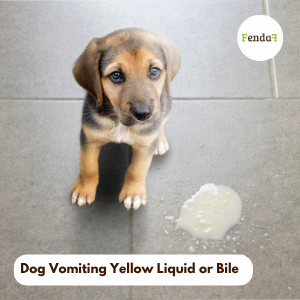
Yellow Vomit in Dogs – Should I Be Worried?
Reading time: about 7 min
From time to time, dog owners come to us because their dog vomits yellow foam or mucus in the morning or after a longer gap between meals. Most people quickly realise that the yellow colour comes from bile, but the harder question is: why does it happen, and what should you do?
My own dogs have rarely had problems with vomiting, so over the years I have read a great deal about the subject from both conventional and integrative veterinary perspectives.
The most important thing to understand is that yellow vomit is not a diagnosis. In some dogs the cause may be fairly simple, such as too long a gap between meals. In others, recurrent vomiting may be related to gastrointestinal inflammation, pancreatic disease, a foreign body, parasites or another health problem.
Why is my dog’s vomit yellow?
The yellow colour comes from bile.
Bile is produced by the liver and stored in the gallbladder. It is involved primarily in fat digestion and normally enters the small intestine after a meal.
Sometimes bile can flow in the opposite direction and move back into the stomach. When the stomach is empty and bile irritates the stomach lining, a dog may vomit yellowish fluid or foam.
This pattern of recurrent vomiting on an empty stomach is often referred to as bilious vomiting syndrome.
The most common reason: too long between meals
If your dog tends to vomit:
- early in the morning;
- at night;
- shortly before the usual mealtime;
- after a longer-than-usual gap between meals,
the first thing worth reviewing is the feeding schedule.
Some dogs simply do not tolerate a long period with an empty stomach very well.
What can you try?
Divide the daily food allowance into smaller meals or offer a small meal before bedtime.
This does not necessarily mean that your dog needs to eat continuously throughout the day. Sometimes simply moving part of the evening meal to a later time is enough.
If the problem disappears after this change, a long gap between meals was likely playing an important role.
What about fasting?
There is an important distinction to make here.
Bilious vomiting on an empty stomach and acute diarrhea do not necessarily call for the same approach.
Integrative veterinarian Dr Peter Dobias recommends, as one option for an adult dog with acute diarrhea, a 12-24 hour fast while maintaining access to water. The aim is to give an irritated digestive tract a short period of rest. He then recommends starting with small amounts of pumpkin or zucchini and a lean meat broth, before gradually returning to the regular diet.
That is a very different situation from a dog that vomits precisely because its stomach has been empty for too long.
So there is no universal rule that “vomiting or diarrhea = 24 hours of fasting.” The dog, the symptoms and the likely cause all matter.
Fasting should not be used without veterinary guidance in puppies, very small dogs, dogs with diabetes or other metabolic disease, or animals whose general condition is poor.
Could food sensitivity be the cause?
It can be.
Food sensitivity or other gastrointestinal irritation may be accompanied by symptoms such as:
- diarrhea or unstable stools;
- gas;
- gurgling in the abdomen;
- frequent lip licking or swallowing;
- changes in appetite;
- recurrent digestive problems.
Yellow vomit alone, however, does not automatically mean that a dog has a food sensitivity.
The same applies to grass eating. Many dogs occasionally eat grass without being ill. However, if grass eating, vomiting and other gastrointestinal symptoms repeatedly appear after a particular food or treat, food sensitivity is worth investigating more closely.
Fatty food
Bile is needed for fat digestion, and a very fatty or unusually rich meal can irritate the digestive tract in some dogs.
A single episode of vomiting after a richer-than-usual meal does not necessarily mean disease. If your dog is otherwise bright, eating, drinking and the symptom does not recur, observation may be enough.
Repeated vomiting after fatty foods deserves more attention, as high-fat meals may also be associated with pancreatitis in susceptible dogs.
Can herbs help?
Integrative veterinary medicine uses several herbs to support the stomach and gastrointestinal lining.
Marshmallow root
Marshmallow root is rich in mucilage. When mixed with water, these compounds form a gel-like material, which is why marshmallow has traditionally been used to support irritated mucous membranes.
It may be one option for supporting a sensitive stomach and digestive tract.
Slippery elm
Slippery elm is also rich in mucilage and is one of the classic gastrointestinal-support herbs used in integrative veterinary medicine.
Chamomile
Chamomile is traditionally used to support digestion and help soothe the gastrointestinal tract.
Licorice root
DGL, or deglycyrrhizinated licorice, is often used for gastrointestinal support. Most of the glycyrrhizin has been removed, because larger amounts or long-term use of glycyrrhizin can cause unwanted effects.
Aloe vera: which part of the plant matters
There is a great deal of confusion around aloe because people often speak about “aloe vera” as if the entire plant were one and the same substance.
It is not.
The yellowish latex beneath the outer part of the aloe leaf contains aloin and other anthraquinones, which can cause gastrointestinal irritation and severe diarrhea in dogs.
The clear inner gel is a different material.
For that reason, I would not simply give a dog an aloe leaf or a freshly cut, unprocessed leaf if you do not know exactly how it should be prepared.
If aloe is used internally as integrative gastrointestinal support, it should be a purified inner aloe gel intended for that purpose, with aloin removed or reduced to a very low level.
It is also worth remembering that strong clinical evidence for aloe as a treatment for gastrointestinal disease in dogs is still limited, so I would view it as supportive rather than as a treatment in itself.
When can yellow vomit be monitored at home?
If an adult dog vomits once and is then happy, drinking, eating and moving normally with no other symptoms, a single episode does not automatically mean an emergency.
Always look at the whole dog, not just the vomit.
When should you contact a veterinarian?
Your dog needs more prompt assessment if:
- vomiting repeats or becomes more frequent;
- the dog cannot keep water down;
- there is blood in the vomit or it resembles coffee grounds;
- the abdomen is painful or unusually tense;
- the dog becomes lethargic or weak;
- severe or bloody diarrhea develops;
- the dog refuses food;
- weight loss develops;
- the dog repeatedly tries to vomit but nothing comes up;
- there is a possibility that the dog swallowed a toy, bone fragment or another foreign object.
Seek help earlier for puppies, very old dogs and dogs with chronic health conditions.
What can be behind recurrent bilious vomiting?
In addition to long gaps between meals, vomiting can be caused by conditions such as:
Pancreatitis
Inflammation of the pancreas can cause vomiting, abdominal pain, lethargy, loss of appetite and diarrhea. Flare-ups are often associated with very fatty food, although pancreatitis can have many different causes.
Foreign body or intestinal obstruction
Toys, socks, pieces of bone and other swallowed objects can cause partial or complete obstruction of the gastrointestinal tract.
This can rapidly become life-threatening.
Parasites and infections
Giardia and other parasites can also cause recurrent gastrointestinal symptoms.
Chronic inflammation of the stomach or intestines
Recurrent chronic vomiting is no longer simply a “sensitive stomach.” Possible causes include chronic enteropathy, damage to the stomach lining or another gastrointestinal disease.
In summary
Yellow vomit is not a disease in itself. It is a symptom.
If your dog occasionally vomits yellow foam early in the morning, is otherwise completely well and the problem disappears after changing meal timing, the cause may simply be too long a gap between meals.
If other symptoms accompany the vomiting or it starts to recur, the underlying cause needs to be investigated.
Depending on the situation, supportive measures at home may include:
- redistributing meals across the day;
- a small late-evening meal;
- reducing very fatty treats;
- gastrointestinal-support herbs such as marshmallow root and slippery elm;
- when appropriate, purified aloin-free aloe gel;
- a high-quality gastrointestinal-support supplement.
Most importantly: do not look at a symptom separately from the dog in front of you. One small patch of yellow vomit on the floor may be insignificant. Yellow vomit together with pain, lethargy and refusal to eat is a very different situation.
Sources:
- Ferguson, Wennogle & Webb, 2016, PubMed: Bilious Vomiting Syndrome in Dogs
- Veterinary Partner / VIN, Bilious Vomiting Syndrome
- University of Illinois College of Veterinary Medicine, “Why Is My Pet Vomiting? Bilious Vomiting Syndrome”.
- Dr Peter Dobias, DVM, “Holistic and Natural Approach to Treating Diarrhea in Dogs”.
- Dogs Naturally, “Is Your Dog Throwing Up Yellow? Causes and Simple Fixes”.
- Dogs Naturally, “The Health Benefits of Marshmallow Root for Dogs”
- Dogs Naturally, “9 Times Slippery Elm Can Help Your Dog”
- ASPCA Animal Poison Control, Aloe.
- PetMD / Pet Poison Helpline Veterinary Team, “Aloe Vera Poisoning in Dogs”.
🐾 FendaF believes in informed choices
The purpose of the FendaF blog is not to tell you what you must do. Our aim is to share knowledge, introduce different evidence-based and integrative perspectives, and help you make more informed decisions for your pet.
Every animal is unique, and no article can replace a consultation, diagnosis or treatment provided by a veterinarian. If your pet has a health concern or you need individual advice, always contact a veterinarian.







Leave a Reply