


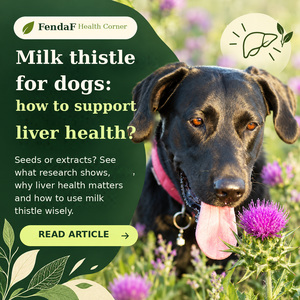
Milk thistle for dogs: liver support, detox and wider health connections
Reading time: about 6 min
I became interested in milk thistle after reading Dr Peter Dobias’s approach to supporting dogs’ livers and its possible links with other health concerns. Previously, I had mainly used chlorella. The idea that the liver could influence skin, ears, digestion and general well-being made me look into the subject more deeply. This article is about more than one herb: it also explores why integrative veterinarians suggest considering liver health before obvious signs of illness emerge.
Milk thistle is not merely a passing trend. Silymarin and silybin have been studied, and they are used in veterinary liver support. Although not every proposed preventive benefit has yet been confirmed by research, I personally lean towards the integrative veterinary perspective. I see no reason to wait for the first poor test results before thinking about reducing the burden on a dog’s liver. A lack of evidence is not proof of no effect; equally, an assumed effect cannot be presented as a guaranteed medical outcome. Let us look at what research shows, what Dr Dobias reports from practice, and what dog owners can actually use.
What does the liver do in a dog’s body?
The liver participates in carbohydrate, protein and fat metabolism, glycogen storage, blood-protein synthesis and bile production. It also processes substances produced through normal metabolism, medicines and many compounds encountered in the environment so that they can be eliminated. The liver works together with the intestines, kidneys and other organs. It therefore makes sense to consider liver health as part of the body’s wider functioning rather than an isolated blood-test result.
The liver has a remarkable capacity to regenerate, but that capacity is not unlimited. Chronic injury can progress with few obvious symptoms. The enzymes ALT and ALP may provide important clues, but an increase does not automatically mean liver failure; conversely, one normal result does not establish that all metabolic and liver processes are functioning perfectly. Depending on the circumstances, a veterinarian may also investigate bilirubin, albumin, clotting parameters, bile acids and ultrasound findings.
Dobias takes a broader view: in his opinion, nutrient shortfalls, environmental exposures and disturbed metabolism can contribute to health problems that initially appear unrelated. This is an integrative explanatory model worth examining seriously, but it does not mean that the liver is necessarily the underlying cause of most diseases. An ear infection, for instance, may be linked to allergies while still leaving room to ask whether overall nutrition and metabolism influence susceptibility to inflammation.
What plant is milk thistle?
Milk thistle is Silybum marianum, a plant in the daisy family with purple flowers. Product names can sometimes be confusing, so check the Latin botanical name rather than relying on a generic label saying “thistle”.
Milk thistle seeds contain a mixture of compounds known collectively as silymarin. One of the best known is silybin, also called silibinin. These terms are not interchangeable: whole seeds, ground seed powder, standardised silymarin extract and phospholipid-bound silybin preparations can contain very different amounts of active compounds and differ in absorption. Consequently, milligram doses from a clinical study cannot simply be converted into teaspoons of seeds.
Why is milk thistle used to support the liver?
Silymarin and silybin have been investigated for antioxidant, anti-inflammatory, potential antifibrotic and liver-cell-protective actions. These are not merely claims from folk medicine. In a 2021 canine study, several laboratory markers, including ALT and the liver-injury marker miR-122, improved in dogs with liver problems receiving a silybin-containing supportive preparation. In a 2024 study of 32 dogs with liver disease, clinical and biochemical measures improved in groups given silymarin or a combination of silymarin and SAMe. In the latter research, animals also received other necessary treatments and there was no placebo group, so improvement cannot be attributed entirely to the herb.
This area of research should not be dismissed. Measurable changes have been documented in dogs, not only subjective owner impressions. The 2019 ACVIM consensus on chronic hepatitis discusses silymarin as a potentially supportive compound and describes its biological effects. At the same time, it makes clear that larger, well-controlled studies are needed to establish which dogs, diseases, doses and treatment durations lead to better clinical outcomes. This defines the limits of the evidence; it is not proof that silymarin has no effect.
Mary Wulff and Greg Tilford emphasise in Herbs for Pets that milk thistle is a purposeful medicinal herb rather than necessarily an endless daily supplement. The idea behind using courses is straightforward: when the goal does not require continuous use, allow intervals without the herb. A practical schedule of 3–6 weeks of use followed by a 1–3-week break is described by Dogs Naturally Magazine and canine herbal practitioner Cat Lane. Dr Dobias also recommends courses and breaks for his liver-support products, although his current protocol differs from that used for pure milk thistle. Their common practical message is to avoid thoughtless, uninterrupted use.
Dr Dobias’s integrative perspective: liver, gut, skin and immunity
Dr Peter Dobias describes the liver as an organ whose functions intersect with energy levels, digestion, hormonal and immune regulation, skin health and mobility. His approach does not limit liver support to elevated enzymes. He recommends assessing lifestyle, food quality, potential environmental irritants, medication burden and the body’s capacity to recover. In his view, some health complaints may warrant looking for a systemic contributing factor as well as treating local symptoms.
Dobias has described improvements in chronic ear infections, skin irritation, allergy-like symptoms and joint stiffness alongside liver-support regimens. His published examples include a dog whose recurring ear problems subsided for an extended period while using LiverTune. These are concrete observations from clinical practice and dog owners, and they can be valuable. However, they do not establish how much improvement was due to liver support, dietary changes, other treatments or the natural course of the condition.
There is a very important distinction here: Dobias’s LiverTune is not pure milk thistle. It is a fermented botanical blend containing milk thistle, dandelion, artichoke, turmeric, barley grass, coriander, ashwagandha, broccoli sprouts and other ingredients. His clients’ experiences and the product’s dosing schedule therefore cannot be transferred directly to plain milk thistle seed powder. Dobias is also the founder of the company making LiverTune. That does not invalidate his observations, but it is relevant context when assessing his recommendations.
Do we need to wait for abnormal blood tests before supporting the liver?
In my view, not necessarily. For a healthy dog, the first step may be reducing unnecessary chemical exposures, feeding an appropriate complete and balanced diet, providing adequate water and using medicines thoughtfully. Some owners may also consider gentle, time-limited herbal support in consultation with a veterinarian. This is a preventive choice, not a diagnosis. When there is confirmed liver disease, persistently raised ALT, jaundice or a risk of medication-related liver injury, a specific diagnostic and treatment plan and a carefully selected preparation become essential.
The main point of a milk thistle course is not exact arithmetic with weeks. It is to avoid giving a medicinal herb continuously simply from habit, and to include periods without supplementation. A commonly cited practical guideline in integrative herbalism is 3–6 weeks on followed by 1–3 weeks off. Cat Lane described this as early as 2011, and the same rhythm appears in Dogs Naturally Magazine. The phrase “let the liver rest” communicates the idea figuratively. The liver never stops working and does not literally require a rest period; a break simply means the additional plant compounds are not given indefinitely and that the dog’s condition can be observed without them. Cat Lane has subsequently clarified that continuous versus cyclical use depends on the individual dog, the dose and the objective. The 3–6-week/1–3-week pattern is a traditional practical guide, not a medically proven mandatory interval for every dog.
Dr Dobias’s verifiable recommendation is somewhat different: his present LiverTune protocol starts with a 4–6-week course, followed by one week of use each month. An earlier liver-cleanse article similarly suggested an initial four-week course and one week per month. I could not confirm that he specifically recommended the literal 1–3-week break in his original text. Furthermore, LiverTune includes several herbs besides milk thistle, so its schedule should not automatically be applied to pure milk thistle. Both cyclical approaches are worth describing, but the objective, product and the dog’s health should determine the actual plan.
“Detox” often causes disagreement because people use the word to mean different things. Poisoning is a medical emergency. Dobias’s everyday approach to “detox” mainly involves supplying nutrients the liver needs, reassessing food and environment and offering botanical support. The body already has pathways for metabolism and excretion. There is no reason to assume that a herbal course physically “flushes toxins out”. It is, however, entirely reasonable to investigate whether compounds found in certain plants help liver cells cope with injury.
Silymarin dosage: why the composition of the product matters
The key distinction in dosing is between the amount of active compound and the total weight of powder or a capsule. The 2019 ACVIM consensus gives an approximate literature-based reference of 4–8 mg/kg per day, divided into two or three administrations, for conventional standardised silymarin extract. Other ranges are discussed for phosphatidylcholine-bound silybin preparations because their absorption differs. These figures refer to studied preparations, not seed powder, a teaspoon of seeds or Dobias’s herbal blend. For a specific product, its composition and, if possible, analytically confirmed active-compound content must be considered. The amount declared on a label is not itself a guarantee of the actual amount.
When assessing a product, check whether it is seed powder, a standardised extract, a silybin complex or a combination of herbs. Look for the botanical name Silybum marianum, the amount of active compounds per dose, instructions appropriate for dogs and the list of additional ingredients. “500 mg milk thistle” alone does not tell you how much silymarin a dog receives. Sweetened human drops may contain unsuitable ingredients. Possible metabolic interactions also matter when a dog takes long-term medication; the same caution standard should apply as with conventional medicines.
Should seeds be soaked before grinding?
In her teaching material Raw Feeding Puppies, integrative veterinarian Dr Katie Woodley recommends soaking seeds for 12–24 hours before feeding to help reduce phytic acid, followed by fine grinding. She does not consider the same preparation necessary for sprouted seeds. This is general advice about preparing seeds, not a study specifically conducted on milk thistle (Mordor notebook 5, M05-020).
Phytic acid, or phytates, can bind certain minerals in the digestive tract. Soaking may lower phytate levels partly through leaching into the water and partly through the action of enzymes in the seed. Results vary considerably among species, however. Findings in grains and legumes cannot automatically be applied to milk thistle. I did not find a reliable experiment showing how much soaking for 12–24 hours reduces phytates specifically in milk thistle seeds. It is therefore a defensible preparation method, not proof that it improves silymarin absorption.
I prefer to buy clean, whole Silybum marianum seeds and prepare them myself. I soak them for roughly a day, discard the soaking water, rinse them, dry them thoroughly and only then grind them as finely as possible. During prolonged soaking, I keep them cool to reduce the risk of spoilage. They must be completely dry before storage or grinding; I do not use seeds that smell unpleasant, appear spoiled or have visible mould. This is my practical preference, not a clinically validated medicinal preparation.
Does “standardised” guarantee quality?
For me, the word “standardised” is not by itself a quality mark or a reason to assume an industrial extract must be better than carefully prepared whole seeds. If I buy ready-made seed powder, I want to know the seeds’ origin and processing: were they soaked or sprouted, and how were they dried and ground? If I consider an extract, the stated silymarin content on the label is not enough. Ideally, I would like a certificate of analysis for the particular production batch, covering active-compound levels and contaminants. Such a report gives confidence about measured parameters, not a guarantee that the product suits every dog.
This caution is not merely theoretical. A 2019 study examined 26 milk thistle supplements intended for people and found discrepancies between measured silymarin content and labelling, differences between batches and contaminants. That study does not tell us how common such issues are in pet products, but it provides good reason not to accept the word “standardised” unquestioningly.
In the European Union, complementary pet feeds are subject to feed-safety and labelling requirements, but these are not the same as the pre-market authorisation process for veterinary medicines. I therefore often prefer clean whole milk thistle seeds with no added ingredients. I can see my starting material and control how I soak, dry and grind it. That tells me what I have done to the seeds and that I have not added anything, but it does not provide laboratory confirmation of precise silymarin content or freedom from contaminants. Origin and storage still matter: soaking does not guarantee removal of pesticide residues or mycotoxins.
Milk thistle preparations have generally been well tolerated in studies, but softer stools, nausea and hypersensitivity are possible. With a sensitive dog, it makes sense to introduce one product at a time and begin with a smaller amount. Dobias sometimes recommends starting his own botanical blend at 25% of the label dose and increasing it over one to two weeks. That is his practical approach, not a clinically validated silymarin dosing rule. During pregnancy or lactation, in dogs on ongoing medication for liver disease or on combinations of drugs, discuss supplementation with a veterinarian first.
Liver, ear infections and itching: why integrative veterinarians connect them
This possible relationship was what initially interested me most. Dobias discusses connections among liver, gut and skin, and describes dogs whose itching, red ears and recurrent inflammation diminished during a broader liver-support programme. From his perspective, an ear problem is not always only about which drops go into the ear. With Oscar, I have also noticed that itching, coat condition and general well-being can change alongside nutrition and overall support. That is why I value a systemic perspective and do not want to leave it out of the discussion.
At the same time, a possible contributing factor must be distinguished from a specific diagnosis. Common causes and contributors to ear inflammation include allergy, anatomical features, moisture and local microbial overgrowth. An ear that is painful or producing discharge needs examination and sometimes cytology, not simply a liver-support course. Such support can form part of a wider plan when there is a plausible connection or a low-risk adjunctive measure, but it has not been established that most ear infections in dogs are caused by an “overloaded” liver. The hypothesis deserves investigation rather than automatic dismissal.
If trying systemic support for recurrent itching, record the frequency of itching, ear redness, any discharge and dietary or medication changes before starting. Review the pattern a few weeks later to see whether anything actually changed. This helps distinguish possible benefits from ordinary fluctuations. If the problem worsens, do not wait until the end of the course.
What can diet and the environment actually contribute?
Liver support does not start with a capsule. Dobias places emphasis on reducing unnecessary environmental irritants, providing sufficient clean water, fresh food suited to the dog, exercise and avoiding unjustified medication. These are sensible principles even for an owner who chooses no herbal supplements. A high-quality complete and balanced dry or wet food should not automatically be labelled harmful to the liver: its suitability, nutrient balance, tolerability and the dog’s individual health matter more. In a dog with diagnosed copper-associated liver disease, the diet must specifically address that condition.
In an earlier article I mentioned leafy greens, watercress, basil, turmeric, dandelion leaves and chamomile flowers. Small amounts of some dog-safe plants and vegetables can add variety to the diet, and some contain compounds with antioxidant activity. But this list is not a proven “liver cleanse recipe”. For a dog with liver disease, the entire menu must be assessed, including copper, fat, energy and other nutrient requirements. In FendaF’s article “The liver and toxins”, I discuss Dobias’s broader perspective on liver support separately.
My earlier article also listed ¼–1 teaspoon of apple cider vinegar added to food. This is a traditional home-use reference, not a scientifically established dose for liver support. If a dog tolerates a small, diluted amount, it does not demonstrate a liver-healing effect. Nor is there a reason to declare every drop added to food inherently harmful. For a dog with a sensitive stomach or an active digestive complaint, apple cider vinegar is not a sensible first experiment. It is not a substitute for milk thistle or a required ingredient in Dobias’s LiverTune programme.
Two principles matter equally to me. First, the idea of preventive liver support should not be dismissed just because there is no large canine trial for every potential benefit. Second, with any intervention we should decide what to monitor and when to evaluate the outcome. That avoids a false choice between blind belief and automatic rejection. When a dog’s condition requires diagnosis or treatment, herbal support cannot replace it.
How can you tell whether supportive measures might help?
The benefit of a preventive course in a healthy dog without symptoms can be hard to measure objectively. It is sensible to focus on dietary quality, tolerability and avoiding excessive exposure. If there is a skin problem, recurrent ear redness or intermittent lethargy, record the frequency and intensity of changes before adding anything new. For example, over four weeks you might track ear condition, an itching score from 0 to 10, stool quality, appetite and all concurrent medicines. If you change the food, shampoo and three supplements at once, you will not know what helped.
When liver disease has already been identified, monitoring how the dog feels is not enough. Work with a veterinarian to decide which tests to repeat and when. Repeated vomiting, yellow mucous membranes, severe lethargy, confusion or seizures are not signs that “detox is working”: they are reasons to seek urgent help.
FendaF’s practical plan: getting started with liver support
- Start with the basics. Review your dog’s complete diet, drinking water, unnecessary chemical exposure and medicines. Do not stop prescribed treatment on your own.
- Choose one clear goal. Is this preventive support, or are you monitoring a specific itch, ear complaint or liver marker? The latter may need veterinary investigation.
- Do not equate “standardised” with a quality guarantee. Check origin and preparation of whole seeds; for powders ask about processing; for extracts seek batch testing of active compounds and contaminants where possible. A label is not a laboratory report.
- Use a course and a break. Herbal practitioners describe 3–6 weeks of milk thistle followed by 1–3 weeks without it, not because the liver literally stops working. Dobias’s LiverTune follows a different schedule: 4–6 weeks initially, then one week each month. For diagnosed disease, agree on duration with your veterinarian.
- Track results and tolerability. Record changes in skin, ears, digestion and well-being. Add only one new product at a time; stop if adverse effects occur and seek advice if needed.
- Never delay urgent care. Jaundice, recurrent vomiting, severe weakness, seizures or possible poisoning require a veterinarian, not a home “cleanse”.
Sources
- Dr Peter Dobias. How to Protect and Care for Your Dog’s Liver
- Dr Peter Dobias. Rising Liver Disease in Dogs: What You Need to Know
- Dr Peter Dobias. Detox: A hoax or an effective treatment method?
- ACVIM (2019). Consensus statement on the diagnosis and treatment of chronic hepatitis in dogs
- Libera et al. (2021). Effects of silybin supplementation on liver indices in dogs
- Lakshmi & Padmaja (2024). Efficacy of Silymarin and SAM in Hepatic Disorders in Dogs
- Use of Milk Thistle in Farm and Companion Animals: A Review
- Cat Lane (2011; later update). Silybum marianum – Milk Thistle
- Dogs Naturally Magazine (2024). How Milk Thistle For Dogs Protects The Liver
- Dr Katie Woodley. Raw Feeding Puppies. Mordor notebook 5, M05-020 (soaking seeds 12–24 hours and grinding)
- Elliott et al. (2022). Can sprouting reduce phytate and improve nutrient bioaccessibility?
- United States Pharmacopeia (2022). Powdered Milk Thistle Extract
- Does “activating” nuts affect nutrient bioavailability? (2020)
- Dr Peter Dobias. How to replace the bad guys with the good guys
- Fenclova et al. (2019). Poor chemical and microbiological quality of commercial milk thistle dietary supplements. Scientific Reports
- Analysis of selected nutrients and contaminants in fish oil supplements for dogs (2025)
- Regulation (EC) No 767/2009 on the placing on the market and use of feed
- Regulation (EU) 2019/6 on veterinary medicinal products
- FendaF. The liver and toxins
- FendaF’s earlier milk thistle article and Oscar’s experience
🐾 FendaF believes in informed choices
The purpose of the FendaF blog is not to tell you what you must do. Our aim is to share knowledge, introduce different evidence-based and integrative perspectives, and help you make more informed decisions for your pet.
Every animal is unique, and no article can replace a consultation, diagnosis or treatment provided by a veterinarian. If your pet has a health concern or you need individual advice, always contact a veterinarian.







Leave a Reply