


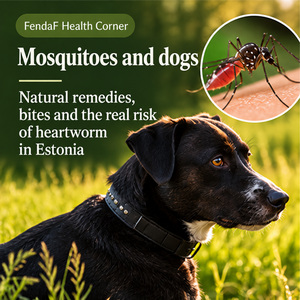
Mosquitoes and dogs: natural repellents and heartworm risk in Estonia
Reading time: about 12 min
Mosquitoes have always had a pretty clear preference in our house. They may hang around Faddu, but if given the choice, a larger group will gather around Ossu. And Ossu is not the kind of dog who always tolerates mosquito bites unnoticed. Sometimes he gets really bad bumps. I am also sensitive to mosquitoes, so I understand the itch all too well.
That’s why I’ve been researching natural mosquito repellents, different oils, and ways to soothe a dog’s skin after a bite over the years. But the more I’ve delved into the subject, the clearer one important difference has become: repelling mosquitoes, reducing the itching of bites, and preventing mosquito-borne diseases are three different goals.
And one thing has changed in Estonia as well. While the older article talked about heartworms mainly as a threat that spreads elsewhere, now we have scientific data on Estonian dogs. Therefore, the topic of heartworms can no longer be simply brushed aside.
Can a mosquito bite be dangerous for a dog?
Most often, a mosquito bite causes only short-term discomfort to a dog. Some dogs barely react, while others scratch and lick the area or develop a larger local skin reaction. If the dog is prone to allergies or scratches the bite site, skin irritation and secondary inflammation may occur.
A greater risk, however, is the mosquito’s role as a vector of pathogens. Not all mosquitoes are infected and not every bite means infection. However, mosquitoes can be intermediate hosts for several parasites belonging to the Dirofilaria genus. This is why it makes sense to talk about mosquito control not only as a summer convenience.
Heartworm in dogs in Estonia: no longer only a risk associated with travel
Heartworm disease is caused by the parasite Dirofilaria immitis. The larvae enter the dog’s body through the bite of an infected mosquito; there, the adult parasites can develop and settle in the pulmonary arteries and the right side of the heart. The disease can damage the lungs and cardiovascular system. The infection does not necessarily manifest itself quickly: it can take several months for the first symptoms to appear, and some infected dogs may initially appear completely healthy.
In 2024, researchers from the Estonian University of Life Sciences and partners published a study describing six cases of heartworm diagnosed at the Estonian University of Life Sciences’ Small Animal Clinic in 2021–2022. Two of the dogs were imported, but four had no history of international travel or being imported. This suggests the possibility that D. immitis is also spread locally by mosquitoes in Estonia.
This finding is important, but it must be kept precise. Six clinical cases do not tell us what percentage of Estonian dogs are infected, nor does it mean that every summer mosquito bite is high risk. The study authors emphasize that more prevalence studies are needed in Estonia. Also, molecular species confirmation of all cases was not performed in this study. However, we have enough reason to take the risk of heartworm seriously as part of the veterinary discussion, even in dogs that have never traveled abroad.
Heartworm and subcutaneous dirofilariasis are not the same disease
Another species, Dirofilaria repens, has also been described in Estonia, the adult parasites of which are mostly located in subcutaneous tissues and can cause nodules and other local changes. According to scientists from the Estonian University of Life Sciences, this species is already diagnosed relatively frequently in local dogs.
Both are transmitted by mosquitoes, but their preferred location in the body and the disease presentation are different. Therefore, it is not correct to simply call all species of Dirofilaria transmitted by mosquitoes heartworms. The veterinarian should differentiate the species with appropriate tests, if necessary.
When to think about heartworm?
A prolonged unexplained cough, decreased exercise tolerance, rapid breathing, difficulty breathing, weight loss, or weakness may be consistent with heartworm disease, but they can also occur with many other diseases. If a dog has these symptoms, the underlying cause should be investigated. Diagnostic tests include antigen testing, microfilaria testing, and, if necessary, heart and lung testing. The timing of the test is important because very early infections may not be detected by the available tests.
Does natural mosquito repellent help prevent heartworm?
If a dog gets fewer mosquito bites, it will also have fewer opportunities to be exposed to parasites transmitted by mosquitoes. This makes sense, and repellents are being studied and used to reduce the risk of infection. However, no home-made oil blend is known to provide reliable protection against heartworm infection.
The ESCCAP European guidelines recommend the use of repellents in heartworm risk areas, as appropriate, in combination with a preventive parasite treatment against larvae, the suitability of which should be determined by a veterinarian. These measures are complementary, not substitutes. The choice is influenced by the location of residence, travel, mosquito season, the age and health of the dog, and the indications for the medication used.
I know that many people, myself included, want to weigh the benefits of a medication against the potential risk of side effects. That’s perfectly reasonable. But with heartworm, there are two real risks to consider: the potential side effects of prevention versus the potential severity and more complex treatment of the disease. The choice cannot be based solely on the claim that all medications are bad or that natural remedies are always safe.
What natural mosquito repellents could be considered?
Lemon eucalyptus, citronella and other herbal fragrances
Some plant-derived active ingredients have been shown in studies to have insect repellent properties. This is a really interesting area. However, there is a catch behind the words: a ready-made preparation with a standardized active ingredient is not the same as an essential oil mixed at home.
For example, products containing PMD from lemon eucalyptus are used in mosquito repellents for humans. This does not mean that pure lemon eucalyptus essential oil can be simply sprayed on dogs. The safety and effectiveness of a product tested for humans does not automatically transfer to dogs.
Citronella, lavender, cedarwood, and neem have both laboratory results and integrative practitioner experience. However, different studies use different species, extracts, concentrations, and insects. Based on all of this, there is no one-size-fits-all recipe for a homemade spray bottle that is safe for dogs.
I would prefer a product for dogs that has clear ingredients, species-specific instructions, frequency of use, and safety information. This doesn’t necessarily mean that the herbal ingredient is bad. Rather, it means that a natural active ingredient also needs the right dosage and controlled formulation.
Insect Repellent Recipes and Safety Limits from Integrative Veterinarians
Our previous version of the article featured several homemade mosquito repellent mixtures. I do not want to simply leave them out: if an integrative veterinarian has published a specific recipe, a person could find it in the FendaF article, along with the source and usage limits. This doesn’t mean that all oils should be used the same way on every dog. I’ll show two actual published examples and explain which claims are based on practical experience and what to consider before trying them.
Dr. Karen Becker: Water-based mixture with neem
Dr. Karen Becker, in her 2024 treatise on natural parasite control, describes the following repellent mixture for dogs:
- About 240 ml of pure water (8 US fluid ounces).
- About 120 ml of unfiltered apple cider vinegar (4 US fluid ounces).
- 20 drops of neem oil.
- If desired, add 5 drops of an essential oil. Becker mentions geranium, lemongrass, and eucalyptus, among others; I don’t automatically consider these to be equally safe options.
Becker recommends shaking the mixture before use, spraying it on the coat (not towards the eyes or muzzle), storing it in the refrigerator, and reapplying it every four hours or so, if necessary. The latter is his practical usage recommendation, not the duration of proven protection against heartworm infection in dogs. The actual effectiveness of neem oil and essential oils also depends on the specific product, species, and method of use.
Dr. Andrew Jones: Neem, Cedarwood, and Lavender Oil Blend
Dr. Andrew Jones has published a different recipe specifically for flea and tick control. I include it for comparison, as integrative veterinarians do not use a single, universal blend:
- About 120 ml of alcohol-free witch hazel extract.
- About 60 ml of liquid coconut oil.
- 3 ml of neem oil.
- 10 drops of cedarwood essential oil and 10 drops of lavender essential oil.
Jones describes mixing, shaking before use, and only lightly spraying the coat, avoiding the eyes and mouth. His source is primarily concerned with flea and tick control: this recipe cannot be taken to mean that it is a proven protection against mosquitoes or heartworms. A mixture of coconut oil and witch hazel extract is not automatically a stable, properly formulated product.
What does “always diluted” mean?
Dilution means that the concentrated essential oil is not applied in its pure form to the dog’s skin or coat. But one important technical nuance remains: the oil does not dissolve in water or apple cider vinegar. Shaking the bottle helps to temporarily disperse the mixture, but does not ensure the same amount of active ingredient in each spray. Witch hazel extract is also not a substance in itself that would keep the oil permanently and evenly distributed in water. Therefore, the risk of a home recipe is greater if its composition and dispersion cannot be assessed. The advantage of a properly formulated finished product for dogs is precisely the controlled composition and instructions for use.
Essential oils are highly concentrated and even a diluted blend may not be suitable for every dog. I consider the dog’s age, weight, skin condition, the likelihood of the dog licking the product, respiratory or other underlying medical conditions, and whether the dog lives with a cat. If the dog is a puppy, pregnant or nursing, chronically ill, has sensitive skin, or tends to lick itself a lot, I would not try such blends without specific guidance from a veterinarian. I would not spray the oil blend on broken or oozing skin, wounds, or near the eyes, nose, ears, or mouth. “100% natural” is not a dosage guide.
If I decide to use a herbal active ingredient, I prefer a ready-made product intended for dogs, with a clear composition and instructions for use. Even in this case, I monitor the animal’s reaction. Not all essential oils are created equal: for example, concentrated eucalyptus and cinnamon oil can cause poisoning, and a risk assessment is especially important in a home with cats. And it is also important to consider the fact that a ready-made product does not automatically mean that it has been diluted correctly. Many parasite-control products containing certain pyrethroids can also be dangerous for cats; therefore, it is always necessary to check the animal species and instructions for a specific product.
My practical limit would be this: first I check the exact type of oil and the composition of the finished mixture, then I ask for advice from an integrative veterinarian if necessary; I do not use the concentrate directly on the skin; I initially test a new suitable product on a very small area of healthy skin and monitor the reaction. If redness, severe itching, salivation, vomiting, imbalance, coughing or difficulty breathing occurs, I stop the contact and immediately seek advice from a veterinarian. The lack of research does not prove that the herbal mixture is worthless. However, a specific recipe cannot promise measured protection against infection. I discuss the risk of heartworms and, if necessary, larval prophylaxis with the veterinarian separately.
Garlic against mosquitoes?
Garlic is sometimes recommended in integrative circles as a way to repel insects. I wouldn’t rule it out just because it’s an old folk suggestion, but the effectiveness of oral garlic for preventing heartworm or mosquito bites in dogs has not been reliably confirmed. The sulfur compounds in garlic can damage a dog’s red blood cells in large amounts or in concentrated forms. Therefore, we don’t know if garlic can actually prevent heartworm infection.
What can you do without putting any oil on your dog?
The simplest options are sometimes underestimated. Empty containers of standing water and check rainwater tanks, as these can be breeding grounds for mosquitoes. Use screens on windows if necessary, choose a different time or route for walking during peak mosquito activity, and clear your yard of areas where water can stand for long periods of time.
Of course, we can’t keep the dog indoors all summer. And I don’t plan on stopping Ossu from going to the forest just because of mosquitoes. But we can reduce unnecessary exposure and assess whether a particular dog needs additional protection.
How to ease itching after a mosquito bite
If your dog has a single itchy bump and is otherwise well, you can gently cool the clean skin with a compress dampened with cool water. Avoid rubbing and make sure your dog doesn’t lick the area. If the itching is severe or persistent, it’s a good idea to ask your vet about a topical treatment that’s right for your dog. Anti-itch creams or essential oils for humans are not automatically suitable.
I have had previous experience with homeopathic Ledum, both for myself and for Ossu. I used it when the bites were causing discomfort and I felt it might help. This is just my experience and not a verified proof of efficacy. Homeopathy has not been shown to be reliable in repelling mosquitoes or preventing heartworm infection. Therefore, I would not consider it a preventative measure or delay necessary treatment because of it.
If a bite causes severe facial swelling, difficulty breathing, collapse, a rapidly spreading skin reaction, or the dog becomes very lethargic, you should contact a veterinarian immediately.
FendaF’s practical checklist
My five questions before the start of mosquito season: can the dog get bitten badly by mosquitoes; has he had any skin reactions in the past; are we visiting areas or traveling to countries where the risk of Dirofilaria is higher; is the remedy we choose really suitable for the dog; and does heartworm prevention need to be discussed separately with the vet? The most sensible protection answers all of these questions, not just the first one.
In conclusion
Mosquitoes in our household still tend to prefer Ossu and they probably don’t ask his consent for it. :) I still believe that several herbal substances can have a place in dog skin care and insect control, but I think it’s important to distinguish between an actually studied active ingredient and a homemade mixture, and a practical observation from proof of disease prevention.
The Estonian University of Life Sciences study made this topic more meaningful for me: heartworm is no longer just a distant travel threat here. This is not a reason to panic, but a reason to make more informed choices during mosquito season. And if there is a risk of the parasite, a pleasantly smelling spray bottle should not be the only defense plan.
Sources
- Mõttus, Mõtsküla, Jokelainen (2024). Heartworm disease in domestic dogs in Estonia: indication of local circulation of the zoonotic parasite Dirofilaria immitis farther north than previously reported. Parasites & Vectors 17:124. https://doi.org/10.1186/s13071-024-06217-5
- Estonian University of Life Sciences (26 March 2024). Report on local emergence of the heartworm parasite Dirofilaria immitis in dogs. https://www.emu.ee/uudised/eestis-on-levimas-koerte-sudameusstove-pohjustav-parasiit-dirofilaria-immitis
- ESCCAP. Guideline 5: Control of Vector-Borne Diseases in Dogs and Cats. https://www.esccap.org/guidelines/gl5/
- American Heartworm Society. Canine Guidelines for Prevention, Diagnosis and Management of Heartworm Infection (2024). https://www.heartwormsociety.org/veterinary-resources/american-heartworm-society-guidelines/canine
- CDC. Mosquitoes, Ticks, and Other Arthropods: Insect Repellents. https://www.cdc.gov/yellow-book/hcp/environmental-hazards-risks/mosquitoes-ticks-and-other-arthropods.html
- Merck Veterinary Manual. Garlic and Onion (Allium spp.) Toxicosis in Animals. https://www.merckvetmanual.com/toxicology/food-hazards/garlic-and-onion-allium-spp-toxicosis-in-animals
- Dr Karen Becker / Bark & Whiskers (2024). All-Natural Pest Deterrent for Pets. Source of the original recipe. https://www.barkandwhiskers.com/2024-05-19-natural-pest-deterrent-for-pets/
- Dr Andrew Jones, DVM / Veterinary Secrets (2024). DIY Natural Flea Spray: Effective & Easy Recipe for Spring! Source of the comparison recipe (fleas and ticks, not proven heartworm protection). https://veterinarysecrets.com/its-spring-and-fleas-are-coming-new-natural-flea-spray-recipe/
- Pet Poison Helpline, Kia Benson DVM. Updates on Essential Oils. Risks related to essential oil species, concentrations and exposure routes. https://www.petpoisonhelpline.com/uncategorized/updates-on-essential-oils/
- ASPCA Animal Poison Control (2022). The Essentials of Essential Oils Around Pets. Risks of applying concentrated essential oils. https://www.aspca.org/news/essentials-essential-oils-around-pets
🐾 FendaF believes in informed choices.
We share scientific research, integrative veterinary perspectives and practical experience so that you can make well-informed decisions for your pet. Every animal is unique, and no article can replace veterinary assessment, diagnosis or treatment. If your pet is unwell, consult your veterinarian.
Author: Piret Oper









Leave a Reply