


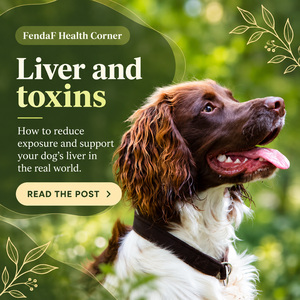
Dog Liver and Toxins: Supporting Liver Health in the Real World
Reading time: about 5 min
I can choose high-quality food for my dog, avoid unnecessary household chemicals, and keep toxic substances out of reach. But I can’t put him in a bubble. He breathes the same air as us, walks on city streets and green spaces, rests on textiles at home, and licks his paws after a walk. That’s why, in addition to reducing exposure, I’m interested in another question: how to support an organism that has to cope with all this every day?
The liver is one of the central organs in this larger picture. Its normal function is not only a matter of liver disease, but is also related to metabolism, digestion, nutrient utilization and the body’s defense systems. However, it is important to distinguish between supporting the normal functioning of the liver, treating existing liver damage and treating specific poisoning. These are three different situations.
Environmental exposure cannot be reduced to zero
When we talk about environmental substances, we often think of serious poisoning: a dog eating rat poison, drinking a chemical, or getting hold of human medication. Such situations are obviously dangerous. Much less is thought about the small and repeated exposures that are part of our daily lives.
In the winter, your dog may walk on surfaces that have been treated with anti-slip agents. If he licks his paw pads when he gets home, he could ingest the residue. This is not just a theoretical possibility: Veterinary Poison Control Centers list paw licking as one of the most common routes of exposure. Your dog may also be exposed to residue from floor care products, pesticides used on landscaping, airborne pollutants, and compounds used in the treatment of furniture and textiles.
We also know from research that these exposures are not just imaginary. A 2024 pilot study by the Dog Aging Project found a variety of pesticides, phthalates, flame retardants, and other compounds in collar samplers from 15 dogs. Another study, also published in 2024, found traces of a wide range of environmental compounds in the urine and feces of dogs and cats. This suggests that exposures are real, but does not prove by itself that every animal studied had liver damage.
In addition, blood samples from 31 dogs in a PFAS-contaminated area were tested. The researchers found associations between some PFASs and laboratory parameters, including ALP. The sample size was small, and the study does not prove that PFAS caused liver disease in these dogs. However, it does show why the impact of environmental chemicals on liver and metabolic parameters is a serious line of research, not just speculation.
What does the liver actually do with these substances?
The liver processes both the metabolic products produced in the body itself and many compounds originating from the external environment. Two main stages of biotransformation are often spoken of. In the first, enzymes change the chemical structure of a substance. In the second, it is often bound to another molecule to make it easier for the body to excrete it. Some substances leave the intestines through bile, while others, after processing, are excreted through the kidneys into urine.
This work requires functioning enzymes and the body’s own defense mechanisms. For example, glutathione is important, which helps neutralize certain reactive intermediates and protect cells from oxidative damage. Liver biotransformation is not always a straightforward "bad stuff in, good stuff out" process: some compounds can initially become more reactive during processing. Therefore, liver health is about antioxidant protection, nutrient adequacy, and inflammation control.
However, not all ingested substances are processed by the liver in the same way. For example, sodium chloride, which is commonly sprinkled on roads, does not require digestion by liver enzymes like many organic chemicals. Its excessive amount can disrupt, in particular, the fluid and electrolyte balance, in which the kidneys play an important role. Therefore, the substance from the paws reaching the body is real, but the effect depends on the specific substance. In the case of some pesticides, drugs and other compounds, the processing of the liver and possible damage are of central importance.
Does normal liver function mean that support is not needed?
I see no reason to contrast these two ideas. Yes, the liver does its job every day without any “detoxification”. But this does not mean that its working conditions are always ideal or that the influence of diet, environment and other supporting factors is insignificant. By the same logic, we could say that since the body regulates its own fluid balance, the quality of water and sufficient drinking are not important. Of course they are.
Liver capacity can be affected by the presence of disease, age, genetic predisposition, certain medications, nutritional deficiencies, and exposure to specific chemicals. Oxidative stress and glutathione depletion are part of the mechanisms of damage from several known liver toxins. At the same time, it cannot be concluded from the environment alone that every healthy dog has an “overloaded” liver. This should be assessed based on the dog’s health and actual exposure.
For me, the practical starting point is therefore simple: reduce what I can take, while at the same time supporting the body’s normal functioning through diet and lifestyle. If there is reason to suspect liver disease or poisoning, general support is not a substitute for diagnosis or treatment.
Peter Dobias’ integrative view: the liver does not work in isolation from the rest of the body
Integrative veterinarian Dr. Peter Dobias has written extensively about this. His central message is that the daily environmental stressors of today’s dog cannot be completely avoided. Therefore, he believes that simply recommending "stay away from toxins" is not enough: attention must also be paid to diet, mineral adequacy, digestion, antioxidant protection, and liver support.
Dobias links the health of the liver to a very broad whole: energy, skin, digestion, the immune system and long-term health. This has a clear physiological basis, because the liver is indeed involved in many systems of the body. However, this does not mean that every case of itching, fatigue, indigestion or other health problem is caused by poor liver function. The existence of a connection and proving the cause of a specific disease are different issues.
There are three overarching directions in his approach. First, the highest quality, nutritionally balanced food for dogs. Second, reducing unnecessary chemical exposures and ensuring adequate levels of essential minerals and nutrients. Third, herbal and nutritional liver support, which Dobias also uses as part of a preventative wellness routine. For his own product, LiverTune, he describes an initial course and subsequent periodic courses. This is his practical protocol, not a universally accepted need for all dogs.
What is important to me in Dobias’ approach is systemic thinking. Food, intestines, liver and environment are interconnected. I shouldn’t have to choose between two extremes, where one end promises to remove all toxins with one preparation and the other claims that there is no point in talking about supporting the liver at all. There are many meaningful options in between.
What exposures should be considered on a daily basis?
| Environment | How can the substance reach a dog? | What can I do right now? |
|---|---|---|
| Winter street | Salts and other anti-slip agents remain on the paws and end up in the mouth when they lick. | After a walk, rinse the paws and, if necessary, the belly; dry gently. |
| Home and textiles | Floor cleaning products, fragrances, treated textiles and dust can reach the skin, respiratory tract or mouth. | Ventilate, avoid excessive fragrance, follow product instructions; let surfaces dry. |
| Garden and green areas | Plant protection products or their residues can reach the fur and paws; the risk depends on the substance and the use. | Avoid freshly treated areas, follow waiting times and wash paws if necessary. |
| Food and water | Moldy feed may contain mycotoxins; contaminated water, for example, may contain cyanobacterial toxins. | Store food properly; do not offer spoiled food or allow them to drink from suspicious water sources. |
Not every exposure equals poisoning. The risk depends on the substance, the amount, the duration of exposure, and the dog’s sensitivity. But these are specific places where an owner can reduce their dog’s daily exposure without having to completely overhaul their life.
Liver support starts with food, not a bottle of medicine
The liver needs sufficient energy, high-quality proteins, essential amino acids, vitamins and minerals to function properly. It is important to pay special attention to ensuring that your dog’s diet is balanced as a whole. Variety can be valuable, but no single “liver-supporting” food will compensate for a long-term nutritional deficiency.
If your dog eats high-quality complete food, this is a practical way to ensure that he gets the nutrients he needs. Adding fresh food, wet food, and raw food is not a problem in itself, but their proportions must form a reasonable whole. This is especially important if the menu uses a lot of individual ingredients. I have explained the difference between complete food and complementary food in a separate article, and we have also written extensively about combining foods.
Also read FendaF articles “Complete feed vs. complementary feed” and “Dog food and how to combine different foods?”.
Nutritious, dog-friendly vegetables and other fresh additions can supplement the menu with various bioactive compounds. However, you can’t tell how much a food will excrete a chemical in a particular dog just by looking at the color, the word “natural,” or the antioxidant content. The strength of a liver-supporting menu is consistency and integrity, not one superfood.
What nutrients and plants have been studied for their role?
Glutathione and SAMe
Glutathione is an important antioxidant in the body, which plays a role in neutralizing certain harmful metabolites. SAMe, or S-adenosylmethionine, is involved in methylation reactions in the body and helps support the processes necessary for the formation of glutathione. In veterinary medicine, SAMe is used as a supportive treatment for certain liver diseases. This does not mean that every healthy dog needs SAMe supplementation, but the mechanism and clinical experience of use exist.
Milk thistle and silymarin
Milk thistle silymarin and its constituents, including silybin, are of interest in veterinary medicine due to their antioxidant, anti-inflammatory, and potential hepatoprotective effects. The 2019 ACVIM consensus on chronic hepatitis in dogs considers it a supportive treatment option. The issues of composition, dosage, and absorption are important: different extracts or mixtures of multiple plants cannot be considered automatically equivalent.
We have discussed milk thistle and its possibilities in a separate FendaF article. “Milk thistle for dogs: liver support, detox and health links”.
Vitamin E and other antioxidants
Vitamin E helps protect cell membrane lipids from oxidation. This is also considered as part of the supportive care of liver disease in dogs. Research into the role of antioxidants is warranted, but higher doses are not automatically better: the dog’s needs depend on the diet, health and other supplements. The appropriate formulation and reasonable amount should be used.
Dandelion, artichoke, turmeric, broccoli sprouts and fermented herbal blends
These plants are often included in integrative approaches to liver support. Interest in them stems from, for example, their potential effects on antioxidant defenses, inflammatory pathways, or regulation of bile formation and flow. Dobias uses several of them in its LiverTune formula and considers fermentation to be an important part of the product’s formulation.
These are possibilities worth exploring. However, the evidence base for different herbs is patchy, and laboratory testing of a single active ingredient does not yet answer how a particular blend will work in a particular dog. Nor can it be assumed that fermentation will increase the absorption of each ingredient to the same extent. Noting this does not take away the value of herbal research, but rather helps us ask more specific questions.
In addition, it must be taken into account that, for example, different parts of a dandelion (root, leaf, and flower) are all used for different purposes.
Could a healthy dog have a preventative course of liver support?
Dobias also recommends periodic herbal liver support for healthy dogs in his practice. His idea is preventive: if exposure to environmental substances is constant, it is worth taking care of the normal functioning of the liver and the body’s antioxidant defenses. I understand the logic of this approach and would not consider it right to dismiss it simply because there is no separate clinical study for each treatment schedule.
However, a distinction must be made between a general principle and a specific protocol. We have data on exposure to environmental chemicals, liver defense mechanisms, and some supportive agents. We do not have the same strong evidence that, for example, a monthly seven-day course for all healthy dogs would remove measurably more environmental toxins or extend lifespan. This is a question worth investigating, not a reason to trash the integrative approach.
I would start with the dog’s health, diet, medications, and known environmental risks. If your dog already has liver problems or is taking any medications, it is worth discussing with your veterinarian the appropriate herbal or nutritional support. It is also important to note that many medications are metabolized in the liver, and some herbal extracts can affect their behavior in the body. Therefore, the support program needs to be appropriate for the dog, not simply as long as possible.
How do you know if your dog’s liver needs more attention?
Assessing liver health is not as simple as a single number in a blood test. ALT and AST can indicate cell damage, while ALP and GGT can partly indicate changes in the bile ducts or other factors. Elevated enzymes do not in themselves indicate liver failure. Liver function can be assessed by, for example, bilirubin, albumin, glucose, coagulation parameters, and, if necessary, bile acids and ultrasound.
When indicators change, it is worth analyzing the whole picture: foods, medications and supplements, recent possible exposures, body weight, appetite, digestion and the duration of the changes. Sometimes the cause is a transient deviation, sometimes the dog needs targeted examinations. A persistent or significant change is not a place where you should just stick to general liver support.
Also, the condition of the liver cannot be reliably assessed based on external symptoms alone. Indigestion, itching, or fatigue can occur with liver disease, but they also have many other causes. Dobias’ holistic view helps to expand the range of causes; diagnostics help to make this range more precise.
FendaF’s practical advice: supporting the liver in the real world
- Reduce exposure: In winter, rinse your paws after a walk and avoid freshly mowed lawns.
- Check your home environment: Reduce unnecessary fragrances, keep chemicals away, and let washed surfaces dry.
- Support the body with nutrition: Choose a nutritious menu suitable for your dog and provide fresh drinking water.
- Consider additional support individually: For example, the suitability of milk thistle or other liver support depends on the dog’s health and medications.
- Notice the problems: If there are persistent changes in liver function or if poisoning is suspected, contact your veterinarian.
In conclusion
The liver is not an organ that needs to be “cleaned” at all costs, but it does not work independently of the environment either. A dog is exposed to many substances throughout its life, and some of them do enter the body, including through daily paw licking. Some compounds undergo complex transformations in the liver, while others primarily burden other systems. We do not have to treat all of these substances in the same way to recognize the reality of environmental stress.
For me, reasonable liver support means two parallel activities: I reduce unnecessary exposures where possible and I make sure that the dog’s body has the necessary conditions for normal functioning. I myself am an advocate of milk thistle detox and have seen very positive effects in my own dogs, but this does not mean that every dog necessarily needs a regular liver cleanse. However, my recommendation to consider a liver cleanse coincides with Dr. Dobias’s idea – if your dog has constant skin or ear problems, it is worth thinking about how much strain your dog’s liver may be under and whether it can do its job optimally or needs a little support.
Integrative veterinary medicine has valuable questions and experiences on this topic. Research is helping us to understand more precisely which options provide benefits, for whom, and to what extent.
Sources used
Dr. Peter Dobias. How to Protect and Care for Your Dog’s Liver
Dr. Peter Dobias. How to replace the "bad guys" with the "good guys"
ACVIM (2019). Consensus statement on the diagnosis and treatment of chronic hepatitis in dogs
Merck Veterinary Manual. Hepatotoxins in Small Animals (updated 2026)
Pet Poison Helpline. Road Salt Safety Tips for Pets
ASPCA Poison Control (2026). Is It Safe to Use De-Icers Around Your Dog?
Dog Aging Project (2024). Silicone tags and chemical exposures in dogs
Li & Kannan (2024). Urinary and Fecal Excretion of 121 Environmental Chemicals in Pet Dogs and Cats
Domestic Dogs and Horses as Sentinels of PFAS Exposure (2023)
🐾 FendaF believes in informed choices
The purpose of the FendaF blog is not to tell you what you must do. Our aim is to share knowledge, introduce different evidence-based and integrative perspectives, and help you make more informed decisions for your pet.
Every animal is unique, and no article can replace a consultation, diagnosis or treatment provided by a veterinarian. If your pet has a health concern or you need individual advice, always contact a veterinarian.





Leave a Reply