


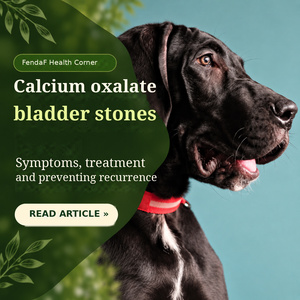
Calcium oxalate bladder stones in dogs: signs, treatment and preventing recurrence
Reading time: about 6 min
When a dog keeps trying to urinate but produces only a few drops, bladder stones may be the cause. Some stones merely irritate the bladder lining; others may enter the urethra and block urine flow. An obstruction is an emergency. There is no time to wait and see whether drinking more water solves it.
Calcium oxalate is one of the common types of canine bladder stones. Any dog can develop them, although some breeds are more susceptible and they are diagnosed more often in older dogs. The bad news is that, unlike some struvite stones, calcium oxalate stones generally cannot be dissolved through diet. The better news is that hydration, an appropriate diet and consistent monitoring can help reduce recurrence risk and identify new stones sooner.
I am drawing on integrative veterinarian Dr Karen Becker’s observations while comparing them with ACVIM’s consensus recommendations on urinary stones and the updated Merck Veterinary Manual. That helps distinguish useful practical suggestions from approaches requiring an individual veterinary diagnosis.
What are calcium oxalate bladder stones, and which dogs are at greater risk?
Bladder stones, or uroliths, form when minerals in urine precipitate into crystals that grow into larger structures. Calcium oxalate stones contain calcium and oxalate. Finding crystals in a urine sample does not automatically mean a stone is present, and the absence of crystals does not rule stones out.
Breeds at increased risk include Miniature Schnauzers, Bichons Frisés, Shih Tzus, Lhasa Apsos, Yorkshire Terriers, Miniature Poodles and other small breeds. Stones are found more often in middle-aged and older dogs and, in some populations, more often in males. A breed predisposition does not make the condition inevitable, nor does it exclude mixed-breed or large dogs.
Genetics are part of the picture. Increased urinary calcium excretion, high blood calcium, hyperadrenocorticism (Cushing’s disease), primary hyperparathyroidism, urine acidity and dietary factors may also contribute. Older explanations mention nephrocalcin, a urinary protein involved in crystal growth. But it would be misleading to present a single protein ‘defect’ as the established primary cause of all calcium oxalate stones: the condition is multifactorial and not yet fully understood.
What symptoms might suggest bladder stones?
A dog may urinate more frequently, hold the urinating position for longer, dribble urine, lick the genital area or suddenly have accidents indoors despite being reliably house-trained. Urine may look pink or visibly bloody. Discomfort and abdominal pain are possible, while small stones can sometimes cause few symptoms for a time.
Urinary tract inflammation, tumours and other conditions can produce similar signs. Blood in the urine or frequent urination alone cannot tell us that the stone, if present, is specifically calcium oxalate.
If your dog repeatedly strains to urinate but cannot pass urine, or produces only a few drops and shows pain, vomiting, weakness or agitation, go straight to an emergency veterinary clinic. Urethral obstruction may be life-threatening. Do not try to squeeze the bladder or give ‘stone-dissolving’ remedies at home.
How does a veterinarian identify the type of stone?
The investigation usually starts with a history, physical examination and urinalysis. Urine specific gravity indicates its concentration; pH indicates acidity; microscopy and, when appropriate, urine culture help assess crystals and infection. X-rays and ultrasound show the location, size and number of stones, but may not reliably identify their mineral composition.
Calcium oxalate stones are usually visible on X-rays, yet imaging alone cannot definitively confirm their composition. If a stone is removed or passed naturally, sending it for quantitative laboratory analysis is worthwhile. Struvite, calcium oxalate and other stones require different prevention strategies. One universal ‘urinary stone diet’ will not suit every type.
When calcium oxalate stones are confirmed, veterinary recommendations also include assessing blood calcium and, where indicated, illnesses that increase urinary calcium excretion. Existing kidney or heart disease matters too, because it may limit fluid and medication recommendations.
Treatment: why can’t calcium oxalate stones simply be dissolved?
Unlike certain struvite stones, calcium oxalate stones cannot be dissolved to a clinically useful extent with a specialised diet. This does not mean every dog needs open bladder surgery. Depending on the number, size and location of stones, the dog’s sex and the clinic’s capabilities, less invasive removal options may be available.
In suitable cases, veterinarians can flush certain small bladder stones out using controlled urine flow and a specialised technique. Other options include cystoscopy, laser lithotripsy and surgical removal. A stone lodged in the urethra can sometimes be moved back into the bladder by the clinician. That is a veterinary procedure, never a home remedy. Other procedures are considered for particularly complex or repeatedly obstructive cases.
For some dogs with very small, symptom-free stones and a low assessed obstruction risk, monitoring may be preferable to repeated surgery. The decision depends on the individual’s anatomy and risk, not simply on the presence of a stone.
Prevention starts with less concentrated urine
Adequate fluid intake is one of the most useful practical measures. The more dilute the urine, the lower the concentration of many stone-forming substances and the lower the chance of their precipitating together. ACVIM recommends moisture-rich food or adding enough water to an appropriate dry diet to help prevent recurrence. In dogs, a urine specific gravity target of around 1.020 or less is often used, but the goal must be tailored and checked by urinalysis.
I have written more about hydration in our article How much water should a dog drink? With bladder stones, however, merely reaching a general daily water-intake figure is not enough. What matters is how dilute the urine becomes and whether the dog can empty the bladder regularly.
Wet food, soaking dry food and placing several bowls of fresh water around the home may help. Some dogs prefer running water; others need a wider bowl or a quieter drinking spot. Sometimes a small amount of dog-safe broth without onion or garlic and with a suitable sodium content can improve palatability, provided it does not interfere with medication or a therapeutic diet. Dogs with heart or kidney disease need an individually agreed hydration plan.
My simple 24-hour water-intake test
Every so often, I recommend actually measuring how much your dog drinks. In the morning, put a measured volume of water in the bowl. Throughout the day, record how much you add and how much you pour away. Measure what remains the next morning. Water drunk = starting amount + water added − water discarded − water remaining. If some was spilled, the result will be less accurate.
For example, some practical guidance uses 30 ml/kg, or 1.2 litres per day for a 40 kg dog, as one rough reference point. It is not a universal minimum and does not guarantee enough water to prevent bladder stones. Needs vary with weather, activity, food moisture and health. Dogs eating wet food obtain considerable water from meals, so measuring only what disappears from the drinking bowl will not capture their total intake.
In homes with several dogs, a shared bowl cannot reveal how much each individual drank. It can still be a useful first step when reviewing drinking habits and water-bowl placement.
Record drinking-water amounts and food moisture, but also ask your veterinarian to check urine specific gravity and pH. The numbers only become useful alongside laboratory stone analysis and your dog’s medical history. After treatment, confirm that all stones were removed and schedule regular checks for recurrence.
Which foods should you choose, and what should you avoid?
In integrative approaches I have seen advice to avoid excessively acidic urine, limit very high-oxalate foods and increase dietary moisture. There are useful ideas here, but a diet should not be designed around one ingredient or urine pH alone. For a dog prone to calcium oxalate stones, the whole diet matters, including protein, calcium, sodium and other minerals.
Spinach and rhubarb, for example, contain substantial oxalate and would not be sensible additions in large amounts for an at-risk dog. That does not mean every green vegetable, including green beans, must be completely banned. Nor is it correct to say the dog ‘must have no calcium’: calcium is essential, and too little creates other problems. Discuss any calcium supplements and their amounts with a veterinarian; do not add high doses on your own.
ACVIM recommends avoiding excessive urine acidification and excessive protein intake in dogs with calcium oxalate stones, while favouring a moisture-rich diet. A complete food formulated to reduce urinary stone recurrence may be appropriate, but should also suit the dog’s other conditions and tolerances. Home-prepared food can work if formulated by a veterinary nutrition specialist. Simply switching to raw food or adding random vegetables is not proven stone-prevention therapy.
Do not try to raise urine pH yourself by adding baking soda or large quantities of supposedly ‘alkalising’ foods. If urine is persistently acidic, a veterinarian may prescribe potassium citrate, which influences acidity and calcium binding. The dose and suitability require professional assessment, particularly alongside other conditions or medications.
Integrative sources sometimes mention vitamin B6, dandelion, alfalfa, yarrow and olive leaf. High-quality clinical evidence for preventing calcium oxalate stone recurrence in dogs with these supplements is currently insufficient. I would not automatically give them to a dog with stones or substitute them for urinalysis, an appropriate diet or medication when needed. They may, however, have a supportive role in some dogs once the underlying problem has been addressed.
How often should you monitor, and why do stones return?
Calcium oxalate stones frequently recur because removing a stone does not necessarily change the metabolic or genetic background that encouraged it to form. ‘Surgery done, problem forgotten’ is therefore not a good strategy. Follow-up may include urinalysis, urine culture when indicated, and X-rays or ultrasound. For dogs at high risk of recurrence, the Merck Veterinary Manual often recommends imaging every 3–6 months.
Timing of the first follow-up depends on the treatment. Some dogs are rechecked after a few weeks or months to confirm complete stone removal and assess the diet’s effect. A longer-term schedule follows. Finding a small stone early can sometimes make a less invasive procedure possible before another major surgery is needed.
Unfortunately, no diet, herb or drinking-water trick can provide a 100% guarantee. But consistent monitoring is an area where owners can genuinely make a difference.
In summary
If I had to reduce this topic to one recommendation, it would be: don’t wait for the first severe urination problem. If your dog is predisposed to calcium oxalate stones or has had them before, monitor hydration, discuss an appropriate complete diet and arrange regular urine and bladder checks.
The 24-hour water-intake test is a simple place to begin. It cannot replace measuring urine specific gravity, but it may offer a useful clue, especially when the problem keeps recurring. And if your dog is straining but unable to urinate, home monitoring is no longer appropriate: go to an emergency veterinary clinic.
Sources
- Merck Veterinary Manual (updated 2026). Urolithiasis in Dogs: calcium oxalate stones.
- Lulich et al. (2016). ACVIM Small Animal Consensus Recommendations on the Treatment and Prevention of Uroliths in Dogs and Cats.
- Merck Veterinary Manual. Overview of Urolithiasis in Small Animals: removal methods.
- Karen Becker. Calcium Oxalate Stones in Pets. Bark & Whiskers, integrative perspective.
- FendaF. How much water should a dog drink?
🐾 FendaF believes in informed choices
The purpose of the FendaF blog is not to tell you what you must do. Our aim is to share knowledge, introduce different evidence-based and integrative perspectives, and help you make more informed decisions for your pet.
Every animal is unique, and no article can replace a consultation, diagnosis or treatment provided by a veterinarian. If your pet has a health concern or you need individual advice, always contact a veterinarian.









Leave a Reply