


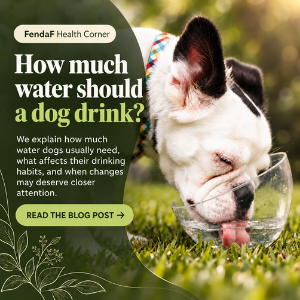
How much water should a dog drink?
Reading time: about 9 min
Water is as fundamental to a dog as food, but judging water intake can be surprisingly misleading. One dog visits the water bowl several times a day, another drinks less often but consumes a larger amount at once. A dog eating wet food may drink little from the bowl while obtaining much of its water from food. A dog eating dry food, on the other hand, must drink most of its water separately.
So the most useful question is not only “how many millilitres did the dog drink from the bowl?”, but “how much water does the dog get in total, and has the usual pattern changed?”
A healthy dog’s water requirement is not one rigid number. It helps to separate two different measures. From the FendaF and integrative-practice perspective, about 30 ml of plain drinking water per kilogram of body weight per day can be used as a practical lower-end reference, particularly for a dog eating dry food. This is not the same as total daily water requirement and it is not a diagnostic threshold. For total water intake, around 50–60 ml/kg/day is more commonly used as a general reference. Merck Veterinary Manual gives approximately 44–66 ml/kg/day as an orientation for most mammals in a thermoneutral environment, while Cornell describes typical drinking-water intake in a healthy dog as roughly 40–60 ml/kg/day. Total water intake also includes water in food and a small amount of metabolic water.
Quick guide by body weight
|
Dog’s weight |
~30 ml/kg plain drinking water* |
~50 ml/kg total water |
~60 ml/kg total water |
|
5 kg |
150 ml/day |
250 ml/day |
300 ml/day |
|
10 kg |
300 ml/day |
500 ml/day |
600 ml/day |
|
20 kg |
600 ml/day |
1000 ml/day |
1200 ml/day |
|
30 kg |
900 ml/day |
1500 ml/day |
1800 ml/day |
|
40 kg |
1200 ml/day |
2000 ml/day |
2400 ml/day |
* 30 ml/kg is used here as a practical lower-end reference for plain drinking water, not as the optimal total water requirement or a threshold below which a dog is automatically dehydrated. A dog eating wet or fresh complete food may drink less than this from the bowl because the food itself contains substantial water. Needs may increase in hot weather, with high activity, lactation, fever, diarrhoea or other fluid losses.
The water bowl does not show total water intake
A dog’s daily water intake consists of drinking water, water contained in food, and a small amount of water produced through metabolism. Two dogs of the same weight can therefore drink very different amounts from the bowl and still both be normally hydrated.
Dry food usually contains relatively little water, so dogs eating dry food generally drink more freely available water. Wet and fresh foods usually contain much more moisture. In a controlled study published in 2025, dogs eating fresh food with about 71% moisture obtained so much water from the food that their total water intake was higher even though they drank significantly less from the bowl than dogs eating dry food. This is a good example of why bowl intake should not be assessed separately from the diet.
Adding water to dry food
If you want to add water to dry food, you can do so simply to increase water intake or moisten the meal. The kibble does not need to be soaked for a long time. There is not enough evidence to say that adding water to dry food itself reduces the risk of gastric dilatation-volvulus (GDV), but in FendaF’s experience, adding water slows eating in some dogs. Because rapid eating and aerophagia have been associated with a higher GDV risk, this effect could be one small part of overall risk management. It should not, however, be presented as a proven method of preventing GDV. GDV risk is multifactorial.
When is a dog drinking too much?
In veterinary medicine, drinking more than about 100 ml/kg of water per day is often used as a practical reference for polydipsia. For a 20 kg dog, that would mean more than 2 litres of water drunk from the bowl per day. This is not a diagnosis, but it is a level at which the reason should be investigated systematically. A single day can be misleading, so it is better to measure water intake over several consecutive days while also considering food moisture, weather, activity and medications.
A change from the dog’s own normal pattern also matters. If a dog has always been a heavy drinker and its wellbeing, urine, body weight and appetite are stable, that does not automatically mean disease. But if a dog that previously drank moderately suddenly starts emptying the bowl repeatedly, the change itself is important information.
Why might a dog start drinking more?
- Hot weather, increased activity or other normal fluid loss.
- Diarrhoea, vomiting, fever or another condition causing dehydration.
- Kidney disease, diabetes mellitus, Cushing’s syndrome, liver disease, pyometra and other diseases that may cause polyuria/polydipsia.
- Glucocorticoids, diuretics such as furosemide and some anticonvulsants can increase thirst and urination.
- Diet composition. Very salty food can increase thirst; dry food contributes little water, so more must be drunk from the bowl.
If a dog suddenly starts drinking considerably more, measure the amount and take that information to your veterinarian. Excess drinking should not be “treated” by restricting water, because with many diseases increased drinking is a necessary physiological compensation.
How can you tell if your dog is drinking too little?
Low bowl intake does not automatically mean water deficiency. A dog eating wet food may obtain a large share of its water from food. More concerning is the combination of drinking less than usual together with lethargy, a dry or sticky mouth, loss of appetite, repeated vomiting or diarrhoea, fever or another sign of illness.
Dehydration is not simply “thirst”. If the dog’s general condition is poor, it cannot keep water down, vomits repeatedly or is very lethargic, giving tiny amounts of water at home is not enough. The cause needs to be assessed and fluid therapy may sometimes be required. The red flags are discussed separately in FendaF’s article Dehydration in dogs: signs and practical tips for hot weather.
Does low water intake affect the urinary tract?
Adequate water intake helps increase urine volume and reduce urine concentration. That is one reason why higher-moisture food or adding water to food can be a practical part of urinary-tract support. Stone formation still depends on stone type, urine pH, minerals, genetics, infections and other factors, so we cannot simply say that “not drinking enough causes bladder stones”. Concentrated, low-volume urine is better understood as one possible risk component.
Personal experience: why change can matter more than the number
We have had a situation ourselves where Peku had barely drunk anything and became very weak by the evening. After water was offered and some time had passed, the dog’s condition clearly improved. This is one dog’s practical response, not proof that every episode of weakness is automatically dehydration. But it left me with a very practical lesson: when a dog suddenly behaves differently, alongside “has the dog eaten?”, it is also worth asking “has the dog drunk today?”
How to measure water intake at home
The most useful approach is not visual estimation but a simple 2–3 day measurement.
- Use a measured amount. In the morning, place for example 2 litres of water in the bowl, or measure exactly how much you add.
- Control other water sources. If the dog drinks from several bowls, measure all of them; in multi-dog households, separate drinking stations during the measurement period if possible.
- Measure what remains after 24 hours. Include any water you topped up or replaced.
- Record the food. Water obtained from wet or fresh food means the bowl number alone does not describe total water intake.
- Repeat for at least 2–3 days. A hot day, long hike or stressful day can distort the result.
- Calculate ml/kg/day. Divide the amount drunk over 24 hours by the dog’s body weight, and focus especially on the trend and change from the dog’s own usual level.
Practical FendaF water rule
- Do not confuse the amount drunk from the bowl with total water intake. Wet or fresh food can provide a large proportion of daily water.
- Use about 30 ml/kg of plain drinking water as a practical lower-end reference, not as a universal dehydration threshold. A dog eating wet or fresh food may drink less than this from the bowl.
- Use about 50–60 ml/kg/day as a general reference for total water intake, not as a rigid requirement. This includes drinking water + water from food.
- If drinking-water intake persistently approaches or exceeds 100 ml/kg/day, measure it over several days and discuss it with your veterinarian.
- A sudden change matters more than one “ideal number”. If a dog suddenly starts drinking much more or much less, look for the reason.
- Water can be added to dry food to increase intake or moisten the meal. In FendaF’s experience, this slows eating in some dogs. Because rapid eating and aerophagia have been associated with higher GDV risk, it may be one small part of overall risk management, but adding water cannot be regarded as a proven GDV-prevention method.
- If reduced drinking is accompanied by lethargy, repeated vomiting, diarrhoea, a dry/sticky mouth or a worsening general condition, it is not sensible simply to wait for the dog to drink later.
What should you actually take away from this article?
A dog’s water needs cannot be judged by one number or by the water bowl alone. The most practical approach is to know your dog’s usual pattern, consider the moisture in the diet and measure intake when something changes. About 30 ml/kg of plain drinking water can be used as a practical lower-end reference, while about 50–60 ml/kg better describes a general reference for total daily water intake. They are not the same metric. Persistent drinking-water intake above 100 ml/kg/day, or a sudden change, deserves attention. If a dog eating dry food persistently drinks clearly below 30 ml/kg/day, review the dog’s wellbeing, urine, environment and actual total water intake; a dog eating wet or fresh food may normally drink less from the bowl.
And the simplest rule remains the same: fresh drinking water should always be freely available. Restricting water is not a way to “test” or treat excessive drinking.
Sources used
- Merck Veterinary Manual. Nutritional Requirements of Small Animals.
- Merck Veterinary Manual. Maintenance Fluid Plan in Animals.
- Schoeman JP. Approach to the Dog with Polyuria and Polydipsia. WSAVA World Congress Proceedings, 2011.
- Bruyette D. Approach to the Patient with Polyuria and Polydipsia. WSAVA World Congress Proceedings, 2015.
- Zanghi BM, Gardner CL. Total Water Intake and Urine Measures of Hydration in Adult Dogs. Front Vet Sci. 2018.
- Feeding fresh food and providing water ad libitum is clinically proven to exceed calculated daily water requirements and impact urine relative supersaturation in dogs. 2025.
- Raghavan M, Glickman NW, Glickman LT. The effect of ingredients in dry dog foods on the risk of gastric dilatation-volvulus in dogs. J Am Anim Hosp Assoc. 2006.
- Glickman LT et al. Multiple risk factors for the gastric dilatation-volvulus syndrome in dogs. J Am Anim Hosp Assoc. 1997.
- Cornell Riney Canine Health Center. Canine Polyuria and Polydipsia (PU/PD), 2024.
🐾 FendaF believes in informed choices
The purpose of the FendaF blog is not to tell you what you must do. Our aim is to share knowledge, introduce different evidence-based and integrative perspectives, and help you make more informed decisions for your pet.
Every animal is unique, and no article can replace a consultation, diagnosis or treatment provided by a veterinarian. If your pet has a health concern or you need individual advice, always contact a veterinarian.





Leave a Reply