


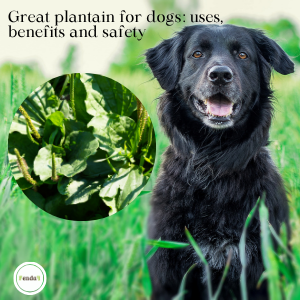
Great plantain for dogs: what is actually worth knowing about this medicinal herb?
Reading time: about 9 min
Great plantain probably grows in almost every garden and, honestly, most of the time we see it as an annoying weed. As a child, I had a completely different relationship with plantain: if I scraped my knee or something was bleeding, a plantain leaf went on top. At some point I completely forgot the practical side of this plant and started seeing it simply as something to pull out of the lawn. As a garden owner, it really can be quite a nuisance.
A few years ago I came across information about using great plantain for dogs, and that brought this familiar old plant back into view. The more I looked into it, the more interesting it became. At the same time, one important problem emerged: the English word “plantain” can refer to completely different plants in different sources. If they are all blended together, great plantain very quickly gets credited with properties that actually belong to another species.
So the point of this article is not to declare great plantain a miracle remedy. Instead, we will look at what is actually known about Plantago major, where traditional and integrative use makes sense, and where it is worth applying the brakes.
Great plantain is not the same as cooking plantain or psyllium
First, let us get the names straight. Great plantain is Plantago major. Ribwort plantain is Plantago lanceolata. Ispaghula used as psyllium comes mainly from Plantago ovata. They all belong to the same genus, but that does not mean a study on one species can automatically be transferred to another.
The English word plantain creates another trap as well: the same word is also used for cooking plantain, the starchier relative of the banana. The food and the medicinal herb are completely different things. When looking for information in English, it is therefore always worth checking the Latin name.
What does Plantago major contain and what has been studied?
The leaves and other parts of great plantain contain a variety of bioactive compounds, including iridoid glycosides such as aucubin, flavonoids, phenolic compounds, polysaccharides and other plant constituents. This is why the Plantago genus has been studied in the context of inflammation, oxidative stress, microbes and wound healing.
There is an important distinction to make here: “a biological effect can be seen in the laboratory” is not the same as “this treats a specific disease in a dog”. There are interesting laboratory and animal data on Plantago major, and a 2026 review describes the possible role of the Plantago genus in different stages of wound healing. At the same time, a 2021 systematic review of Plantago major wound-healing studies found that the available preclinical studies were of uneven quality and carried a high risk of bias. In other words, the potential is real, but clinical certainty is much more limited.
Anti-inflammatory and antimicrobial potential
In integrative herbal medicine, great plantain is valued, among other things, as a soothing, astringent herb that may influence inflammatory responses. There is a genuine pharmacological rationale behind this: different Plantago studies have described effects on inflammatory pathways, antioxidant mechanisms and antimicrobial activity.
What I would not do as a dog owner is jump from that to the conclusion that “plantain treats infection”. Antibacterial activity seen in a laboratory does not replace the diagnosis and treatment of an infected wound, urinary tract infection or other bacterial disease.
Skin, small superficial injuries and traditional use
Traditional use of great plantain is perhaps most intuitive when it comes to skin. Fresh bruised leaves have been used in folk medicine for small scratches, abrasions, insect bites and irritated skin. My own childhood memory of putting a plantain leaf on a wound belongs here too.
I still see this as a perfectly reasonable integrative home measure when we are talking about a small superficial skin irritation and the plant is clean and correctly identified. But the boundary is very clear: a deep wound, puncture wound, heavy bleeding, burn, pus, marked swelling or rapidly worsening inflammation is not a “put a leaf on it and wait and see” situation.
The same applies to a bee sting or another insect sting. A cool compress or a clean bruised plantain leaf can be one supportive option for a small local reaction. But if a dog develops swelling of the face or throat, difficulty breathing, weakness or a rapidly worsening reaction, urgent veterinary care is needed.
For wounds, it is also worth reading FendaF’s separate article on why an antiseptic may not always be the best automatic choice for every wound.
Digestion: where does great plantain end and psyllium begin?
The biggest source of confusion between the different plants is the seed section. Psyllium really does have a very interesting role in digestive support, and there are veterinary studies in dogs as well. Soluble fibre can help modify stool consistency and is used in certain cases of both diarrhoea and constipation.
But here we are mainly talking about psyllium, or the seed husk of Plantago ovata, not automatically the seed stalks of Plantago major collected from the garden. That is why I would not dose great plantain seeds as “one teaspoon per x kilograms” simply because an English-language source uses the word plantain.
If the aim is to use soluble fibre, I prefer standardized psyllium where we know what we are giving. If a dog has diarrhoea, the cause, duration, hydration status and warning signs still need to be considered at the same time.
Urinary tract: used in herbal medicine, but diagnosis comes first
Great plantain and other Plantago species have also been used in herbal medicine to support the urinary tract. The rationale behind traditional use includes soothing mucous membranes and supporting urine output, and laboratory studies have identified mechanisms related to inflammation.
With a dog’s bladder problems, however, I would never give the herb the role of a diagnosis. Frequent urination, blood in the urine or straining can mean a bacterial infection, crystals, stones or something else, and no medicinal herb can distinguish those causes from one another. If plantain is part of an integrative plan, it should come after the question “what problem are we actually dealing with?”, not instead of it.
Cough and throat irritation: this is where Plantago lanceolata enters the picture
One more species distinction. In the European Medicines Agency herbal monograph, the plant associated with traditional use for cough and pharyngeal irritation is ribwort plantain, Plantago lanceolata, not Plantago major. The monograph concerns herbal preparations used in humans and is not evidence that the herb treats kennel cough in dogs.
In integrative veterinary medicine, herbs that soothe mucous membranes may be used to support the respiratory tract, but when a dog is coughing I first want to know why. Kennel cough is one possibility, but heart, lung or other problems can also be behind a cough. FendaF’s kennel cough article explains separately when home support may be reasonable and when veterinary care is needed.
When plantain is not enough and a veterinarian is needed
Plantain can be an interesting and practical medicinal herb, but it should never become the reason important diagnostics are delayed. A veterinary assessment is definitely needed if a dog has a deep or heavily contaminated wound, uncontrolled bleeding, a significant burn, severe pain, pus or rapidly increasing swelling.
I also would not use plantain as a home solution if a dog has swallowed a foreign object. In that situation, intestinal obstruction has to be considered. It can be life-threatening and requires veterinary assessment.
A persistent or severe cough, difficulty breathing, inability to urinate, blood in the urine together with poor general condition, or a gastrointestinal problem that lasts for a long time also needs the underlying cause to be investigated, not only herbal support.
Harvesting and practical use
If you want to use great plantain, start with the most important point: make sure you can identify the plant correctly. Harvest it from a place where pesticides or other chemicals have not been used, and avoid busy roadsides and areas where dogs regularly urinate. Rinse the leaves thoroughly before use.
For topical use, a clean fresh leaf can be bruised or crushed to release the plant juices and used briefly on a small superficial skin irritation or insect bite. Another option is to prepare an infusion from the leaves, allow it to cool and use it as a compress for a small superficial skin irritation.
With internal use, I am more cautious based on the information available today than I used to be. I do not give Plantago major a universal “teaspoon per body weight” dose because there is not a sufficiently good species-specific dosing basis in dogs. If the goal is to support a specific condition, the dose and preparation are best discussed with a veterinarian familiar with herbal medicine.
For drying, harvest healthy clean leaves, dry them in a well-ventilated place and store them somewhere dry and protected from light. If you do not want to harvest them yourself, pharmacies and herbal shops sell plantain preparations, but always check the Latin species name because “plantain” does not automatically mean Plantago major.
In summary
What I still like about great plantain is the idea that a completely ordinary “weed” growing in the corner of the garden can be far more interesting than it first appears. Plantago major contains compounds whose effects related to inflammation, microbes and wound healing are genuinely being studied, and it has a long history of traditional use.
At the same time, medicinal plants make it very easy for a good story to run ahead of the evidence. Great plantain is not psyllium, Plantago major is not Plantago lanceolata, and a laboratory result is not the same as a treatment proven in dogs. But the absence of a proven treatment effect does not mean the information is “rubbish”.
For me, that does not reduce the value of plantain. Quite the opposite. When we know what we can realistically expect from a plant, where traditional use ends, where there is scientifically interesting potential, and where a condition requiring veterinary diagnostics begins, we can use it much more wisely. An integrative approach does not have to mean “a natural remedy instead of treatment”. It can mean using herbal support where it makes sense, and conventional diagnostics and treatment where they are needed.
Verified sources:
- European Medicines Agency (EMA). Plantaginis lanceolatae folium – European Union herbal monograph, Revision 1. Viimati uuendatud 20.10.2025. EMA
- European Medicines Agency (EMA). Plantaginis ovatae seminis tegumentum – European Union herbal monograph. Plantago ovata / ispaghula husk. EMA
- Cardoso FCI, Breder JC, Apolinário PP jt. The Effect of Plantago major on Wound Healing in Preclinical Studies: A Systematic Review. Wound Management & Prevention, 2021;67(1):27–34. PubMed
- Hertiani T, Khafi M, Amalia L, Irawan MB. Plantago mechanisms for enhanced wound healing: A review on bioactive phytoconstituents. Chinese Herbal Medicines, 2026;18(3):662–683. ScienceDirect
- Alves JC, Santos A, Jorge P, Pitães A. The use of soluble fibre for the management of chronic idiopathic large-bowel diarrhoea in police working dogs. BMC Veterinary Research, 2021;17:100. BMC Veterinary Research
- Rudinsky AJ, Parker VJ, Winston J jt. Randomized controlled trial demonstrates nutritional management is superior to metronidazole for treatment of acute colitis in dogs. Journal of the American Veterinary Medical Association, 2022;260(S3):S23–S32. PubMed
- Merck Veterinary Manual. Gastrointestinal Obstruction in Small Animals. Full review August 2025. Merck Veterinary Manual
🐾 FendaF believes in informed choices
The purpose of the FendaF blog is not to tell you what you must do. Our aim is to share knowledge, introduce different evidence-based and integrative perspectives, and help you make more informed decisions for your pet.
Every animal is unique, and no article can replace a consultation, diagnosis or treatment provided by a veterinarian. If your pet has a health concern or you need individual advice, always contact a veterinarian.









Leave a Reply