


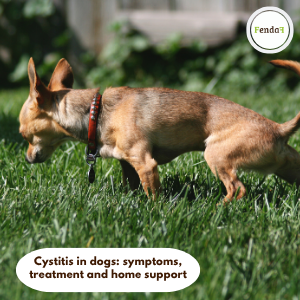
Cystitis in dogs: symptoms, diagnosis, treatment and home support
Reading time: about 11 min
When a dog suddenly asks to go outside every few minutes, squats repeatedly, passes only a few drops of urine or has blood in the urine, it is very easy to think “cystitis” straight away. Sometimes a bacterial bladder infection really is the cause. But not always. Urinary crystals or bladder stones, problems affecting the ureter or urethra, prostate disease, an anatomical abnormality, a tumour or another form of urinary tract inflammation can cause very similar signs.
For me, the most important point in this topic is simple: home support can be very valuable, but first we need to understand as well as possible what we are actually supporting. A bacterial infection should not be guessed at and treated with natural remedies, but at the same time, painful urination does not automatically mean that antibiotics are needed.
Cystitis, urinary tract infection and bacteriuria are not quite the same thing
Cystitis means inflammation of the bladder. When bacteria are the cause, we are talking about bacterial cystitis, or a bacterial infection of the lower urinary tract. Bacterial urinary tract infections are considerably more common in dogs than, for example, in young cats, and Escherichia coli is the organism most commonly found on culture.
Bacteria in the urine do not always mean that a dog has cystitis that needs treatment. Modern veterinary medicine also recognises subclinical bacteriuria, where bacteria grow on a urine culture but the dog has no corresponding clinical signs. These cases are not automatically treated with antibiotics, because the goal is not to sterilise every urine sample. The goal is to treat the sick animal and use antibiotics where they genuinely provide benefit.
Which signs can point to a urinary tract problem?
The most typical signs include needing to urinate frequently, passing smaller amounts of urine than usual, straining or discomfort during urination, blood in the urine, suddenly urinating indoors and licking the genital area more often. Some dogs drink more, some become restless, and some are simply “not quite themselves”.
One sign requires particularly urgent action: if the dog cannot urinate at all, or repeated straining produces only a few drops, there may be a urinary obstruction. This is an emergency, especially in a male dog. Prompt veterinary attention is also needed if urinary signs are accompanied by marked lethargy, vomiting, loss of appetite, fever or abdominal pain, because the infection may have involved the upper urinary tract and kidneys.
Why is a home urine dipstick not enough?
A home dipstick may provide interesting additional information in some situations, but it cannot confirm or rule out a bacterial infection. Urine pH changes with diet, the timing of sample collection, bacteria, urine storage and other factors. The leukocyte field on urine dipsticks, widely used in human medicine, is also unreliable in small animals.
A urinalysis performed at a clinic looks at the bigger picture: urine concentration, sediment, blood, protein, glucose, crystals and other findings. Even a good urinalysis cannot always rule out a UTI. If we need to know whether bacteria are truly growing in the urine and which antibiotics they are susceptible to, the key test is a urine culture with antimicrobial susceptibility testing.
When is a urine culture especially important?
Culture is particularly valuable with recurrent problems, previous antibiotic treatment, an atypical course, failure to respond to treatment or a potentially more complicated infection. Whenever possible, a sterile urine sample is preferred for culture, often obtained by cystocentesis, where a fine needle is used to collect urine directly from the bladder. This reduces the chance of bacteria from the skin or genital tract contaminating the sample.
When the problem keeps coming back, the question should not only be “which antibiotic this time?” but also “why is this happening again?”. Recurrent infections may be associated with bladder stones, incomplete bladder emptying, anatomical abnormalities, endocrine diseases such as diabetes or Cushing’s disease, immunosuppressive medication, prostate disease or other urinary tract problems.
Antibiotics are sometimes necessary, but more is not always better
If a dog has symptomatic bacterial cystitis, antibiotic treatment is often necessary. The major change in recent years has been a move toward smarter use of antibiotics. Current guidelines do not automatically call for a long course of treatment for every uncomplicated bladder infection, and shorter courses are used for many sporadic cases. The specific drug and duration should still be chosen by the veterinarian based on the dog’s signs, history and, when indicated, culture results.
This matters because of antimicrobial resistance as well. The susceptibility of bacteria isolated from canine urinary tracts varies between antibiotics, and with a recurrent infection, assuming that “the same drug as last time” will work can be a poor guess. At the same time, it does not make sense to switch antibiotics blindly simply because a symptom has not disappeared within a day. If treatment is not working as expected, that is a reason to investigate again.
Urine pH: is more acidic always better?
No. Certain urease-producing bacteria can make the urine more alkaline and promote the formation of struvite stones. But “alkaline urine = infection” and “acidic urine = healthy” are not valid rules. Dogs can also develop calcium oxalate, urate and cystine stones, and the treatment strategy is different for each. Overly aggressive urinary acidification may be a poor choice for some dogs.
Methionine and apple cider vinegar may make the urine more acidic, but we do not give a universal recommendation here for how much to add for a bladder problem. Methionine has a legitimate place in veterinary medicine as a urinary acidifier, but it is a diagnosis-based tool, not a general “cystitis supplement”.
The same applies to apple cider vinegar: if there is a specific reason to use it and the dog tolerates it, it may have a place in the diet, but it does not treat a bacterial infection. These can be useful additions when we know exactly what the problem is, but they should not be added casually to every urinary problem.
Water, moisture and frequent opportunities to urinate
One area where conventional medicine and an integrative approach meet quite nicely is adequate hydration. More fluid means a larger urine volume and more frequent emptying of the bladder. For some dogs, this can be supported with wet food, water added to meals or another way of increasing dietary moisture. If a dog suddenly starts drinking much more than before, however, that should not simply be celebrated as “good hydration”, because increased thirst can itself be an important symptom.
Dogs should not be expected to hold their urine for excessively long periods either. A dog with recurrent urinary tract problems in particular should have frequent enough opportunities to go outside. This does not treat an infection, but it is a simple practical way to support normal bladder emptying.
What about diet?
I still believe that diet plays a huge role in a dog’s overall health. What is too broad, however, is the claim that a grain-based or carbohydrate-rich diet is “often the cause of chronic UTI”. There simply is not strong enough evidence for such a generalisation.
Diet becomes very important when urinary crystals or stones enter the picture. The strategy is not the same for struvite, calcium oxalate, urate and cystine. In dogs, for example, struvite stones are often associated with infection by urease-producing bacteria, and treatment may involve both treating the infection and using a specialised dissolution diet. Calcium oxalate stones, in contrast, cannot be dissolved with diet.
In other words, there is no single universal “bladder diet”. Food choices depend on the actual problem we are dealing with.
Cranberry: interesting, but not a substitute for antibiotics
Cranberry is widely used to support urinary tract health, and there is a genuine biological rationale behind it: certain cranberry compounds may reduce the ability of E. coli to adhere to the urinary epithelium. There are also some studies in dogs, but the results are not as straightforward as they are sometimes presented.
A very small 2016 study included only 12 dogs with recurrent UTI. During six months of follow-up, no UTI developed in either the antibiotic group or the cranberry extract group, and laboratory testing showed reduced E. coli adhesion to cells. That is an interesting finding, but six dogs are not enough to claim that cranberry is “as effective” as an antibiotic. A larger randomised study published the following year, involving 94 dogs, did not find a statistically significant reduction in bacteriuria with cranberry extract.
My conclusion is therefore fairly simple: cranberry may be a reasonable supportive option for some dogs, particularly with recurrent E. coli problems, but it does not replace diagnosis or antibiotics when they are needed.
D-mannose and herbs
The logic behind D-mannose is similar to cranberry: certain fimbriae of E. coli bind to mannose, so in theory it may reduce bacterial attachment to the urinary tract wall. In integrative veterinary medicine, D-mannose is used as supportive care for recurrent E. coli infections. In dogs, however, the clinical evidence is much thinner than the mechanism itself.
The same applies to medicinal herbs. Marshmallow, couch grass, parsley and horsetail are used in herbal medicine for urinary support for different purposes, for example to soothe mucous membranes or support urine flow. They may form part of an integrative plan, but they should not be treated as stand-alone therapy for a bacterial UTI, and there is no single dose that is appropriate for every dog.
First we need to know whether the dog has an infection, a stone, crystals, a kidney problem or something else.
What can an owner realistically do at home?
When a dog develops urinary signs, the most practical first step is to contact the veterinarian and ask how the urine sample should best be collected. Do not start an old antibiotic left in the medicine cabinet “just in case” before the sample is taken, because it may interfere with culture results, and using the wrong drug or the wrong duration does nobody any favours from the perspective of antimicrobial resistance.
At home, you can monitor how often the dog urinates, whether a normal amount of urine is produced, whether there is blood or pain, how much the dog is drinking and whether their general condition changes. Offer water and enough opportunities to go outside. If the dog cannot urinate, becomes lethargic, vomits or is clearly unwell, this is not the time for home experimentation.
For me, the integrative question is: “why does it keep coming back?”
What I like about integrative veterinary medicine is that the problem does not end with the question “which bacterium is it?”. If a dog develops cystitis once, it may genuinely be an isolated event. If it keeps returning, I want to know why the urinary tract’s protective mechanisms are not working as well as they could.
Then it makes sense to look at the whole picture: does the dog empty the bladder properly, are there stones or crystals, does the dog drink enough, is there an endocrine disease, is the dog receiving immunosuppressive medication, what are the dog’s body condition, diet and overall inflammatory load, and has the gut microbiome taken a hit from repeated courses of antibiotics? None of these questions provides one magical answer, but they can help us avoid treating the tenth infection exactly the same way as the first.
One of the principles I value most in integrative veterinary medicine is looking beyond the symptom and searching for the reason the problem developed in the first place or keeps recurring. For me, that is the most valuable part of the integrative approach alongside conventional medicine: not choosing one over the other, but using diagnostics and treatment while also looking at the dog as a whole.
In summary
When a dog shows signs of cystitis, the first goal is to distinguish a bacterial infection from other urinary tract problems. Urinalysis is important, but in recurrent or more complicated cases, urine culture and antimicrobial susceptibility testing often provide the information that truly helps to get treatment on the right track.
If a bacterial infection is present, cranberry, D-mannose, apple cider vinegar and medicinal herbs are not automatic substitutes for antibiotics. But integrative support does not need to be thrown out either. Its sensible place is alongside appropriate treatment: review hydration, diet, bladder emptying and possible underlying causes, and tailor every recommendation to that individual dog’s diagnosis.
And if the problem keeps coming back, I would ask “why?” at least as loudly as I ask for the name of the next antibiotic.
Sources:
- Weese JS, Blondeau J, Boothe D jt. International Society for Companion Animal Infectious Diseases (ISCAID) guidelines for the diagnosis and management of bacterial urinary tract infections in dogs and cats. The Veterinary Journal, 2019. PubMed
- Merck Veterinary Manual. Bacterial Cystitis in Small Animals. Merck Veterinary Manual
- Merck Veterinary Manual. Urinalysis. Merck Veterinary Manual
- Merck Veterinary Manual. The Urinary System in Animals. Merck Veterinary Manual
- Merck Veterinary Manual. Controlling Urine pH in Animals. Merck Veterinary Manual
- Merck Veterinary Manual. Urolithiasis in Dogs. Merck Veterinary Manual
- Chou HI, Chen KS, Wang HC, Lee WM. Effects of cranberry extract on prevention of urinary tract infection in dogs and on adhesion of Escherichia coli to Madin-Darby canine kidney cells. American Journal of Veterinary Research, 2016. PubMed
- Olby NJ jt. Effect of Cranberry Extract on the Frequency of Bacteriuria in Dogs with Acute Thoracolumbar Disk Herniation: A Randomized Controlled Clinical Trial. Journal of Veterinary Internal Medicine, 2017. Oxford Academic
- DeLomba E. D-mannose Use for Bacterial Urinary Tract Infections in Dogs and Cats. Journal of the American Holistic Veterinary Medical Association, 2022. AHVMA
🐾 FendaF believes in informed choices
The purpose of the FendaF blog is not to tell you what you must do. Our aim is to share knowledge, introduce different evidence-based and integrative perspectives, and help you make more informed decisions for your pet.
Every animal is unique, and no article can replace a consultation, diagnosis or treatment provided by a veterinarian. If your pet has a health concern or you need individual advice, always contact a veterinarian.









Leave a Reply