


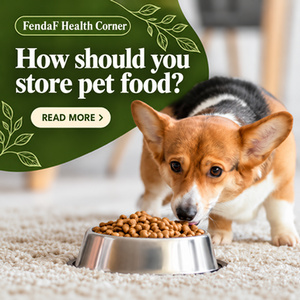
Storing pet food: how to keep it fresh and safe
Reading time: about 6 min
Some time ago I watched a video by Dr Karen Becker and Rodney Habib about storing pet food at home. A few of their suggestions made me take a hard look at my own kitchen cupboard and food container. We've talked about storage at FendaF before, but the more I look into it, the clearer one point becomes: even excellent food can lose quality if it is stored poorly.
The issue isn't just whether a bag has been opened. Air, heat, humidity, packaging construction, the type of fats, cleanliness and how quickly the food is used after opening all matter.
Why can dry food change after opening the bag?
Many dry foods contain fats that provide energy and improve palatability. Some are added during production or sprayed onto the surface of kibble afterwards. When exposed to oxygen, those fats can oxidise and gradually become rancid. Heat and light may speed up the process, while suitable packaging, antioxidants and a cool, dry storage place help protect quality.
That doesn't mean every bag suddenly becomes poisonous at the end of week six. Science doesn't support such a universal deadline. Fat type, recipe, antioxidants and storage environment make a substantial difference.
In one 2025 study, researchers followed opened dry pet food for up to 120 days at 25 and 35 °C and observed relatively small quality changes in the particular food studied. In another controlled experiment published in 2026, fat oxidation varied considerably with the source of fat, the kibble matrix and the antioxidants used. One product's results cannot establish that every dry food is safe or unsafe under the same conditions.
My practical conclusion is simple: don't buy more opened food than your dog can use within a sensible time, and don't leave the bag in a hot garage or damp shed. If a large bag lasts your dog several months, ask the manufacturer how long that specific product should be used after opening.
Don’t keep a bag of dry food directly on underfloor heating or in direct sunlight. A cold but damp terrace is not a good storage spot either, particularly when temperatures fluctuate. Choose a dry, shaded location protected from insects and rodents.
Dry food storage: original bag or container?
Here, integrative veterinary approaches and official food-safety guidance have much in common. The FDA recommends keeping dry pet food in its original bag, properly sealed, and placing the entire bag in a clean lidded container if additional protection is needed. The food is better protected, and the manufacturer's details, lot number and best-before date stay available. Those details are essential if a quality problem arises.
The ‘best before’ date on the package doesn’t mean that an opened bag will keep for just as long. It assumes the manufacturer’s storage conditions, generally for an unopened package. Once opened, follow the manufacturer’s recommended use-after-opening period.
Pouring dry food directly into a container isn't automatically wrong. But the container should be suitable for food contact, clean, completely dry and well sealed. Greasy residue and crumbs from the previous batch shouldn't mix with the new food. The FDA recommends washing and thoroughly drying containers between bags. Don't top up yesterday's leftovers with a fresh bag.
It's also important not to assume that a number on the bottom of a plastic container, by itself, proves the container is safe for food. The recycling or resin identification code indicates a type of plastic, not every possible condition of use, temperature or repeated use. Food-contact suitability should be established from the product label and manufacturer information. A random rubbish bin or bin liner isn't automatically designed for food storage, and even food-grade plastic containers vary in construction and properties.
Is glass better than plastic?
I like glass because it's easy to clean and doesn't absorb fat. But a glass jar isn't magic if it sits in a sunny, warm window or moisture gets inside. A good plastic or metal container intended for food contact can work too, provided it is used correctly. Cleanliness, dryness, a tight lid and suitable materials are what matter most.
After watching Becker and Habib's video, I looked again at our own food container. We kept a small amount of Ossu's food in the kitchen cupboard, and the bottom of the container had a number 5, indicating polypropylene. Knowing it was intended for food storage was reassuring, but today I'd add one caution: the number alone isn't enough; the container's intended use matters too.
Can a large bag of dry food be kept in the freezer?
Cold and darkness can slow down fat oxidation. So it's understandable that some integrative veterinarians recommend freezing large quantities of dry food in smaller portions. Yet whether this is suitable depends on the particular product and packaging. Repeatedly taking food out and putting it back can cause condensation, which is not a friend of dry kibble.
If you want to store food for longer, ask the manufacturer whether freezing is appropriate for that recipe and packaging. If so, divide it at once into dry, tightly sealed portions and avoid repeated thawing. Sometimes the simplest option is just buying a smaller bag.
I've stored WINNER PLUS foods and cold-pressed foods from our range in the freezer myself, and I'm comfortable recommending this for larger quantities too. I do, however, recommend dividing the food into smaller amounts, so you can take out only what you need rather than repeatedly moving the whole supply in and out of the freezer.
Wet food needs different handling
Store unopened tins and pouches as the manufacturer instructs. Opened wet food is different: it should be refrigerated promptly or discarded. The FDA recommends keeping opened wet food covered in the refrigerator at no more than 4.4 °C. How long a particular product remains suitable after opening should come from the manufacturer's guidance; the same three-day rule cannot be applied automatically to every recipe.
I used to transfer opened wet food from a metal tin into a glass container. It was convenient and made storage easier to manage. A clean glass container or food-grade stainless-steel container with a lid works if the food goes into the fridge straight away. If you know you can't use the leftovers within the time recommended by the manufacturer, you may be able to freeze an appropriate portion. Again, follow the product's instructions.
When should food be thrown away?
If food has an unusual or clearly rancid smell, moisture damage, mould, pests, damaged packaging or other signs of spoilage, don't try to 'fix' it by mixing or heating. At the same time, a dog suddenly refusing its food doesn't automatically prove rancidity. Changes in appetite can also have dental, digestive and other health causes.
Store natural treats according to the manufacturer’s instructions, in a cool, dry place with the package closed. For dried meat treats in particular, check for changes in smell, appearance and moisture after opening; a dry appearance alone doesn’t guarantee that a treat has kept well.
FendaF’s practical food-storage checklist
- Keep dry food cool, dry and away from light, preferably in the original bag inside a clean sealed container.
- Keep the batch number and best-before information even if you transfer food to a container.
- Wash and completely dry a container between bags; never pour new food on top of leftovers.
- Refrigerate opened wet food promptly, covered, and follow the manufacturer’s recommended time after opening.
- Discard food with a rancid smell, moisture damage, mould or pests. Ask the manufacturer if a large bag stays open for a long time.
Storage isn't a trivial detail. I've changed some of my habits after researching these questions, and I encourage others to look at theirs too. The best food isn't the one whose ingredients were good only on the day it was purchased, but the one that reaches the dog's bowl in the quality its manufacturer intended.
Sources
FDA. Proper Storage of Pet Food & Treats.
American Veterinary Medical Association. Safe handling of pet food and pet treats.
🐾 FendaF believes in informed choices
The purpose of the FendaF blog is not to tell you what you must do. Our aim is to share knowledge, introduce different evidence-based and integrative perspectives, and help you make more informed decisions for your pet.
Every animal is unique, and no article can replace a consultation, diagnosis or treatment provided by a veterinarian. If your pet has a health concern or you need individual advice, always contact a veterinarian.





Leave a Reply