


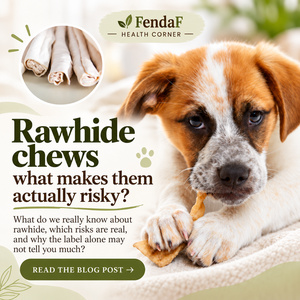
Rawhide dog chews: what are the real risks?
Reading time: about 7 min
Rawhide chew sticks and pressed bones were once my favorites. My dog loved them and would sometimes chew for hours. It seemed like the perfect solution: activity for my dog and a little peace for me. Today, I do not recommend rawhide chew products. Not because all such products have been proven to be toxic, but because as ordinary buyers, we are often unable to determine which products are transparently and controlled and which ones we should simply trust the manufacturer. In addition, even with good production, the risk of a dog swallowing a large, softened piece does not disappear.
What is a rawhide chew?
In English, the term rawhide is used. It is usually the collagen-rich part of an animal’s skin that is processed, dried and shaped into, for example, a stick, roll or pressed bone. It is not the same product as simply a dried piece of meat or a chewy tendon. The raw material and production process can vary from manufacturer to manufacturer. Therefore, it is not reasonable to take one manufacturer’s processing scheme and declare that every rawhide on the store shelf is made exactly the same way.
However, it is the transparency that raises questions for me. Where does the leather come from? What animal is it from? Where is the product processed, what detergents, preservatives or dyes are used, and are the finished batches checked for residues and microbiological quality? The packaging doesn’t always tell you all the answers. The word “natural” says something about the origin of the raw material, but it doesn’t provide a safety certificate on its own.
Are concerns about chemicals justified?
In June 2017, United Pet Group recalled several brands of rawhide chews in the U.S. The FDA said the company’s Mexican and Colombian plants and a Brazilian supplier used a mixture of quaternary ammonium compounds as a manufacturing aid that was not approved for rawhide production in the U.S. The recall included American Beefhide, Digest-eeze, and Healthy Hide lines, and was later expanded to include private label products from retail chains. Consumers complained of an off-odor; vomiting and diarrhea were also reported. This is a documented example of a manufacturing control issue, not proof that all modern rawhide treats contain the same chemical.
And here is my main concern. As a consumer, I cannot check by looking at the packaging what substances were used in the production process, whether their residues were measured, what the results were, and whether the tests applied to the particular batch I am buying. A manufacturer’s statement is useful, but it is not the same as an independent laboratory result. Also, a nice appearance, a bright color, a high price, or the word “natural” do not prove anything about ultimate safety. We cannot lump every product into one category, but we also do not have a reliable and easy way to separate all safe and unsafe products on the store shelf. This ignorance is one reason why I do not recommend rawhide.
My questions are not limited to whether there are any chemical residues in one product or another. Some manufacturing processes use hydrogen peroxide or bleach to clean the leather; white coating pigments and binders have also been described for certain products. This does not mean that all manufacturers use them or that every processed chew is toxic. However, I do not want to choose a product for my dogs that raises more questions about its manufacturing than I get answers about.
The snow-white rawhide bone is particularly questionable to me. Of course, a light layer of skin is possible, so you can’t say for sure that the product has been bleached based on the color alone. However, bleaching with hydrogen peroxide is a documented production method, and some chews have also been described as having a white coating. If a manufacturer claims that their leather is not bleached, but uses hydrogen peroxide for cleaning, this does not necessarily mean that there are harmful residues in the finished product. However, this does not change my decision: I do not consider such a treatment necessary for my dog’s chew.
The issue of titanium dioxide (TiO₂) is worth discussing separately. This white pigment has also been used in some dog chews; it is not the same as hydrogen peroxide used for bleaching hides. In 2021, EFSA found that the safety of titanium dioxide as a feed additive could not be confirmed because the potential genotoxicity, or risk of DNA damage, could not be excluded. European Union Regulation (EU) 2021/2090 refused to authorise titanium dioxide as a feed additive and provided for the withdrawal of feed containing it from the market in 2022. This is a serious precautionary decision. However, this does not indicate that all white rawhide treats contain titanium dioxide or that every such treat causes DNA damage in dogs. The issue is the composition and controllability of the specific product.
It is also reasonable to ask how a pressed or reshaped chew product holds together. The production describes both the recycling of leather scraps and the possible use of glue or other bonding techniques. This does not mean that all rolled or knotted bones are glued together. However, before buying such a product, I would like to know what it is actually made of.
The price also sometimes makes me wonder what makes a very cheap product so cheap. Raw material selection, processing, traceability and quality control cost money. A cheap price does not prove poor quality and an expensive price does not guarantee good quality, but I would not judge the safety of a chew product based on price and pretty packaging alone. Another thing: some warning articles list formaldehyde, heavy metals, bleaches, glues and dyes in relation to rawhide. These are reasonable questions for the manufacturer, but it cannot be concluded from such a list that all rawhide treats contain these substances or that their content exceeds the safety level. Without analysis of the specific product, concentration of the substance and exposure data, this claim is not proven. Also, one old recall does not automatically make all current batches dangerous.
How well does rawhide digest and why does the size of the piece matter?
The digestibility of rawhide is not zero, but it is not the same for all products. In a 2020 laboratory study, the dry matter loss of rawhide and rawhide-like treats tested ranged from 35.1% to 95.7% after a stomach and small intestine digestion model. This is a large difference and shows why the statement “rawhide is not digestible at all” is misleading. However, a laboratory digestibility percentage does not indicate whether a particular piece will pass safely through a dog’s digestive tract. A large, chewy, slippery piece that is swallowed can get stuck in the esophagus or cause a blockage, even if the material partially breaks down over time. The product, the size of the piece, and the way the dog chews will be decisive.
For me, a clear sign of danger would be a dog that doesn’t chew but tries to swallow a large piece whole. The same applies if the product has become so small that it can be swallowed in one bite. Vomiting, repeated retching, excessive drooling, loss of appetite, abdominal pain or difficulty swallowing after chewing are reasons to contact a veterinarian immediately, rather than waiting for the piece to move on its own.
I remember well how these initially hard rawhide bones, with prolonged chewing, became soaked in saliva and became chewy, slippery, and almost sticky. This describes the texture, not evidence that glue was used in a particular bone. However, a dog can tear off a large piece of the softened material and swallow it. Just because a piece is soft does not mean that it will immediately disintegrate in the digestive tract.
This is what makes the risk so insidious to me. A dog can chew on a treat like this repeatedly and everything will be fine, until one day a large piece gets stuck in the esophagus or causes a blockage in the digestive tract. This situation may require urgent veterinary care, sometimes surgery. Previous use without problems is no guarantee for the next time.
Two more questions: bacteria and energy content
Rawhide is an animal-derived material and production, transport and storage may introduce a risk of microbiological contamination. This does not prove that every product contains Salmonella or E. coli, but it is
another reason to ask the manufacturer about batch-by-batch quality control. Also, long chewing times are not calorie-free activities. A study published in 2018 analyzed 41 dog treats, including five rawhide products. Significant variability was found between nutrient, energy, and composition labeling, and the authors recommended providing more information on the packaging.
In the same study, rawhide treats were particularly rich in hydroxyproline, which is derived from collagen. There is some debate in the scientific literature about whether oxalate from hydroxyproline may be important in animals predisposed to calcium oxalate stones. This does not mean that rawhide itself causes bladder stones. However, it is worth discussing the suitability of chews with your veterinarian for dogs at risk of urinary stones.
But it’s good for your teeth, right?
Some rawhide chews can actually help with mechanical teeth cleaning. There are also certain rawhide chews that are approved by the Veterinary Oral Health Council (VOHC) for the reduction of plaque or tartar. This is not an endorsement of the entire category. Also, the potential benefits of dental cleaning do not negate the risk of choking or blockage. I would not replace brushing with a single chew bone, rawhide or not. In addition, with particularly hard chews, there is the added risk of tooth fracture. Antlers, very hard bones and some rigid chew toys can be a much greater mechanical stress on a dog’s teeth than they may seem at first glance.
Why don’t some integrative veterinarians recommend rawhide?
This is not just my opinion. Integrative veterinarian Dr. Karen Becker has addressed the risks of rawhide and advised against making it a primary chew choice for dogs. Her 2017 article in Bark & Whiskers specifically highlights the case of chemical contamination, the risk of choking and intestinal obstruction, and the need to tailor the chew to the individual dog. Dana Scott, author of Dogs Naturally, also recommends avoiding rawhide, but her position is editorial, not a consensus of veterinary professionals. I am not suggesting that all integrative or all conventional veterinarians make the same recommendation. However, their warnings are for a valid reason: the uncertainty of the manufacturing process and the mechanical risks may outweigh the potential benefits of chewing.
In my opinion, this is a matter of making an informed choice, not waiting for statistical proof that every specific rawhide bone is dangerous. If I can’t verify the origin, production, and batch analysis, and there are other suitable chews, why should I decide this uncertainty for my dog? This is a FendaF recommendation based on the precautionary principle, not a claim that the safety of an entire product category has been disproven by a single study.
What do I offer instead?
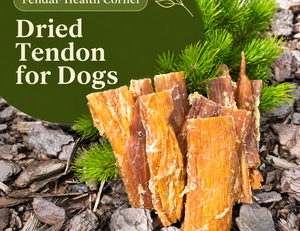
I like various dried animal-based chews, such as bovine trachea and suitable tendons. Bull penises can also be a nice chew for some dogs. I wouldn’t call them completely risk-free: swallowing too large a piece, choking, gastrointestinal irritation, and manufacturing hygiene remain issues with them as well. Some dogs need a flexible chew toy that is sized to fit their jaw and chewing style.
I have also used raw meaty bones with my dogs, but I would not recommend them as a universal safe substitute. Very hard bones can break teeth, bone fragments can cause intestinal problems, and raw bones carry bacterial risks for both the animal and humans. With multiple dogs in a home, there is added competition, which is why I give valuable chews separately and under supervision.
This same selectivity applies to our human food. My dogs eat meat and offal specially bought for them, but they don’t get much from my own table. Pate bread is exceptionally interesting: the pate is licked off the top and the bread is left behind. Potato chips and other fast food don’t go down well with them. This is simply our family’s experience, not a rule by which to judge the appetite or health of any dog.
> FendaF practical check. Before buying a chew product, I ask: Do I know its origin and composition? Is it the right size and hardness for the dog’s mouth? Does my dog chew or swallow? Can I monitor the chewing and remove a piece that has become small? Can I safely separate the chews for multiple dogs? If any of the answers are no, I choose another solution.
In conclusion
FendaF does not recommend rawhide chews. I make this position strong and clear, but not by claiming that all rawhide treats are toxic. We know that manufacturing processes can vary; we have documented examples of unacceptable chemical processing; studies show a high variability in digestibility and that swallowed pieces can cause serious problems. What we often don’t know is which specific products and batches have been transparently tested and which manufacturers’ promises are simply to be trusted. Neither does the white color, the beautiful packaging nor the high price give me this certainty. For me, the potential benefits do not outweigh this uncertainty and the risks associated with chewing, especially when there are other suitable options. The alternatives are not risk-free either: the choice must be based on the size of the dog, the condition of the teeth and the way it chews, and chewing requires supervision. Just because nothing has happened so far does not guarantee safety the next time.
Sources
- FDA/United Pet Group (2017; published on FDA website 2018). Rawhide product recall due to possible chemical contamination. Read source
- Veterinary Oral Health Council (VOHC). Accepted Products for Dogs. Read source
- Cornell University College of Veterinary Medicine. Risks from a fractured tooth. Read source
- VCA Animal Hospitals. Why Bones Are Not Safe for Dogs. Read source
- FendaF. Bones for dogs: which bone and for what purpose? Read source
- Lefebvre et al (2012). In vitro digestibility of expanded pork skin and rawhide chews. Read source
- Evaluation of selected categories of pet treats using in vitro assay and texture analysis (2020). Read source
- In vitro disappearance characteristics of selected categories of commercially available dog treats (2015). Read source
- Dr. Judy Morgan. Pet Choking Prevention Awareness. Read source
- Today’s Veterinary Practice (2024). The Benefits and Risks of Chew Treats. Read source
- EFSA (2021). Titanium dioxide: no longer considered safe as a feed additive. Read source
- US Patent US20120055417A1. Collagen fiber reconstituted rawhide and process for making. Read source
- European Commission Implementing Regulation (EU) 2021/2090. Refusal to authorise titanium dioxide as a feed additive. Read source
- FDA / United Pet Group (2017, expanded recall). Private label rawhide products. Read source
- Morelli et al. (2018). Study of ingredients and nutrient composition of commercially available treats for dogs. Read source
- Calancea et al (2024). The science of snacks: a review of dog treats. Read source
- Dr. Karen Becker / Bark & Whiskers (2017). Major Dog Chew Recall. Read source
- Bark & Whiskers (2026). The Dog Chew That Can Turn Into an Emergency. Read source
- Dana Scott / Dogs Naturally (updated 2025). Is Rawhide Bad For Dogs? Read source
🐾 FendaF believes in informed choices
The purpose of the FendaF blog is not to tell you what you must do. Our aim is to share knowledge, introduce different evidence-based and integrative perspectives, and help you make more informed decisions for your pet.
Every animal is unique, and no article can replace a consultation, diagnosis or treatment provided by a veterinarian. If your pet has a health concern or you need individual advice, always contact a veterinarian.









Leave a Reply