


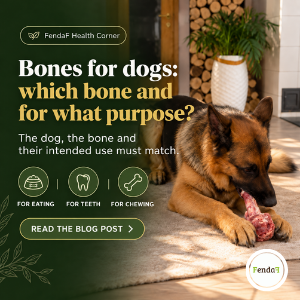
Bones for dogs – which bone and for what purpose?
Reading time: about 16 min
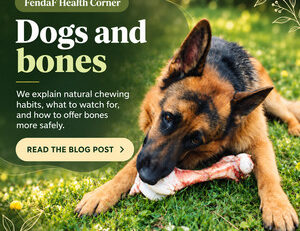
Some time ago, I was asked to write about which bones are suitable for which dogs. The starting point for this article was, and still is, the approach of integrative veterinarian Dr Peter Dobias, who divides bones into three groups according to purpose: for eating, for cleaning teeth, and for longer chewing. Dr Judy Morgan and Dr Karen Becker use the same idea in different forms: the question is not simply whether a bone is ‘good or bad’, but which bone, for which dog, and for what purpose.
I have fed raw meaty bones to my own dogs for years. By a ‘meaty bone’, I mean a bone that genuinely has meat, tendons, or other soft tissue attached to it, not a bare piece of bone scraped clean. At the same time, I also have personal experience with a dog that developed an intestinal obstruction after eating bones. That is why I do not want to reduce this topic to the slogan ‘bones are always safe’ or ‘bones are always dangerous’. The dog, the bone, and the way it is used need to fit together.
Most important: a bone is not one single product
A raw chicken neck, a lamb neck, a beef shank, and a large marrow bone are all ‘bones’, but from the point of view of a dog’s teeth, swallowing, and digestion, they are very different things. When choosing, look at at least four factors:
- purpose – is the bone meant to be eaten, to mechanically clean teeth, or for longer chewing;
- size and hardness – a piece that is too small may be swallowed whole, while a bone that is too hard may damage a tooth;
- the dog’s size, teeth, and bite force – the same bone may be a good fit for one dog and a poor choice for another;
- the dog’s chewing style – a calm chewer and a ‘gulper’ need completely different approaches.
Dobias places particular emphasis on very hard weight-bearing bones from large animals, such as beef, bison, or buffalo leg bones, which may fracture a strong chewer’s tooth. For dental cleaning, he prefers bones from medium-sized animals such as sheep or goats, which provide abrasive action without being as massive as the weight-bearing bones of large cattle. [1-3]
Dobias’s practical classification: for eating, for teeth, or for chewing
The table below is not a universal list of ‘safe bones’, but a practical starting point. In Dobias’s own guidance, the choice changes according to the size of the dog and whether the dog truly chews or tries to swallow pieces whole. [1-3]
| Purpose | Typical examples in the integrative approach | What to pay particular attention to |
| Edible bone | Chicken and duck necks, backs, wings and feet; quail; rabbit; other softer bones covered with meat. | It must actually be chewable for the dog, not something the dog can swallow whole. For a large dog, a small poultry bone may be too small if the dog tends to gulp. |
| Dental cleaning | For many medium and large dogs, Dobias prefers sheep or goat bones, necks, and suitably sized ribs; softer poultry bones may be suitable for smaller dogs. | The aim is abrasive chewing, not the hardest possible material. Very hard weight-bearing bones increase the risk of tooth fracture. |
| Longer chewing / activity | A larger piece that the dog cannot swallow whole; the choice depends heavily on chewing style. | ‘The bigger, the better’ does not automatically apply. A very hard marrow or leg bone is not suitable for a powerful chewer simply because it is large. |
A practical choice by dog size
Summarising Dobias’s guidance, you can think about it like this:
Small dog: chicken or duck necks, backs, wings and feet, as well as quail or rabbit, may work as edible bones. For dental cleaning, a smaller dog may need only a softer bone that still requires chewing. If a small dog is an exceptionally strong chewer, the same rule applies as with a large dog: a bone that is too hard can fracture a tooth.
Medium dog: poultry, rabbit, and suitably sized sheep or goat bones are often used as edible bones. For dental cleaning, Dobias especially recommends sheep or goat bones and appropriately sized ribs. Beef ribs require caution if the dog tends to swallow long pieces whole.
Large dog: with small edible bones, the most important issue is gulping risk. For dental work, a bone from a medium-sized animal may be a better choice than a giant beef shank. Dobias recommends that dogs with powerful bite force avoid large beef, bison, and buffalo leg or marrow bones because they may be too hard for the teeth.
No size chart can replace knowing your own dog. A Labrador that tries to swallow a turkey neck whole needs a different solution from a dog of the same size that calmly chews it into smaller pieces. For recreational bones, Becker recommends choosing a piece that is not too small for the dog and supervising the dog throughout the chewing session. [6]
Why give a raw meaty bone at all?
1. Mechanical cleaning of the teeth
This is one area where the benefits of bones are not based only on the experience of integrative veterinarians. In a small 2016 study, eight adult Beagles chewed raw beef bones. The surface area covered by dental calculus decreased by about 71% in 12 days and by nearly 88% in 20 days, depending on the bone type. During the study period, no tooth fractures, bones lodged between teeth, or intestinal obstructions were observed. [7]
In a 2020 follow-up study, dental calculus also decreased very quickly, but some dogs developed gum injuries and two had bone fragments become lodged between their teeth. Again, no tooth fractures or oesophageal or intestinal obstructions were observed during the short study period. The study used autoclaved beef bones, so it should not be equated one-to-one with home-cooked bones or used as evidence that all heat-treated bones are safe. [8]
These studies are small and short-term, but one point is fairly clear: the abrasive action of chewing a bone can genuinely reduce dental calculus. Judy Morgan lists raw meaty bones as one option for helping to keep teeth cleaner and likewise emphasises the mechanical effect of chewing. [4-5]
A 2025 Finnish DogRisk study also found that an unprocessed meat-based diet eaten during puppyhood and adolescence was associated with a lower occurrence of dental calculus later in life, while an ultra-processed carbohydrate-rich diet was associated with a higher occurrence. This was an observational study, so it does not prove causation or show that bones themselves were responsible for the effect, but it supports the idea that the overall dietary pattern may be related to oral health. [9]
2. Chewing is an activity, not just food
For a dog, chewing is also an activity. Working on a suitable bone uses the jaw muscles, provides mental stimulation, and may help satisfy the need to chew. The goal is not for the dog to finish the whole bone as quickly as possible. Especially with a recreational bone, the point is controlled chewing rather than fast consumption.
3. Nutrients and minerals
Edible raw meaty bones provide calcium, phosphorus, and other minerals, and together with the soft tissues also provide protein, fat, and collagen. If bone is genuinely being used as the mineral source in a homemade or raw diet, the rule ‘I give a couple of bones a week’ is not enough. The entire diet needs to be balanced, especially for a puppy. Bone can be part of a ration, but it does not automatically make an otherwise unbalanced diet complete and balanced.
4. Digestion, stool, and anal glands
Dobias points out that edible bone gives the digestive tract ‘work’ and may make stools firmer, which in turn may support the natural emptying of the anal glands. [2-3] Many raw feeders observe the same in practice. But there is a limit: white, very dry or crumbly stool, straining, and constipation suggest that the amount of bone is too high for that particular dog. In another dog, fatty marrow may instead cause soft stool or diarrhoea.
What about gastric dilatation-volvulus?
Dobias goes a step further in his approach and writes that regular bone feeding strengthens the muscular layer of the stomach and intestines and may help reduce the risk of bloat or gastric dilatation-volvulus (GDV). [2-3] I did not find good controlled clinical studies confirming this specific claim. I would therefore keep it in the article honestly for what it is: a view shaped by an integrative veterinarian’s long clinical experience, not a currently proven method of preventing GDV.
After a larger meal or a long bone-chewing session, I would not let a dog do very intense exercise immediately. At the same time, I would no longer present an exact ‘4-6 hour rule’ as a scientifically established limit. GDV is a condition with multiple risk factors, and FendaF has a separate article on gastric torsion in dogs.
Why are veterinarians often cautious about bones?
This is where the two worlds are worth bringing together. Integrative veterinarians such as Dobias, Morgan, and Becker intentionally use raw bones and consider appropriately selected bones valuable. Conventional veterinary practice, however, genuinely sees the cases in which the wrong bone or the wrong chewing style ends in a fractured tooth, choking, a foreign body, or intestinal obstruction. Both observations can be true at the same time.
Tooth fractures: bigger does not automatically mean safer
The most important shared point is to avoid extremely hard bones in powerful chewers. Dobias warns about large beef, bison, and buffalo leg bones specifically because of tooth-fracture risk. Becker highlights the same risk for aggressive chewers, dogs with crowns, and dogs with previous dental work. [1,6] AAHA is even more conservative and warns against very hard bones and antlers because they can fracture teeth. [11]
So the risk of tooth fracture does not mean that every bone should be removed from the menu. It means that ‘the biggest and hardest bone’ is not a good safety strategy.
Intestinal obstruction and sharp fragments: the risk is not zero
Dobias emphasises that the canine digestive tract is adapted to processing bone material and that he has seen few problems with raw bones in his clinical work. [2] At the same time, obstructions and gastrointestinal injuries are real complications seen in veterinary practice. My first dog developed an intestinal obstruction after eating raw bones. That experience is exactly why I would not describe any bone as ‘completely risk-free’.
I used to link my own case very firmly to the fact that I gave bones too often and the dog moved too little. Today I would phrase it more cautiously: a high amount of bone may have played a role, but movement is not automatically a protective mechanism that rules out obstruction. The most important factors are the individual dog’s chewing and digestive ability and the size of the pieces it swallows.
At the same time, I also have to mention Faddy and Oscar, who eat bones very frequently and have never had a problem with them so far. That does not prove that bones are suitable for every dog, but the experience is not meaningless either. For me, it comes back to the individual dog: how they chew, how active they are, and whether they are accustomed to bones at all.
Bacteria: detection does not equal disease
With raw meat and bones, Salmonella, E. coli, Campylobacter, and other bacteria are often raised as a concern. The risk is real, but it is very important to distinguish three different things: bacteria may be present in the food, the dog may carry or shed the bacteria in faeces, and third, clinical disease may develop. These are not the same thing.
In one controlled study, 16 dogs ate Salmonella-contaminated raw food. Seven dogs subsequently shed Salmonella in their faeces, but none developed diarrhoea or other clinical signs of illness. [10] This illustrates well why ‘bacteria were found’ does not automatically mean ‘the dog became ill’. Dogs can carry and shed certain pathogens without showing symptoms.
At the same time, asymptomatic carriage means hygiene is not pointless. A dog that does not become ill may still spread bacteria into the environment. In its 2024 policy on raw or undercooked animal-source protein, the AVMA specifically notes that even an apparently healthy animal can pose an infection risk to other animals and people. [12] This matters particularly in homes with young children, elderly people, pregnant people, immunocompromised people, and very vulnerable animals.
For me, the practical conclusion is not ‘you must never give a raw bone’, but rather: use fresh, high-quality ingredients, keep them at the correct temperature, avoid cross-contamination, and wash hands, surfaces, and bowls after handling.
Raw chicken bones: softer, but not magically risk-free
Dobias considers raw chicken bones a good example of edible bone, and Judy Morgan also recommends raw meaty bones as one part of dental care. [2,4-5] Raw poultry bone is generally softer and more flexible than the dense weight-bearing bone of a large cow. That is one reason chicken and duck necks, wings, backs, and feet are widely used in raw-feeding practice.
I would no longer write that raw chicken bones are ‘completely safe’, because no edible object is zero-risk. What matters is whether the dog chews or swallows. A chicken wing that is an appropriate size for a small dog may simply be a perfectly swallowable piece for a large gulper.
In TCVM, or Traditional Chinese Veterinary Medicine food therapy, chicken is considered a warming protein. Judy Morgan uses the same classification in her TCVM work and may prefer duck, rabbit, or fish for a dog that tends toward heat. [13] This is a traditional-medicine framework and does not determine the mechanical safety of a bone, but if you use TCVM food therapy, it may influence which animal species you choose the bone from.
Cooked bones: I am still cautious here
I would not give a dog a whole cooked, smoked, or otherwise hardened heat-treated bone. Dobias and Morgan both recommend preferring raw bones, and Becker likewise distinguishes raw edible and recreational bones from cooked bones. [1-6] Heating changes the physical properties of bone, and a home-cooked bone may break into sharp fragments.
That does not mean every heat-treated bone particle is automatically dangerous. Finely ground bone in a formulated diet, for example, is a very different thing from the whole bone from a roast chicken. It is important not to treat these two situations as the same.
How often should you give bones?
Dobias typically recommends suitable raw bones for dental cleaning about 1-2 times per week and, more generally, 2-3 times per week in his Recipe Maker guidance. [1,3] I would use this as a practical starting point, not a universal prescription.
If the bone is offered simply for chewing and the dog’s stool, teeth, and digestion are all fine, the appropriate frequency may be one thing for one dog and something else for another. If bone is part of the actual food ration, the amount needs to be assessed in the context of the whole diet. If the stool becomes white, very dry, or the dog strains, there is probably too much bone. If fatty marrow causes diarrhoea, the solution is not necessarily ‘give the same bone less often’; choosing a different bone may make more sense.
When would I rather not give a bone?
- the dog swallows pieces whole and it is not possible to choose a shape or size that makes them chew calmly;
- the dog has painful, cracked, or heavily worn teeth, crowns, or other extensive dental work;
- the dog has previously had a bone-related obstruction or has repeatedly had difficulty digesting bones;
- fatty marrow triggers gastrointestinal problems or the dog has a condition in which a high fat intake is unsuitable;
- bones are being used as a mineral source in a homemade diet but the balance of the entire ration has not been calculated – especially for a puppy;
- the household includes people or animals at very high infection risk, making it reasonable to avoid or strictly limit handling raw animal material.
How can you offer a bone more safely?
- Give raw bones only under supervision.
- Choose a bone that your dog cannot swallow whole in one bite.
- Watch how your dog actually chews. If they try to crack the bone and gulp large pieces, it is not a good recreational bone for that dog.
- For a powerful chewer, avoid very hard weight-bearing bones from large animals and massive marrow bones.
- Remove the bone once it becomes a small swallowable piece or if you see sharp or problematic edges.
- If the bone contains a lot of marrow and your dog is sensitive to fat, remove some of the marrow or choose a leaner option.
- Handle a raw bone like raw meat: keep it cold, use clean surfaces, wash hands, and avoid cross-contamination.
- If you see blood after chewing, check the mouth. Mild superficial gum irritation can happen, but repeated or heavy bleeding should not be normalised.
Is a bone the only good option for dental care?
No. Morgan emphasises the importance of daily oral care, and Becker also recommends tooth brushing. From a conventional veterinary perspective, tooth brushing remains the most reliable basis of home dental care. At the same time, it is also inaccurate to claim that chewing a raw bone has no effect on dental calculus – the small studies available show a clear mechanical effect. [4-8,11]
If your dog does not tolerate bones or you do not want to offer them, there are other options: tooth brushing, suitable chews, VOHC-accepted products, and regular veterinary oral examinations. At FendaF we have also written about anesthesia-free dental cleaning and its limitations.
My principle today
I have not reached the conclusion that bones should be removed from a dog’s diet. Quite the opposite: a correctly selected raw meaty bone can provide nutrients, activity, and very effective mechanical cleaning for the teeth. But I also do not believe in a universal list where the same bone is automatically safe for every dog of the same weight.
Look at your own dog. Do they chew or gulp? Are their teeth strong and healthy? Do they digest bone well? Is the bone soft enough that the tooth is not fighting a material stronger than itself? Is it an edible bone, or are you simply trying to provide longer chewing activity?
Once those questions have answers, ‘can a dog have bones?’ becomes a very different and much better question: ‘which bone is suitable for this dog and for this purpose?’ For me, that is the most important idea in the entire topic.
In summary
- Raw meaty bones are not all the same – edible bones, bones used for dental cleaning, and recreational bones serve different purposes.
- Integrative veterinarians Peter Dobias, Judy Morgan, and Karen Becker consider appropriately selected raw bones valuable for many dogs.
- There is research support for mechanical dental cleaning, although long-term safety studies are limited.
- The hardest and biggest bone is not necessarily the best one; weight-bearing bones from large animals may fracture the tooth of a powerful chewer.
- Finding bacteria, or shedding them in faeces, does not automatically equal clinical disease. A dog can be an asymptomatic carrier, which is why hygiene still matters.
- The risk of obstruction, tooth fracture, and gastrointestinal injury is not zero, so the bone must be chosen according to the dog’s chewing style and the dog should always be supervised.
- If a dog does not tolerate bones, there is no need to force the issue. A balanced diet and other dental-care methods are perfectly valid alternatives.
Used sources:
- Peter Dobias, DVM – The Right Raw Bones Can Save Your Dog’s Teeth and Thousands in Dental Care
- Peter Dobias, DVM – 10 Steps to Bone Feeding: What Is Safe and What Is Not?
- Peter Dobias, DVM – Dog Food Recipe Maker / Raw Bone Guide
- Judy Morgan, DVM – Kick Kibble to the Curb “Revisited” – Dental Myths
- Judy Morgan, DVM – Dental Disease in Pets: Causes, Treatment, and Prevention
- Karen Becker, DVM – Seven Rules for Offering Raw Recreational Bones to Your Dog (republication; original Healthy Pets article)
- Marx FR et al. Raw beef bones as chewing items to reduce dental calculus in Beagle dogs. Australian Veterinary Journal. 2016;94(1-2):18-23.
- Pinto CFD et al. Evaluation of teeth injuries in Beagle dogs caused by autoclaved beef bones used as a chewing item to remove dental calculus. PLoS One. 2020;15(2):e0228146.
- DogRisk / University of Helsinki – Modifiable early life risk factors for dental calculus in dogs: a retrospective cross-sectional study in Finland (2025).
- Finley R et al. The risk of salmonellae shedding by dogs fed Salmonella-contaminated commercial raw food diets. Canadian Veterinary Journal. 2007 (feeding trial data collected 2004).
- American Animal Hospital Association – 2019 AAHA Dental Care Guidelines / dental disease prevention resources.
- American Veterinary Medical Association – Revised Policy on Raw or Undercooked Animal-Source Protein in Cat and Dog Diets, Resolution #5, 2024.
- Judy Morgan, DVM – TCVM food energetics: chicken as a warming food/protein.
🐾 FendaF believes in informed choices
The purpose of the FendaF blog is not to tell you what you must do. Our aim is to share knowledge, introduce different evidence-based and integrative perspectives, and help you make more informed decisions for your pet.
Every animal is unique, and no article can replace a consultation, diagnosis or treatment provided by a veterinarian. If your pet has a health concern or you need individual advice, always contact a veterinarian.



Leave a Reply