


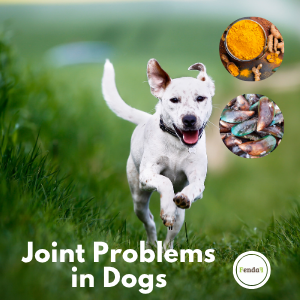
Joint Problems in Dogs – Natural Support, Movement and Pain Relief
Reading time: about 14 min
Joint problems are not only an issue for old dogs.
Osteoarthritis can develop as a result of trauma, a developmental joint disorder, dysplasia, excess weight or long-term uneven loading, and some dogs begin to need joint support at a fairly young age.
This topic is very personal to me.
Oscar has an elbow developmental disorder and arthritis, and supporting his joints has been part of our everyday life for years. I was once told that without surgery we might not get rid of his lameness. At the time, I decided not to operate.
Oscar has lived his entire life without NSAIDs (NSAID = non-steroidal anti-inflammatory drug). Turmeric has been one of the main components of his joint support, together with other measures, and despite his health problem he has remained very mobile.
He runs in the forest, goes on walks and does everything a dog wants to do.
Can I say that turmeric alone caused this result?
No.
In Oscar’s case, an entire combination has been involved: body weight, diet, movement, muscle mass, different joint-supporting nutrients and the choices I make about his workload.
But that is exactly why I do not regard turmeric as merely a theoretical “alternative supplement”. For years I have seen in my own dog that integrative joint support can work very well in real life.
And Oscar is not the only reason to take this approach seriously. Many of these tools are used in integrative veterinary medicine, and some have also been studied in clinical trials in dogs.
What causes joint problems?
Dogs may develop, for example:
- hip and elbow dysplasia;
- osteochondrosis and other developmental disorders;
- ligament and tendon injuries;
- traumatic changes;
- degenerative joint disease, or osteoarthritis.
Osteoarthritis does not simply mean an “old, worn-out joint”.
It is a disease process involving the whole joint, including cartilage, synovium, joint fluid, bone tissue, muscles and inflammatory mediators.
This is why the most sensible approach is usually multimodal. One tablet or one supplement does not have to carry the entire burden.
Inflammation is not always the enemy
Acute inflammation is a normal protective and healing response of the body. The problem begins when inflammation becomes chronic.
A long-term inflammatory environment can increase pain, affect cartilage metabolism and contribute to the progression of osteoarthritis.
One goal of joint support is therefore to reduce chronic inflammatory load without forgetting movement, muscle mass, body weight and overall health.
What about NSAIDs?
Non-steroidal anti-inflammatory drugs, or NSAIDs, such as carprofen, meloxicam and firocoxib, are among the most commonly used treatments for osteoarthritis pain in conventional veterinary medicine.
They can reduce pain and inflammation effectively.
But “effective” does not mean “risk-free”.
NSAIDs work partly by affecting prostaglandin synthesis. Prostaglandins participate in inflammation and pain, but they also have protective roles in the body, including supporting the lining of the stomach and intestines and blood flow to the kidneys.
The FDA lists possible adverse effects of veterinary NSAIDs including:
- vomiting and diarrhoea;
- reduced appetite;
- stomach and intestinal ulcers;
- gastrointestinal perforations;
- kidney damage;
- liver damage.
In rare cases, serious adverse effects can be fatal.
The risk is not the same for every dog. Particular care is needed, for example, in dehydrated dogs and in dogs with kidney, liver or heart disease, or those receiving certain other medications.
An integrative view of NSAIDs
Because of the potential adverse effects of NSAIDs, integrative veterinarians such as Dr Judy Morgan discuss many other ways of controlling pain and inflammation and, where possible, reducing medication burden.
This does not mean that a dog in pain should be made to suffer in order to avoid medication.
Morgan’s approach to arthritis is also multimodal: the aim is to find a combination of methods that keeps the individual animal as comfortable and mobile as possible.
My own preference has been similar: if a dog’s wellbeing can be maintained through nutrition, movement and integrative support, I prefer to start there.
The need for NSAID treatment cannot always be decided in advance. If the dog’s pain and condition allow it, it may be reasonable to first try a multimodal supportive approach and assess how the individual dog actually responds. If that is not enough, medication is still available.
If a dog is in pain, however, that pain must be removed or at least relieved. The purpose of a natural approach should never be to prove an ideological point at the expense of the dog’s welfare.
Natural joint support
Green-lipped mussel
New Zealand green-lipped mussel, Perna canaliculus, is one of the more interesting joint supplements studied in dogs. It contains omega-3 fatty acids, glycosaminoglycans and other bioactive compounds.
And here we are not talking only about theory.
Controlled studies in dogs have found improvements in joint pain and other osteoarthritis symptoms in dogs receiving green-lipped mussel.
In a randomized double-blind study at the University of Helsinki, green-lipped mussel, placebo and carprofen were compared. Green-lipped mussel relieved chronic orthopaedic pain better than placebo. Carprofen had a stronger effect in that study, but no adverse effects were detected in the green-lipped mussel group during the study period.
That makes green-lipped mussel a very worthwhile option for me, especially as part of long-term joint support.
Product quality still matters. Different extracts, powders and processing methods may not have the same composition.
Turmeric and curcumin
Turmeric has been used in the traditional medicine of India and other parts of Asia for a very long time. Today, however, turmeric and its principal bioactive compound curcumin are far from being research subjects only within traditional or integrative medicine.
Turmeric and curcumin are among the most extensively studied plant-derived compounds in the world, and tens of thousands of scientific papers have been published on curcumin.
How extensively has curcumin been studied?
A bibliometric analysis published in 2019 identified 18,036 curcumin-related publications in the Web of Science database. Of these, 14,315 were original research articles and 1,378 were reviews. Even then, more than half of the curcumin literature analysed had been published since 2014.
When researchers looked specifically at the ten-year period from 2014 to 2023, they identified 23,184 scientific publications on curcumin. Publication volume increased consistently during the period and exceeded one thousand papers every year.
A broader review published in 2025 searched several international and Chinese databases, including PubMed, Web of Science, ScienceDirect, Google Scholar and CNKI. That search identified as many as 40,775 English- and Chinese-language articles on curcumin.
These numbers cannot be added together because the databases and time periods overlap. They do, however, make one thing very clear: curcumin is not an under-researched plant compound.
This does not mean that all of those tens of thousands of studies concern canine arthritis, nor does publication volume by itself prove any specific therapeutic effect.
Curcumin has been studied in many areas, including inflammation, oxidative stress, metabolism, the immune system, cancer, neurology, gastrointestinal disease, formulations and bioavailability.
Why is curcumin of interest for joints?
From a joint-health perspective, curcumin’s effects on inflammatory signalling pathways and inflammatory mediators are particularly interesting.
Curcumin has been studied in relation to NF-κB and a number of cytokines and enzymes involved in inflammation. This is one reason it has attracted interest in chronic inflammatory conditions, including osteoarthritis.
Osteoarthritis is not a marginal subject within this literature either. A 2025 review notes that musculoskeletal disorders are one of the larger areas of curcumin clinical research and that later-phase clinical trials in arthritis have also been registered in recent years.
But what do we know about dogs?
Here we need to move from the enormous general curcumin literature to a much narrower question.
Curcumin has been studied in dogs both for its mechanisms of action and in the context of osteoarthritis and joint support. Naturally, there are far fewer canine studies than there are human and laboratory studies, and the results are not identical in every trial. That is not especially surprising.
“Turmeric” is not one standardized pharmaceutical preparation.
Studies may differ in:
- curcumin content;
- extract used;
- dose;
- duration of administration;
- combination with other active ingredients;
- bioavailability;
- severity of disease in the dogs;
- how outcomes are measured.
Therefore, the results of ordinary turmeric powder, Golden Paste and a specially formulated high-bioavailability curcumin extract cannot automatically be treated as equivalent.
Turmeric’s big question: bioavailability
One of curcumin’s best-known limitations is its relatively poor oral bioavailability. Curcumin is poorly soluble in water, is absorbed only to a limited extent and is metabolised rapidly in the body.
This is one reason why curcumin research pays so much attention to different formulations, nanoparticles, liposomes, combining it with fat and other methods designed to improve absorption.
In traditional Golden Paste, turmeric is usually combined with fat and black pepper. Piperine in black pepper may affect curcumin metabolism and increase its bioavailability.
Dr Judy Morgan’s Golden Paste recipe likewise combines turmeric with fat and black pepper, and turmeric is one of the tools she commonly uses in integrative joint support.
My experience with Oscar
And this is where real life sits alongside the scientific literature.
Turmeric has been one of the main components of Oscar’s joint support for years. Oscar has arthritis and an elbow developmental disorder. Despite this, he has remained very mobile and has lived an NSAID-free life.
He does not live in a glass cabinet. He goes on long walks, runs in the forest and is happy to stay active.
I am not claiming that his current mobility proves that turmeric alone caused the result. Oscar’s joint support has never consisted of a single component. But in my practical experience, turmeric has been an important part of his joint support for years.
That is why I do not consider turmeric merely a theoretical integrative supplement.
For me, the whole picture consists of several things at once:
- a curcumin research literature comprising tens of thousands of publications;
- known mechanisms related to inflammatory processes;
- osteoarthritis studies in humans and animals;
- long-term clinical use by integrative veterinarians;
- and finally, what I have observed in my own dog over the years.
None of these alone means that turmeric will definitely work for every dog. Together, however, they give me more than enough reason to take turmeric seriously as part of joint support.
How should turmeric be given?
Curcumin itself is poorly absorbed, which is why Golden Paste recipes usually combine turmeric with fat and piperine from black pepper.
Dr Judy Morgan’s Golden Paste, for example, contains turmeric, fat and black pepper.
For an English-language Golden Paste recipe, see Dr Judy Morgan’s recipe in the sources below.
If a dog is taking medication or has a chronic disease, it is sensible to consult a veterinarian before using larger amounts of turmeric, because plant-derived bioactive compounds can also affect metabolism and the action of medicines.
Eggshell membrane
The thin membrane lining the inside of an eggshell naturally contains collagen, glycosaminoglycans and other connective-tissue components.
Standardized eggshell membrane preparations have also been studied in dogs, with results suggesting potential benefits for joint pain and function.
One point is worth remembering: a study using a standardized extract does not automatically mean that an arbitrary amount of membrane peeled from a household egg will produce exactly the same effect.
Chondroitin and glucosamine
Glucosamine and chondroitin are probably the most classic ingredients in joint supplements.
Chondroitin is a natural component of cartilage and contributes to cartilage structure and water retention.
Clinical trial results for glucosamine and chondroitin have been inconsistent, so I do not regard them as miracle remedies. But I also do not think it makes sense to judge every product solely by the ingredient name. Raw material, form, dose and combination with other substances can differ considerably between products.
Omega-3
EPA and DHA are among the better-studied nutritional components in the context of joint health. They are found in both fish oil and green-lipped mussel.
Freshness matters with omega-3 products. Oxidized or rancid oil is not something I want to deliberately pour onto my dog’s food. That is why I prefer products with controllable quality and storage conditions that reduce oxidation.
CBD
Cannabidiol, or CBD, has also been studied in recent years in the context of osteoarthritis pain in dogs.
Some dogs may benefit, but response and suitable dose can be highly individual. With CBD, it is sensible to use a controlled product intended for animals, with known actual CBD and THC content.
I would not present CBD as a cancer treatment. That is a different and far more complex subject, and an arthritis article does not need to turn it into a miracle cure.
Astaxanthin
Astaxanthin is a carotenoid and a potent antioxidant found naturally in microalgae and, through them, in a number of marine animals.
It has interesting mechanisms related to inflammation and oxidative stress, but the clinical evidence in canine osteoarthritis is more limited than for, for example, omega-3 or green-lipped mussel.
I would therefore use it as one part of broader antioxidant support rather than as the main treatment for a joint problem.
Supplements alone are not enough
With Oscar, it has never been about one jar or one powder.
Body weight
Maintaining a normal body weight is one of the most important things you can do for a dog’s joints.
Every extra kilogram increases mechanical load, and adipose tissue is not merely passive energy storage. It also produces biologically active substances that can influence inflammatory processes.
Movement
A dog with joint problems does not necessarily need less movement. The dog needs the right movement.
Regular controlled exercise:
- preserves muscle mass;
- improves joint stability;
- supports coordination;
- helps control body weight;
- keeps the dog mentally active.
Complete inactivity can actually make a dog with joint problems weaker.
During acute pain, the workload naturally needs to be adjusted.
For many dogs, several shorter walks work better than one very long walk. Swimming, an underwater treadmill, physiotherapy and individual muscle-strengthening exercises may also be useful.
Diet
For me, health always begins to a large extent in the food bowl.
For a dog with joint problems I prefer food that is as high-quality, nutrient-dense and suitable for that individual dog as possible, and I also like to use real foods such as eggs, appropriate animal tissues, fish and other natural nutrient sources.
This does not mean that every dog must eat a 100% raw diet.
It means that joint support should not consist solely of adding one joint tablet next to a poor-quality diet.
Vaccination and joint health
Older integrative literature has also discussed antibodies that may arise after vaccination against various proteins in the body, including collagen.
This should not be presented as if routine vaccination had been proven to cause osteoarthritis in dogs. Existing science does not establish such a causal relationship.
I am, however, generally in favour of not vaccinating dogs automatically more often than their actual protection needs require, and of making decisions individually together with a veterinarian.
That is a broader health principle, not a treatment for arthritis.
Every dog is different
This may be the most important point in joint disease.
For one dog, a combination of body-weight control, movement and supplements may be enough for years.
Another needs physiotherapy.
A third needs an NSAID.
A fourth needs surgery.
And very often, the best result comes from combining several approaches.
Oscar’s story does not prove that surgery or NSAIDs are wrong for every other dog.
But his experience shows something else that matters to me: an X-ray or diagnosis does not automatically determine what the rest of a dog’s life must look like.
Years ago, I had a dog in front of me for whom surgery was being discussed because of a chronic joint problem.
Today I have a dog who is very happy to head into the forest.
That is why I believe in an integrative approach.
Not because “natural” is a magic word, but because a dog’s health can be viewed far more broadly than through the single question: which tablet do we use to take the pain away?
In summary
When supporting a dog with joint problems, I believe it is worth looking at all of the following together:
- normal body weight;
- regular movement at an appropriate workload;
- muscle mass;
- high-quality food;
- omega-3 fatty acids;
- green-lipped mussel;
- turmeric or curcumin;
- other joint-supporting nutrients when appropriate;
- physiotherapy and other rehabilitation options;
- the dog’s actual pain and quality of life.
If that is enough, excellent.
If it is not enough, the treatment plan needs to be expanded.
The goal is not to have the most “natural” dog possible.
The goal is a dog who can move, play, run and enjoy life for as long as possible.
Sources:
- FDA: Get the Facts about Pain Relievers for Pets
- FDA: Veterinary Nonsteroidal Anti-Inflammatory Drugs (NSAIDs)
- AAHA: 2022 Pain Management Guidelines for Dogs and Cats
- AAHA: Nonpharmacologic Modalities for Pain Management
- Judy Morgan DVM: NSAIDs – These Drugs Can Kill Your Pet If Given Incorrectly
- Judy Morgan DVM: Treating Arthritis Naturally
- Judy Morgan DVM: Golden Paste Recipe
- Hielm-Björkman et al. (2009): Green-lipped mussel in canine osteoarthritis
- Corbee (2022): Green-lipped mussel, curcumin and blackcurrant extract in dogs and cats with osteoarthritis
- Innes et al. (2003): Turmeric extract P54FP in dogs with osteoarthritis
- Comblain et al. (2017): Curcuminoids, hydrolyzed collagen and green tea extract in dogs with osteoarthritis
- Barbeau-Grégoire et al. (2022): Systematic review and meta-analysis of nutraceuticals in canine/feline osteoarthritis
- Ruff et al. (2016): NEM eggshell membrane in dogs
- Kunnumakkara et al. (2019): Curcumin – Total-Scale Analysis of the Scientific Literature
- Wang et al. (2024): Bibliometric Analysis of Curcumin Based on CiteSpace
- Frontiers in Pharmacology (2025): Pharmacological effects, formulations, and clinical research progress of curcumin
- HogenEsch et al. (1999): Vaccine-induced autoimmunity in the dog
- Scott-Moncrieff et al. (2002): Antithyroglobulin antibodies after routine vaccination in dogs
🐾 FendaF believes in informed choices
The purpose of the FendaF blog is not to tell you what you must do. Our aim is to share knowledge, introduce different evidence-based and integrative perspectives, and help you make more informed decisions for your pet.
Every animal is unique, and no article can replace a consultation, diagnosis or treatment provided by a veterinarian. If your pet has a health concern or you need individual advice, always contact a veterinarian.










Leave a Reply