


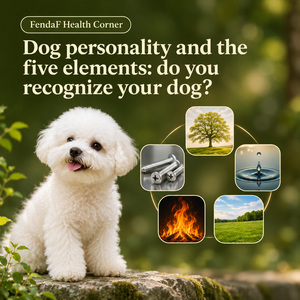
Five Elements of Dog Personality: Take the Quiz
Reading time: about 7 min
When I first came across Dr Judy Morgan’s five-element approach, I was curious rather than convinced. Sorting a dog’s personality into Fire, Water, Wood, Earth or Metal sounded rather unusual. Then I compared the descriptions with our own dogs and was surprised at how much I recognised in Faddy, Oscar, Fenton and Süsi.
Does that mean the system can diagnose health conditions or calculate exactly what a dog should eat? No. Traditional Chinese Veterinary Medicine (TCVM) uses the five elements as one way of observing temperament and stress responses. I think it can be a useful prompt to look more closely at a dog, provided we do not mistake a charming personality description for a laboratory result.
Five elements, five ways of reacting to the world
TCVM describes Wood, Fire, Earth, Metal and Water. It associates each with personality features, seasons, emotions and traditional organ correspondences. Dr Morgan uses this framework to consider how an individual dog reacts to new situations, what excites or comforts them and what happens under stress.
There is an important distinction here. A traditional association between Metal and the lungs, or Water and the kidneys, does not prove that a dog of that type has a higher risk of lung or kidney disease. These connections belong to the TCVM framework, not validated veterinary risk scores. “Cooling” and “warming” foods are also traditional energetic classifications, not evidence that a particular food cures a particular illness.
I find this distinction liberating. We can ask whether a description helps us understand a dog while still checking whether a practical recommendation is safe and necessary for that individual.
Five-element personality questionnaire for your dog
Read each statement and tick it if it describes your dog. Every tick is one point for that element, up to 13 points. Add up the points for each element separately. Your dog may score highly in more than one group.
Fire
Fire: ____ / 13
Wood
Wood: ____ / 13
Earth
Earth: ____ / 13
Water
Water: ____ / 13
Metal
Metal: ____ / 13
Compare your results
Fire: ____ / 13 Wood: ____ / 13 Earth: ____ / 13 Water: ____ / 13 Metal: ____ / 13
This is a traditional descriptive checklist shared by Dr Judy Morgan, not a medical or scientifically validated risk assessment. Some items, including “alpha” and physical features, reflect a traditional classification rather than modern behavioural science.
Fire: sociable, vocal and quick to get excited
Fire is associated with friendly, outgoing dogs who enjoy attention and physical contact. They may be the life of the party, seek affection, get excited quickly and express themselves loudly. TCVM links Fire with the heart and small intestine, but a sociable or vocal dog is not therefore suffering from heart disease or automatically in need of a “cooling” diet.
A more useful question is whether the dog can enjoy contact without becoming overwhelmed. Does every small stimulus send them into overdrive? If a dog struggles to rest, I would consider sleep, exercise, arousal regulation and possible anxiety rather than trying to “turn down the Fire element”.
Wood: determined and active, but sometimes easily frustrated
Wood dogs are described as active, independent, athletic and confident. They enjoy getting things done and moving forward. That same drive can turn into impatience or frustration. TCVM traditionally links Wood to the liver and gallbladder; it should not be used to diagnose liver disease or justify giving herbs without proper assessment.
For such a dog I would look at the daily routine. Can they learn with a clear objective, move enough and then settle? Yet another frantic ball game may not help an already overstimulated dog. Sometimes calm sniffing, varied movement or a short training session followed by real rest works better.
Earth: the family dog who values routine
Earth is associated with calm, gentle, friendly and loyal dogs. They often enjoy company, familiar surroundings, food and a predictable daily rhythm. Some are magnificent negotiators when treats are involved. TCVM associates Earth with the stomach and spleen, but digestive problems cannot be identified from a calm personality.
Faddy scored eight points for Earth when I filled in the questionnaire. Süsi also scored eight. That sounded familiar, yet their temperaments and life stages are very different. The same score does not mean the same dog. The checklist is most useful when it draws attention to possible similarities without erasing important differences.
Water: a sensitive observer who may react with fear
Water dogs are traditionally described as cautious, sensitive, reflective and sometimes reserved around strangers. They may need more time to adjust. TCVM connects Water with the kidneys and bladder and sometimes with noise sensitivity. But a dog’s fear of fireworks or strangers cannot be attributed to a “Water element”: experience, learning, health, age, environment and individual temperament all matter.
With a sensitive dog I would offer more choice over distance and pace. Do not force a greeting. And do not dismiss pain, hearing loss or vision changes because a traditional description calls the dog “deeply sensitive”.
Metal: the orderly independent worker
Metal is associated with consistency, alertness, independence and a preference for doing things in one’s own way. Some dogs do not constantly seek petting; they may prefer peace, structure and purposeful activity. TCVM links Metal with the lungs and large intestine, but that does not show that Metal dogs are more likely to cough or develop constipation.
Oscar scored ten out of thirteen for Metal. And he certainly has his own ideas about work. On our Sunday woodland walks he sometimes finds a stick and carries it, very seriously, for the rest of the outing. There is no point interrupting him. He is working. Some people have meetings; Oscar has sticks.
Fenton also works in his own way. On a run, particularly when passing people or other dogs, he may hold his head high and take the lead into his mouth. That is not a formal herding assignment, but observing the behaviour gives us context. We initially thought only Süsi needed work. It turns out Fenton and Oscar have been busy in their own ways all along.
How our four dogs scored
We ticked the traits in the original checklist and added up the points. Oscar: Metal 10, Water 5, Wood 4, Fire 2 and Earth 2. Süsi: Earth 8, Fire 7, Wood 7, Metal 6 and Water 5. Fenton: Metal 5 and Water 5, Fire 3 and Earth 3, Wood 2. Faddy: Earth 8, Metal 7, Wood 5, Water 3 and Fire 2.
This is an interesting observation exercise, not a clinical test. Owners may interpret words such as “loyal”, “active” or “cautious” differently. A dog can fit several categories and change with context, experience, age and health.
What does research actually show?
A 2020 study in the American Journal of Traditional Chinese Veterinary Medicine compared owner questionnaire ratings with assessments by an experienced TCVM veterinarian. The study included 89 dogs and the owner and veterinarian classifications agreed in 50 cases, approximately 56%. That is above the 20% expected if five categories were chosen at random with equal probability. An intriguing result? I think so.
However, this does not show that the five elements predict disease, represent stable biological types or identify a suitable diet for every dog in a category. A single questionnaire study cannot tell us how closely several different veterinarians would agree with one another or how stable classifications are over time. It measured agreement with one assessment method, not the effectiveness of treatment or nutrition.
Dr Morgan’s use of the five elements is part of her integrative clinical approach. Symptoms, history, examination and appropriate diagnostic tests must still lead health decisions.
FendaF’s small five-element observation game
- Write down five to ten traits you see in your dog, and note when they appear.
- Compare them with the five elements, allowing for more than one match.
- Ask which activities genuinely comfort or motivate your dog: sniffing, contact, solitude, games or a task.
- Do not explain new fears, pain or digestive problems solely as “element imbalances”. Look for their real causes.
- Do not change the diet or start herbs based only on a personality score.
What should we actually take away?
I would not use the five elements as a diagnosis or menu prescription. I do like that the exercise encourages us to watch our dogs more carefully. One needs space, another a task, a third routine and a fourth help settling after excitement. If you notice a previously overlooked need, the checklist has served a practical purpose.
And if your dog seems to be Earth, Metal and a little Fire at the same time, they are not a faulty five-element dog. They are simply a dog. Dogs have never been particularly interested in our spreadsheets.
Sources
- Judy Morgan: Interaction Between TCVM Elements
- Judy Morgan: Wrong and Right Foods in TCVM
- Springer (2020): Development and Validation of a Five Element Personality Questionnaire
- Merck Veterinary Manual: Behavior Problems of Dogs
- 5 Elements Veterinary: The Five Elements
🐾 FendaF believes in informed choices
The purpose of the FendaF blog is not to tell you what you must do. Our aim is to share knowledge, introduce different evidence-based and integrative perspectives, and help you make more informed decisions for your pet.
Every animal is unique, and no article can replace a consultation, diagnosis or treatment provided by a veterinarian. If your pet has a health concern or you need individual advice, always contact a veterinarian.











Leave a Reply