


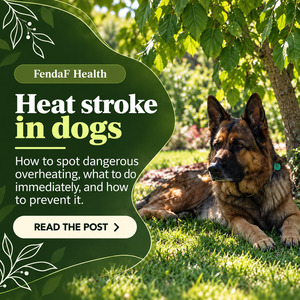
Heatstroke in Dogs: First Aid and Prevention
Reading time: about 9 min
A dog cannot tell you when the heat is becoming too much. They may keep chasing a ball, stay beside you in the sun or guard the house even when their body can no longer cool itself adequately. A dog not choosing shade does not necessarily mean everything is fine. When heatstroke threatens, the owner’s attention and speed of action matter.
If you suspect heatstroke, stop all activity, move your dog somewhere cooler, start cooling with water immediately and arrange urgent veterinary care. Do not wait for panting alone to solve the problem. The central message of the 2026 RECOVER first-aid guidelines is straightforward: when it is safe to do so, cool the dog at the scene before taking them to a veterinary clinic.
What actually happens when a dog overheats?
Dogs primarily cool themselves by panting. Moisture evaporates from the respiratory tract, allowing heat to escape. Sweat glands exist in the paw pads, but they cannot provide the extensive cooling that sweating provides in humans. On a hot, humid day, during strenuous exercise or when a dog’s airways make panting less effective, this cooling system may no longer be enough.
Heat-related illness exists on a spectrum. Initially, a dog may be unusually tired and pant heavily. More severe cases can involve loss of coordination, circulatory problems and organ injury. Heatstroke is not merely a high number on a thermometer: excessive body heat interferes with the body’s normal function. Dangerous symptoms may remain even after the measured temperature has fallen.
A dog’s usual body temperature is approximately 38–39 °C, but the whole clinical picture matters. Body temperature can rise after exercise without heatstroke. Conversely, a dog who has cooled down but remains weak or confused may still require emergency treatment. Never delay first aid because you lack a thermometer or because the temperature has returned towards normal.
Which warning signs need immediate attention?
An early sign is often panting that is heavier, more laboured or unnaturally rapid than usual. A dog may seek a cool surface, fall behind, drool or become restless. Consider what the dog was doing: running in the heat, sitting in a car, playing in the sun or staying in a stuffy room? A change from their normal behaviour is particularly important.
More serious signs include staggering, weakness, confusion, vomiting, diarrhoea, unusual gum colour, difficulty breathing, seizures and collapse. Gums may look bright red, dark or pale; colour alone cannot establish a diagnosis. Impaired consciousness, collapse, repeated vomiting or breathing difficulty is an emergency.
Short-nosed breeds such as pugs and bulldogs need particular care, as do overweight dogs, older or very young dogs and those with heart or respiratory disease. Athletic dogs are not automatically protected. Working muscles generate considerable heat during intense activity, so heat injury can occur without record-breaking outdoor temperatures.
First aid: start cooling now, not only when you reach the clinic
First, stop the activity. Get the dog out of the sun or into a cooler, well-ventilated area, but do not force them to walk to ‘circulate cooler blood’. That was once a common suggestion, but exercise produces additional heat. A weak dog needs as little exertion as possible.
Next, run cool water over the dog’s body, especially the abdomen and other areas with thinner fur, allowing the water to reach the skin. A tap, shower or garden hose can work. Keep water away from the face and airways to reduce the risk of inhalation. If available, use a fan or air conditioning to support heat loss. Wetting only the paws may not be enough because the cooled surface area is too small.
At the same time, call the nearest emergency veterinary clinic. If you have a rectal thermometer and can use it safely, active cooling is generally stopped at around 39.7–40 °C. Where severe upper-airway obstruction prevents effective breathing, the guidelines indicate that cooling may continue until panting clearly improves, but not below 38.6 °C. These are first-aid guides, not permission to monitor a sick dog at home. Do not delay cooling to take a reading or put yourself at risk of being bitten.
If temperature measurement is impossible, RECOVER suggests approximately 15 minutes of active cooling before transport when feasible. If the dog’s condition deteriorates rapidly, breathing is severely obstructed or cooling cannot be carried out at the scene, arrange immediate transport and continue safe cooling on the way as directed by the clinic. Cooling and transport are not competing goals; they should work together.
You may offer water voluntarily to a dog who is awake, clearly responsive and swallowing normally. Never pour water into the mouth of a weak or unconscious dog or force them to drink. After initial cooling, remove excess surface water, keep the car cool and go to the vet even if your dog appears to have recovered.
What water temperature should you use to cool a dog with heatstroke?
The most important thing is to start cooling without delay. Cool running water that penetrates the coat and reaches the skin is suitable. Focus particularly on the underside and other less densely coated areas. Moving air helps cooling too.
People are often advised to avoid cold water because it can constrict blood vessels near the skin and supposedly prevent heat from escaping. Cold exposure can indeed cause vasoconstriction, but the available evidence does not establish that this makes cooling with cold water ineffective or dangerous during heatstroke. Even ice-cold water is used successfully to treat heatstroke in humans.
For dogs, the 2026 RECOVER first-aid guidelines primarily favour cool running water. Immersion in ice-cold water has not been studied sufficiently in dogs to recommend it as a universal home first-aid method. Handling a dog with altered consciousness, breathing problems or other serious illness also calls for particular care.
Practical advice: do not waste precious time searching for the perfect water temperature. Start with available water that is cooler than the dog’s body. Do not cover a wet dog with a thick wet blanket that may interfere with heat loss. Contact a veterinarian immediately because heatstroke can cause serious organ damage even after cooling.
FendaF: quick action checklist
- Stop exercise and move the dog out of the heat without forcing them to walk.
- Start cooling the body immediately with running cool water, keeping water away from the airways.
- Use moving air if available and call an emergency veterinary clinic.
- Offer water only if the dog is alert and swallowing normally.
- Seek urgent veterinary care even if the dog looks better.
Why is a veterinary examination necessary even when panting improves?
A falling body temperature is encouraging, but it does not tell us what has happened to the kidneys, liver, intestines or blood-clotting system. Complications of heat injury may develop after initial cooling. At the clinic, the team assesses breathing, circulation and hydration, and may run blood tests and monitor organ function. Some dogs need observation and intravenous fluids; others require intensive care. First aid at home cannot replace that assessment.
Unlike ordinary tiredness on a summer day, suspected heatstroke is not something to watch overnight and hope will be better tomorrow. Loss of consciousness, seizures or worsening breathing require immediate emergency care.
What about natural and integrative approaches?
Integrative veterinary care can offer a useful broader view of prevention: appropriate activity, body weight, hydration, access to shade, recovery breaks and existing health conditions. A cooling mat or vest suits some dogs; others enjoy a shallow, cool paddling pool or a relaxed walk in a shaded forest. When heat rules out running or fetch, scent games and quiet searching activities can replace some of that exercise. Mental activity is real activity for a dog too.
Integrative veterinarian Dr Judy Morgan has emphasised shade, drinking water, reducing exertion and cooling mats in her summer advice. These preventive measures fit well with more recent safety guidance. Some of her older heatstroke first-aid advice, however, mentions alcohol on paw pads and avoiding very cold water. FendaF separates valuable preventive advice from older emergency practices: the 2026 RECOVER guidance favours cooling the whole body with cool running water rather than relying on the paws alone. Nature-minded care and updated evidence need not be opposites.
Traditional Chinese veterinary medicine sometimes describes certain foods as ‘cooling’. This refers to a food energetics framework; it does not prove that any food can rapidly reduce a dog’s dangerous body temperature during heatstroke. Cool drinking water, a food traditionally described as cooling, and emergency active cooling with water are three different things.
Older natural first-aid materials also mention homeopathic remedies for heatstroke, including Belladonna and Aconitum. Such recommendations do appear in integrative discussions, but there is no robust evidence that these preparations lower a heatstricken dog’s dangerous body temperature or prevent organ injury. FendaF does not recommend choosing or administering homeopathic pellets as first aid for heatstroke: that may consume time needed for cooling and emergency treatment. This boundary is not a judgement on every possible use of homeopathy; it concerns this specific life-threatening emergency.
How can you prevent overheating when your dog does not know when to stop?
The simplest protection is to match activity to the conditions. Long summer walks may be better early in the morning or late in the evening, although even evenings may stay hot during heatwaves. Notice high humidity, sun-baked asphalt and still air in enclosed yards. Every walk need not be the same length. If your dog insists on guarding the property in direct sunshine, calmly guide them somewhere cooler, even if they object.
Water and shade must actually be accessible. In a garden, several water bowls, a shady resting spot and a shallow dog-friendly pool may be useful, provided the dog can be safely supervised. Never leave a dog in a car in warm weather, even ‘for just a couple of minutes’ or with the windows open. For dogs that love swimming, cooler water can be enjoyable, but safe access, water temperature, cyanobacteria and the dog’s exercise tolerance all deserve attention.
A double-coated dog does not automatically need to be shaved when the weather gets hot. Grooming and removing loose undercoat may improve airflow; cutting the coat unnecessarily short may increase sunburn risk. Base the decision on the individual dog’s coat type, skin and surroundings, not one rule for every breed.
Panting is a dog’s way of releasing heat. When panting becomes laboured, behaviour changes or movement becomes unsteady, the message is much more serious. With heatstroke, the most important intervention may be entirely ordinary: stop the activity, turn on the cool water and call for help.
For further reading, see FendaF’s article on dehydration, its signs and prevention.
Sources
RECOVER (2026). First Aid: clinical guidelines.
RECOVER (2026). First Aid: evidence and treatment recommendations.
Carter et al. (2024). Post-exercise management of exertional hyperthermia in dogs.
Parnes et al. (2024). Voluntary head dunking after exercise-induced hyperthermia.
Bradbury et al. (2026). Recognising, grading and managing heat-related illness in dogs.
Judy Morgan, DVM. Dealing with Heat Stroke in Pets.
🐾 FendaF believes in informed choices
The purpose of the FendaF blog is not to tell you what you must do. Our aim is to share knowledge, introduce different evidence-based and integrative perspectives, and help you make more informed decisions for your pet.
Every animal is unique, and no article can replace a consultation, diagnosis or treatment provided by a veterinarian. If your pet has a health concern or you need individual advice, always contact a veterinarian.










Leave a Reply