


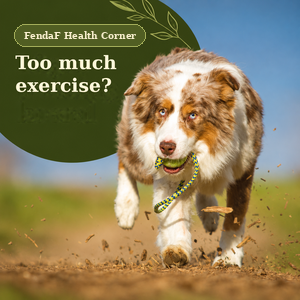
Too much exercise for dogs: how can you tell when the load is excessive?
Reading time: about 6 min
At FendaF we often talk about how important it is to keep dogs moving. And that remains true: a dog should not spend its entire life on a sofa or confined to a fenced garden. But one question is asked too rarely. Can a dog get too much exercise?
Yes. Not because one long walk is inherently bad, but because a dog’s body needs to be prepared for the effort. If activity is limited all week and Sunday brings a very long run or intense ball game, that can be a sudden increase in the load on muscles, tendons and joints. Extra care is needed with overweight dogs, those with chronic illnesses, puppies and older dogs.
When is exercise too much?
There is no universal limit in kilometres or minutes. A distance that is normal for one fit dog may overload another. The effect depends on age, breed, weight, conditioning, health, weather, terrain and whether the dog moves at a steady pace or repeatedly sprints.
It is especially important to distinguish structured exercise from everyday activity. A relaxed sniffing walk, walking, play, training and sprinting meet somewhat different needs. Sniffing is not “less valuable” simply because the heart rate stays lower. It is part of a dog’s interaction with its environment and mental well-being.
Signs to watch for after exercise
Paw pads. Check for rubbing, redness, blisters, tears or sensitivity. Hot asphalt and rough ground can cause more harm than the distance alone suggests. A dog with a limp or a bleeding pad needs rest and, if necessary, treatment.
Muscles and joints. Stiffness the next day, hesitation when getting up, avoiding stairs or familiar jumps and a new limp can suggest excessive loading, but also injury or a flare-up of an existing condition. Persistent or severe symptoms should not be dismissed as the result of a “good workout”.
Fatigue and behaviour. Moving more slowly than usual, wanting to stop the walk, losing interest in play or becoming irritable can mean the dog is not feeling well. Some enthusiastic dogs will keep chasing a ball even when their bodies need rest. We therefore cannot always leave exercise limits entirely up to the dog.
Heat-related overexertion is a separate danger
In warm or humid weather a dog’s ability to cool down can be reduced, making continued exercise dangerous. Short-muzzled, overweight, older and very young dogs, as well as those with heart or respiratory disease, need particular attention. Walks early in the morning, shade, water and adapted activity are simple precautions.
If a dog pants intensely, becomes unsteady, vomits, cannot move normally or collapses, act urgently. Stop the activity, move the dog somewhere cooler, begin careful cooling and contact a veterinarian immediately. Heatstroke cannot be judged only by whether the weather felt very hot to a person.
How to build stamina without overdoing it
VCA’s veterinary guidance emphasises gradual conditioning: moderate activity every day is often a better foundation than a single very long, difficult weekend session. Start with distances suited to the dog’s current abilities and increase duration and intensity gradually. Repeated stiffness the following day suggests the increase was too steep.
Variety matters. One day may include a longer easy walk, another slightly brisker activity, and a third balance and body-awareness exercises. Dogs also need opportunities to rest. I am particularly careful with repeated sharp turns, lunges after a ball and prolonged repetitive effort, because these can produce more mechanical strain than the average pace suggests.
If the goal is weight loss for an overweight dog, I would not start with long runs. First review calories and portion sizes, then provide controlled activity that does not overload the joints. Exercise is essential for health, but weight loss should not come at the expense of joint health.
Puppies, seniors and dogs with chronic illness
Excessive forced activity and repeated jumping should be avoided in growing puppies, but that does not mean depriving them of movement. Likewise, an older dog does not automatically need a life on the sofa. Shorter, more frequent walks, gentle strength and balance work, and activity from which the dog can recover may be suitable.
General advice for healthy dogs cannot simply be applied to those with heart disease, respiratory problems or joint disorders. A dog with a history of collapse, rapid breathing at rest, a marked decline in exercise tolerance or diagnosed heart disease needs an activity plan that takes its individual treatment and the veterinarian’s assessment into account. “More exercise” is not always better, and “less exercise” is not always safer.
FendaF’s practical exercise check
After activity I ask three things: was the dog happy and moving in a controlled way during the activity; did it recover as usual; and how did it feel the following day? One good day does not prove the workload was suitable, but consistently good recovery is a more useful clue.
I recommend making room in the dog’s week for genuine movement, sniffing, play and recovery. Moving around a garden does not always replace walks together, but the length of the walk should not become a goal in itself. The main thing is not how many kilometres the watch records. It is having a dog that is able, willing and happy to move again the next day.
Sources
🐾 FendaF believes in informed choices
The purpose of the FendaF blog is not to tell you what you must do. Our aim is to share knowledge, introduce different evidence-based and integrative perspectives, and help you make more informed decisions for your pet.
Every animal is unique, and no article can replace a consultation, diagnosis or treatment provided by a veterinarian. If your pet has a health concern or you need individual advice, always contact a veterinarian.







Leave a Reply