


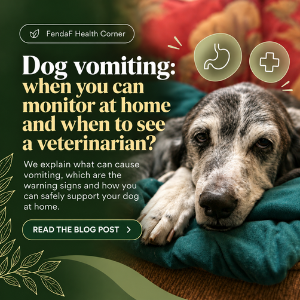
Dog vomiting: when can you monitor at home and when does your dog need a vet?
Reading time: about 10 min
Your dog vomits once, looks at you, shakes it off, and five minutes later asks for food. Panic? Usually not. With vomiting, however, there are always two questions: is there a red flag that needs prompt veterinary attention, and if not, how can you gently support an upset stomach and work out why the episode happened in the first place?
In an integrative approach, “what can I do at home?” and “why is this happening?” are not opposites. A mild one-off episode can be supported symptomatically, while a recurring pattern should also trigger a search for the root cause.
First: vomiting or regurgitation?
Vomiting is an active process. It may be preceded by nausea, repeated swallowing, increased salivation, abdominal contractions and retching. The material comes from the stomach or upper small intestine and may contain digested food, fluid or bile.
Regurgitation is more passive: undigested food or fluid comes back up from the oesophagus without strong abdominal contractions, often quite soon after eating. A single episode after eating too quickly may be harmless, but repeated regurgitation can point to an oesophageal disorder and should be assessed.
A one-off episode or already a pattern?
An otherwise healthy adult dog may occasionally vomit once after eating too quickly, eating a large amount of grass, a diet change, or simply because the stomach is irritated. If the dog is bright afterwards, has no abdominal pain, can drink water and develops no new symptoms, it is often reasonable to monitor at home.
Repeated or forceful vomiting, especially when accompanied by other symptoms, is different. Possible causes include a foreign body, parasites, infection, pancreatitis, medication side effects, food sensitivity, kidney or liver disease, poisoning, gastrointestinal inflammation or a tumour. The cause determines the treatment, not the colour of the vomit alone.
When is home management not a good idea?
Seek veterinary attention sooner if vomiting is accompanied by one or more of the following:
- your dog vomits repeatedly or cannot keep even small amounts of water down;
- there is blood in the vomit or it looks dark and “coffee-ground-like”;
- your dog is very lethargic, weak, painful, dehydrated or clearly behaving abnormally;
- the abdomen is distended and your dog repeatedly tries to vomit or retches without producing anything. This may indicate gastric dilatation-volvulus (bloat) and is an emergency;
- you suspect ingestion of a foreign body, medication, xylitol, a toxic plant, chemical or other toxin;
- vomiting is accompanied by severe diarrhoea, fever, seizures or breathing difficulty;
- the patient is a puppy, a very small dog, a senior or a dog with a chronic illness and the general condition is worsening.
If you feel that “something is wrong”, you do not need to wait until the exact box on a checklist is ticked. You know your dog’s normal behaviour every day, and a sudden change is important information in itself.
What can you do at home for mild acute vomiting?
If an otherwise healthy adult dog has vomited once or twice but is still bright and has no red flags, the first goals are to prevent dehydration and allow the stomach to settle.
Water: small amounts at a time, but do not leave your dog without water
It is not sensible to routinely remove water completely from a vomiting dog. Offer small amounts frequently rather than allowing the dog to empty a whole bowl at once. If even a small amount of water repeatedly comes back up, contact your veterinarian. Vomiting after drinking water can also occur with gastric dilatation-volvulus.
Food: the stomach may need a break, but fasting is not the goal in itself
Both conventional and integrative approaches sometimes use a short food break, often around 8–12 hours, for mild acute vomiting in an otherwise healthy adult dog. Once vomiting has stopped and water stays down, you can start with a small amount of easily digestible food and divide the day’s food into several small meals.
This is not a universal rule for every dog. Puppies, very small dogs, diabetic dogs and animals with other illnesses need a different plan. In more serious gastrointestinal disease or in hospitalised patients, prolonged “gut rest” is not automatically the best option either.
Bone broth?
The older version of this article recommended small amounts of bone broth. It can be used as a palatable fluid option if the dog tolerates it, but broth is not a treatment for vomiting and does not replace water or intravenous fluids when those are needed. Homemade broth should be simple, low in fat and salt, and free of onion or other ingredients unsuitable for dogs.
Integrative view: look at the pattern, not only the vomit
The aim of an integrative gastrointestinal approach is not simply to find a “natural antiemetic”. Look for the pattern too: does vomiting happen on an empty stomach, after fatty food or chewing treats, during stressful periods, after a new medication or supplement, at night together with licking and repeated swallowing, or after a particular food? These details can point towards very different solutions.
Integrative veterinarian Katie Woodley often recommends starting with simple foundations when upper gastrointestinal symptoms recur: smaller and more frequent meals, a small bedtime snack when appropriate, observing whether fattier foods or treats are linked to symptoms, and changing one thing at a time. Her approach combines nutrition and herbal support with conventional diagnostics when further gastrointestinal assessment is needed.
Judy Morgan likewise emphasises looking at the whole animal when supporting the gastrointestinal tract. Depending on the pattern, her integrative approach may include ginger, chamomile, fennel and mucosal-soothing herbs, while also considering diet and the microbiome. This does not mean every vomiting dog needs the same “gut stack”; home support should be chosen for the individual dog and symptom pattern.
Herbal support for nausea and an irritated stomach
The original FendaF article was based on Rita Hogan’s Dogs Naturally approach. Hogan is an experienced clinical canine herbalist, and her practical herbal recipes are one of the most valuable parts of the article. We have kept them in this updated version while adding the broader gastrointestinal perspective of integrative veterinarians and clearer guidance on when home support is not enough.
Herbal support can be a reasonable part of care for mild nausea when the dog is otherwise well and an emergency cause is unlikely. For dogs receiving medication, pregnant dogs, animals with chronic disease or known allergies, the suitability of a specific herb should be checked separately.
Ginger
In addition to a long history of use in herbal medicine, ginger has also been studied directly in dogs. In a 1997 study, certain ginger extracts reduced cisplatin-induced vomiting, although the effect was weaker than the standard antiemetic and the aqueous extract was not effective in that experiment. This is not the same preparation as a homemade infusion, but it supports the idea that ginger’s antiemetic action is more than folklore.
Rita Hogan’s practical recommendation is to make an infusion from 1 tablespoon of freshly sliced ginger root and 250 ml of almost boiling water, let it steep for 10–15 minutes and cool, then give about 1 teaspoon per 6.8 kg (15 lb) of body weight. We would treat this as an integrative herbal recommendation, not an evidence-based veterinary standard dose.
Fennel
Hogan uses fennel mainly to support nausea and gastrointestinal spasms. Her recipe uses 1 teaspoon of ground fennel seed per 250 ml of almost boiling water. Cover and steep for about 20 minutes, then give about 1 teaspoon per 6.8 kg (15 lb) of body weight.
Fennel has a long tradition of use for nausea, gas and gastrointestinal spasms and also appears in integrative veterinary gastrointestinal formulas. High-quality direct clinical evidence for acute vomiting in dogs is limited, so we treat it as supportive care rather than a stand-alone treatment.
Chamomile and peppermint
Chamomile and peppermint are traditionally used in herbal medicine to soothe the gastrointestinal tract and ease spasms. Hogan recommends an infusion made with 1 tablespoon of dried chamomile or peppermint and 250 ml of almost boiling water. Let it cool and give about 1 teaspoon per 6.8 kg (15 lb) of body weight.
Direct clinical evidence for chamomile and peppermint in canine vomiting is limited, but their use for gastrointestinal comfort has a long history in integrative herbal medicine. Here we mean a weak herbal infusion, not oral administration of peppermint or other essential oils.
Hogan describes ginger as “warming”, peppermint as “cooling”, and chamomile as “warming and moistening”. This is the language of traditional energetic herbalism, not a conventional physiological classification. At FendaF, both perspectives can have a place as long as we are clear with readers about which framework we are using.
Mucosal-soothing herbs: slippery elm and marshmallow root
Integrative veterinarians, including Katie Woodley, also use mucilage-forming herbs such as slippery elm (inner bark of Ulmus rubra) and marshmallow root (Althaea officinalis) for reflux and irritation of the upper gastrointestinal tract. Their aim is not to “switch off” the vomiting reflex but to soothe irritated mucosa. Because these preparations may affect medication absorption, they should be given separately from medicines and discussed with a veterinarian when a chronic disease is present.
When home support is not enough: what might be needed at the clinic?
If vomiting does not settle or the dog needs clinical care, the cause has to be investigated in addition to providing support and preventing complications. Depending on the situation, this may include blood tests, faecal testing, X-rays or ultrasound, fluid therapy, and anti-nausea or anti-vomiting medication. Maropitant, for example, can control vomiting very effectively, but it does not solve the cause of a foreign body or gastric dilatation-volvulus.
Integrative and conventional veterinary care can complement one another here. Herbal or nutritional support may help improve comfort during a mild episode, while recurring symptoms call for investigation of possible factors involving food, reflux, stress, the microbiome, medications, the pancreas, liver, kidneys or other underlying causes.
If the vomit is yellow or your dog licks surfaces beforehand
Yellowish vomit often contains bile and in some dogs may be associated with a long interval between meals, but that is not the only possible cause. We have covered this topic separately in “Yellow Vomit in Dogs – Should I Be Worried?”.
Read more: Yellow Vomit in Dogs – Should I Be Worried? https://fendaf.ee/en/health/dog-vomiting-yellow-bile/
Nausea does not always show up as vomiting. Some dogs start licking their lips, the floor, carpet or other surfaces before they feel unwell. This behaviour may also be related to the gastrointestinal tract.
Read more: Dog licking the floor or carpet? Excessive licking and the gut https://fendaf.ee/en/health/dog-licking-floor/
In summary
Home management of mild vomiting does not have to mean one miracle remedy. The best result usually comes from a combination of assessing the dog’s overall condition, maintaining hydration, using a feeding rhythm that suits the stomach, a short food break when appropriate, smaller meals, and herbal support when it fits the pattern.
For a mild single episode, small amounts of water, smaller food portions and, for a suitable dog, a short food break may be enough. Ginger, fennel, chamomile and peppermint can be practical integrative herbal options; integrative practice also uses slippery elm and marshmallow root when reflux or irritated mucosa appears to be part of the pattern.
If vomiting becomes a pattern, look at the whole dog: what and when the dog ate, which medicines or supplements are being used, whether symptoms are linked to an empty stomach, fattier food, stress or night-time reflux, and whether the gastrointestinal tract, pancreas or another organ system needs further investigation. Sometimes the answer is in the food bowl, sometimes in a medicinal herb, sometimes at the clinic, and quite often it takes a combination of these perspectives.
Sources used
- Merck Veterinary Manual. Vomiting in Dogs.
- VCA Animal Hospitals. Gastritis in Dogs.
- Rita Hogan. Dog Vomiting: Treatment At Home. Dogs Naturally, updated 18 April 2024.
- Sharma SS et al. Antiemetic efficacy of ginger against cisplatin-induced emesis in dogs. J Ethnopharmacol, 1997.
- Katie Woodley, DVM. How To Support Your Pet During a Flare – Vomiting in Dogs & Cats. The Natural Pet Doctor, 2025.
- Katie Woodley, DVM. Dog Gulping & Licking at Night? Hidden Acid Reflux Signs. The Natural Pet Doctor, 2026.
- Judy Morgan, DVM. The Importance of a Healthy Microbiome in Your Pet. 2023.
🐾 FendaF believes in informed choices
The purpose of the FendaF blog is not to tell you what you must do. Our aim is to share knowledge, introduce different evidence-based and integrative perspectives, and help you make more informed decisions for your pet.
Every animal is unique, and no article can replace a consultation, diagnosis or treatment provided by a veterinarian. If your pet has a health concern or you need individual advice, always contact a veterinarian.








Leave a Reply