


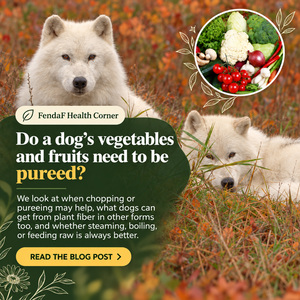
Do a dog’s vegetables and fruits need to be pureed?
Reading time: about 5 min
Some time ago, we wrote on FendaF’s social media that vegetables and fruit should be steamed or boiled and then pureed before being offered to dogs. The idea was simple: breaking down plant tissue makes some of its nutrients easier for the dog’s digestive system to access. I originally explored this after reading Lew Olson’s Raw and Natural Nutrition for Dogs. Today, I would answer a little differently. Pureeing is a useful option, not a compulsory ticket for every carrot entering a dog’s bowl.
You have probably seen recognisable orange pieces in a dog’s stools after they ate a raw carrot. It is tempting to conclude that the dog got nothing from it. It is not quite that simple. We need to distinguish what the dog can digest and absorb from what the intestinal microbes can use.
Why do plant cell walls make digestion more complicated?
Plant cells are surrounded by a wall whose important components include cellulose. A dog’s own digestive enzymes do not break down cellulose as they do starch. That does not mean vegetables pass through completely unchanged. Microbes in the large intestine can ferment some fibres, producing short-chain fatty acids among other compounds. Their role in intestinal function helps explain why fibre has value even when every plant cell does not open up.
A nutrient being present in food is not the same as it being accessible to the body. Mechanically disrupting plant structures can increase the availability of certain compounds. Heating also changes cell structure and softens some fibrous tissue. This helps with some compounds, while processing can reduce certain heat-sensitive vitamins. There is therefore little sense in declaring raw or cooked vegetables universally superior.
Carrots are a good example. Chopping and cooking can affect carotenoid availability, but a whole carrot still provides chewing activity and fibre. You cannot work out how much beta-carotene a dog absorbs from one carrot just by looking for orange pieces in the stools. A small feeding experiment involving four dogs found that granulated carrot also affects bacterial metabolism in the large intestine. That is an interesting mechanism, but results from four dogs do not establish a universal carrot rule or, by themselves, show greater vitamin or mineral absorption.
Raw, chopped or steamed: what is each useful for?
A raw piece can simply be a pleasant crunchy treat. Carrot, cucumber and other dog-appropriate vegetables do not always need a blender. The shape and size must suit the dog’s chewing habits. I would avoid pieces that could lodge in the throat of a dog who gulps large, hard chunks. Nor would I use chewing carrots as a substitute for brushing teeth.
Finely chopped or pureed vegetables are convenient when you want to mix a small amount evenly into food. Breaking plant tissue can improve access to some compounds and makes it harder for the dog to pick out individual pieces. Larger batches of puree can be frozen in small portions. Still, I see no reason to turn every cucumber slice into a laboratory emulsion. The question is the purpose, not which method sounds most scientific.
Light steaming or boiling can be especially useful for tougher vegetables or a dog who does not tolerate much raw produce. Heating can improve access to certain nutrients and soften the vegetable. During boiling, some water-soluble vitamins move into the cooking water. Sometimes that water can be used too, provided it contains no added salt or unsuitable ingredients such as onion. With garlic, risk depends on dose and preparation, but there is no need to use garlic-seasoned cooking water for an ordinary vegetable addition. None of this means cooking causes no losses at all.
I would choose preparation by asking three questions: is this a treat or an addition to a meal, what do I hope to get from it, and how does my dog tolerate it? If your dog loves crunchy fresh carrot and has no digestive trouble, there is no need to rebuild that habit. The same applies to suitable soft fruit, such as an apple piece: pureeing is optional, but remove the core and seeds and choose a safe size. For leafy greens or a little pumpkin added to meals, lightly steamed puree may simply be more practical.
Are dogs adapted to digest plant foods at all?
A dog’s teeth are well suited to tearing animal foods, and dogs do not have the digestive system of a herbivorous ruminant. That does not mean they cannot use any plant nutrients. Domestic dogs can digest appropriately prepared starch and benefit from different fibres. There is no single menu for everyone: digestibility depends on the plant, processing, quantity, the rest of the diet and the individual digestive system.
Integrative nutrition often favours natural, minimally processed plant foods. The value lies in ingredient variety, not in an obligation to feed everything raw. Equally, one visible carrot piece does not prove plant foods are useless to dogs. A better question is what this vegetable adds and whether the preparation helps achieve that purpose.
How much belongs in the bowl?
If a dog eats a balanced complete food, vegetables and fruit should generally remain small additions. A simple starting point is to keep all treats and other unbalanced extras together within roughly ten per cent of daily energy. The word energy matters. Ten per cent of calories is not ten per cent of food weight: cucumber, carrot and meat contain very different amounts of water and energy.
If you prepare the whole diet yourself, calcium, fatty acids, vitamins, trace elements and long-term balance also need attention. Vegetables do not automatically replace raw meaty bones, or vice versa. Lew Olson’s and Ian Billinghurst’s books contain useful practical ideas, but their nutritional philosophies do not prove that every dog needs the same plant proportion or preparation method.
Start with a small amount and watch whether stools, appetite and wellbeing remain normal. A therapeutic diet, gastrointestinal disease or risk of calcium oxalate stones may affect the choice of plants. Safety matters with fruit too: grapes and raisins are dangerous for dogs, and onion-family plants are not suitable casual vegetable additions. We discuss suitable and unsuitable choices further in FendaF’s article vegetables and fruit for pets.
What would I do in practice?
If I had carrot, courgette and a little leafy green to add to food, I might chop or lightly steam some, puree if useful and mix a small portion into the usual meal. If the dog simply wanted to chew a cucumber slice or a small carrot piece, I would offer it as a treat. I am not trying to improve all of nature with one preparation method. I would rather balance what the dog enjoys with what I want to achieve.
FendaF’s practical suggestion. To see whether pureeing makes a difference for your dog, offer the same suitable vegetable in small amounts over a few days, preparing it differently on different days. Keep the rest of the diet unchanged. Watch stools, gas and enjoyment of the food. One home trial cannot establish nutrient absorption scientifically, but it can give a useful clue about tolerance.
Sources
Zentek J, Meyer H (1993). Granulated carrots (Daucus carota) in dog nutrition.
WSAVA Global Nutrition Committee. Frequently Asked Questions and Myths.
Merck Veterinary Manual. Food Hazards.
Lew Olson. Raw and Natural Nutrition for Dogs; Ian Billinghurst. Give Your Dog a Bone (historical approaches to integrative nutrition).
🐾 FendaF believes in informed choices
The purpose of the FendaF blog is not to tell you what you must do. Our aim is to share knowledge, introduce different evidence-based and integrative perspectives, and help you make more informed decisions for your pet.
Every animal is unique, and no article can replace a consultation, diagnosis or treatment provided by a veterinarian. If your pet has a health concern or you need individual advice, always contact a veterinarian.










Leave a Reply