


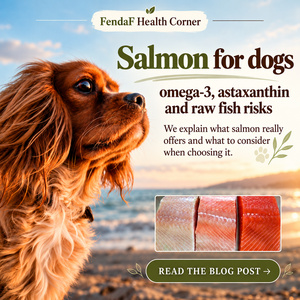
Salmon for dogs: omega-3, astaxanthin and raw fish risks
Reading time: about 5 min
I have noticed something curious with my own dogs: Faddu and Ossu have never been particularly enthusiastic about salmon, yet they happily eat Baltic herring and sprats. Choosing salmon oil has been a lengthy audition too. I have tried at least five or six oils; only two were willingly accepted, including Winner Plus omega-3 salmon oil. That is my experience of taste and smell, not proof that dogs can detect ‘clean’ salmon by scent. Still, I have learned to trust my dogs’ reactions, and for me this relates to zoopharmacognosy. When they refuse something, I ask: what makes this product different for them?
Salmon can be valuable food for dogs, but three distinct questions need separating: the nutrients it contains, what research on those nutrients actually shows, and how to offer fish without introducing avoidable risks.
Why do we talk about EPA and DHA in salmon?
Salmon provides protein and the long-chain omega-3 fatty acids EPA and DHA. They contribute to the functioning of cell membranes and signalling pathways associated with inflammation. These fatty acids have been studied in dogs for skin and coat health, joints and certain other conditions. Effects depend on the dose, the whole diet and the particular problem: a mouthful of salmon is not the same as a clinical omega-3 treatment.
Plant omega-3 sources, such as flaxseed and chia, mainly provide ALA. Dogs can convert some ALA into longer-chain fatty acids, but conversion is limited and variable. A gram of ALA therefore cannot automatically be considered equivalent to a gram of EPA or DHA. Nor are all fish oil products equal: the actual EPA and DHA content, freshness, storage and contaminant testing matter.
What do astaxanthin studies really show?
Salmon’s pinkish colour largely comes from astaxanthin, a carotenoid naturally found in certain algae and small crustaceans. Astaxanthin has antioxidant properties and its mechanisms are actively investigated. That does not mean eating salmon has been proven to prevent cancer, diabetes or eye disease in dogs.
One interesting canine study was published in the Journal of Animal Science in 2013. It involved 28 healthy female beagles, both younger and older dogs. For 16 weeks, they received either an astaxanthin supplement (20 mg daily) or a control diet. Researchers measured, among other things, mitochondrial function in blood cells. Certain markers improved, especially in older dogs. However, the trial studied a specific supplement and laboratory markers, not feeding salmon or long-term disease risk. It cannot establish cancer prevention or claims about an antioxidant being ‘hundreds of times better than vitamins’.
Is farmed salmon ‘dyed’, and is that dangerous?
Astaxanthin is commonly added to the feed of farmed salmon, since farmed fish do not obtain natural colour sources in the same way as wild salmon. Astaxanthin can have different origins, including synthetic production. The European Food Safety Authority (EFSA) has assessed synthetic astaxanthin in feed for salmonids and found no consumer safety concern at permitted levels.
This does not mean all fish farms are identical. Feed composition, farming conditions, environmental impacts and origin still deserve scrutiny. But pink flesh alone is no proof that salmon has been made dangerous by colouring, nor does Faddu and Ossu refusing it prove contamination. That does not invalidate every question about production either. Dogs’ preferences may simply reflect smell, fat content or previous experiences.
Why is it generally better to cook salmon?
Raw fish may carry parasites and disease-causing organisms. One specific hazard is salmon poisoning disease, or neorickettsiosis, described mainly in the Pacific Northwest of North America. It is caused by the bacterium Neorickettsia helminthoeca, which is carried by the fish parasite Nanophyetus salmincola.
Dogs eating infected raw salmon or trout may develop a severe illness that can be fatal if untreated. This does not mean every salmon purchased in an Estonian shop presents the same risk, but it illustrates why origin and preparation matter.
Integrative veterinarian Dr Karen Shaw Becker has likewise recommended cooking salmon before giving it to dogs. I would gently poach or bake plain fish until thoroughly cooked, remove the bones and any sharp parts near the skin, and avoid heavily salted, smoked or seasoned fish. Freezing raw fish for a few days at home is not a universal guarantee against parasites and bacteria, although adequate freezing can reduce some risks.
If salmon is only an addition to an otherwise balanced diet, its calories count alongside treats and other extras. As a general starting point, nutritionally unbalanced extras should stay around a tenth of daily energy intake. Allergies, pancreatitis and other conditions require individual veterinary advice.
Must it be salmon?
Not at all. If your dog prefers sprats or Baltic herring, these can also help diversify the menu if their origin and safe preparation are considered. A quality, tested fish oil may also provide fatty acids. In that case, compare ingredients, energy and EPA+DHA content rather than assuming more oil or a stronger smell means a better effect.
My dogs’ pickiness has taught me that even excellent food is of little practical use if a dog refuses to eat it. That is an observation, not a reason to treat every preference as a hidden nutritional test.
FendaF’s practical checklist
Choose fish of traceable origin; cook it thoroughly, remove bones and do not add salt, onion or seasoning mixes; compare EPA+DHA content and storage conditions when choosing fish oil; include the portion in daily energy intake. Do not interpret an astaxanthin laboratory study as proof that salmon cures disease.
In conclusion
Salmon can supply useful fatty acids and protein, and astaxanthin is scientifically interesting. But the most important considerations are not pink colour or one miracle ingredient. For me, the individual dog’s tolerance, product origin, safety and complete diet come first. If Ossu chooses Baltic herring rather than salmon, I would not turn that into a diagnosis. Personally, I prefer smaller fish for my own dogs and, where possible, avoid salmon raised on feed containing synthetic astaxanthin.
Sources
- Park et al. (2013), Journal of Animal Science Read source
- EFSA FEEDAP (2014), Astaxanthin for salmonids Read source
- UC Davis, Salmon Poisoning Disease in Dogs Read source
- CDC, Pet Food Safety Read source
- FendaF, Omega-3 fatty acids Read source
🐾 FendaF believes in informed choices
The purpose of the FendaF blog is not to tell you what you must do. Our aim is to share knowledge, introduce different evidence-based and integrative perspectives, and help you make more informed decisions for your pet.
Every animal is unique, and no article can replace a consultation, diagnosis or treatment provided by a veterinarian. If your pet has a health concern or you need individual advice, always contact a veterinarian.









Leave a Reply