


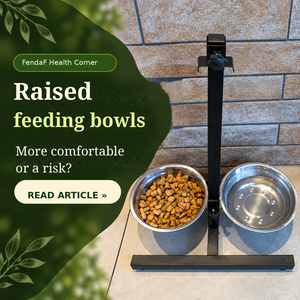
Elevated dog bowls: more comfortable or a health risk?
Reading time: about 7 min
An elevated dog bowl may seem like a sensible purchase. A large dog need not bend so far down, an older dog might be more comfortable, and perhaps the floor stays cleaner. But is a raised bowl really better for dogs? Owners’ experiences and the scientific findings do not entirely agree.
Years ago, my dogs also had raised feeding bowls. I bought them for exactly the reason many owners do: they seemed more comfortable. Eventually I stopped using them. I noticed that Faddu drank water more calmly from a bowl on the floor, and Ossu, or Oscar, who has had joint problems, did not seem to struggle with eating at ground level either. That is our experience, not proof that floor feeding suits every dog.
My starting point today is simple. If a dog can eat from the floor freely and without pain, I see no reason to raise the bowl just because it is fashionable. But if a dog has mobility or swallowing difficulties, bowl height should be assessed according to that dog’s needs.
What does an elevated dog bowl actually change?
An elevated bowl sits in a stand, positioning food or water above floor level. The stand can be wooden, metal or another material, and some models are height-adjustable. The idea is to reduce how far the dog lowers its head and neck and, sometimes, to keep the bowl from sliding across the floor.
Owners of elderly dogs or dogs with arthritis, neck pain or back pain may find a raised bowl clearly more comfortable. Integrative veterinarian Dr Karen Becker also discusses that possibility. Still, I am not aware of a good comparative canine study demonstrating that an ordinary raised bowl measurably improves pain, eating quality or long-term health for most older or arthritic dogs. Comfort is worth observing, but it should not automatically be treated as proven.
If your dog holds its neck unnaturally while eating, avoids the bowl or shows pain, it makes sense to have its mouth, teeth, neck, joints and movement assessed. Simply lifting the bowl will not fix dental pain or a neck condition. If a metal bowl keeps travelling around the room, a non-slip mat often helps without raising it off the floor.
The most serious question: raised bowls and gastric torsion
Gastric dilatation-volvulus (GDV), often called bloat or gastric torsion, is a life-threatening emergency. The stomach expands with gas or contents and may rotate on its axis. This interferes with blood circulation and can rapidly lead to shock. Large and giant deep-chested breeds, including Great Danes and German Shepherds, deserve particular attention, although other dogs can also develop GDV.
A prospective Purdue University study published in 2000 followed 1,637 large and giant-breed dogs. GDV risk was higher among dogs fed from elevated bowls. Increasing age, a first-degree relative with GDV and faster eating were also associated with risk. The researchers estimated that approximately 20% of GDV cases in large breeds and 52% in giant breeds were statistically attributable to raised feeders.
An important distinction: 20% and 52% are population-attributable risk estimates from that study, not proof that a raised bowl caused GDV in a particular dog. It was an observational study, not one in which feeding methods were randomly assigned. For instance, an owner might choose a raised bowl because of the dog’s size or health. The findings deserve attention, but a causal relationship has not been definitively established.
Dr Becker advises avoiding raised bowls for dogs at risk of GDV unless there is a compelling health reason for using one. To me, that is a reasonable precaution, not a claim that every raised bowl will cause gastric torsion. Fast eating and very large individual meals also matter: a 2004 study associated larger meal portions with increased GDV risk.
If your dog repeatedly tries to vomit without bringing anything up, becomes restless, drools, develops a swollen abdomen or becomes weak, go immediately to an emergency veterinary clinic. Do not wait for the abdomen to settle on its own. Visible swelling may not be obvious at first.
Could a raised bowl sometimes be necessary?
Yes. There is no single rule for every dog. For example, feeding position is part of the care plan for dogs with megaesophagus: food needs to move towards the stomach with the help of gravity, and these dogs often need a more upright posture while eating and afterwards. An ordinary bowl raised 10–20 cm is not necessarily sufficient. Feeding posture, food consistency and time spent upright after meals should be planned with the veterinarian.
A customised bowl height may also make eating easier for a dog with severe joint or neck pain. I would watch whether the dog adopts a natural posture, swallows comfortably and actually seems more at ease. For a dog predisposed to GDV, weigh that benefit particularly carefully against the remaining uncertainty.
Bowl size may affect how much food we serve
Height is not the only bowl feature worth thinking about. A very large bowl can make a perfectly reasonable portion look almost comically small. Sometimes we add more kibble not because the dog needs it, but because the bottom of the bowl looks too empty.
A study published in 2012 involved 54 dogs and their owners. Each owner measured dry food using four bowl-and-scoop combinations. The average portions were:
- small bowl + small scoop: 150.7 g;
- small bowl + large scoop: 171.5 g;
- large bowl + small scoop: 172.7 g;
- large bowl + large scoop: 184.5 g.
The small bowl and small scoop produced statistically smaller portions than the other combinations. That does not establish that a small bowl itself makes dogs slimmer. Rather, the experiment showed that container and measuring-tool size influence how much food people serve.
If I have to choose between kitchen scales and a measuring cup, I prefer the scales, especially when weight is an issue. Different kibble shapes and densities can weigh differently even when they fill the same cup. Treats, chews and other extras must also count towards the day’s calories. For a small dog, a seemingly harmless extra bite can account for a surprising share of daily energy intake.
Faddu and Ossu usually stop eating by themselves once they are full. Sometimes they have even skipped the next meal. That does not mean every dog can regulate its intake when unlimited food is available. For dogs prone to excess weight, measured portions and regular body-condition checks are much more dependable.
How many calories does a dog need per day?
I want to clarify a widely circulated calculation that I have shared in the past myself. The formula 30 × body weight in kilograms + 70 does not automatically give the total daily energy requirement. It estimates resting energy requirement (RER). It is generally used as a preliminary estimate for animals weighing 2–45 kg; a broader formula is 70 × body weight (kg)^0.75.
Take the earlier example of a 9.1 kg dog. Its approximate RER is 9.1 × 30 + 70 = 343 kcal per day. That is a resting-energy figure, not evidence that 343 kcal will maintain the weight of an otherwise healthy, active 9.1 kg dog.
Maintenance energy requirement (MER) depends on activity, age, health and whether the dog is neutered or spayed. Veterinary reference estimates for healthy adults include 1.6 × RER for neutered dogs, 1.8 × RER for intact dogs, and 1.4 × RER for dogs prone to gaining weight. For our 9.1 kg example, 1.6 × 343 is approximately 549 kcal, but actual needs can differ substantially from such estimates.
If a dog gains weight, I would not automatically reduce its complete food by an arbitrary 20%. A large cut can also reduce essential nutrient intake. A weight-loss plan should consider body condition, muscle mass, the food’s energy density and, where necessary, guidance from a veterinarian or veterinary nutritionist. Unexplained weight loss calls for investigating the cause, not simply increasing portions.
Weigh the usual portions served over one day, check the food package for kcal per 100 g or per kg, and include treats. Start with the dog’s body condition and the package feeding guide rather than how full the bowl looks. Then track weight and waist measurements and adjust the amount according to real changes.
What material is best for food and water bowls?
For my own dogs, I prefer stainless-steel bowls. They are durable, generally easy to wash and do not shatter into shards if dropped. Good-quality food-safe glass or ceramic may also be suitable, as long as the surface is intact and easy to clean.
Plastic bowls are light and inexpensive, but can become scratched. Scratched or cracked containers are harder to keep clean, and a dog that chews them could swallow fragments. It is also important to ensure that the plastic is intended for food contact. The composition and durability of plastics differ. Not every plastic bowl is necessarily toxic, but in my view the risks are higher than with, say, ceramic or stainless steel. If a plastic bowl is worn, I would replace it.
With ceramic bowls, make sure the glaze is food-safe and the surface has no cracks. Glass carries a breakage risk. A brand name alone cannot guarantee safety: food-contact suitability, material quality and maintenance matter more.
One basic practice matters regardless of material: washing. The US Food and Drug Administration recommends washing and drying food bowls after each meal and cleaning water bowls daily. A microbial layer called biofilm can develop even when a bowl looks clean, and a quick rinse with water may not remove it.
My choice: usually on the floor, but not as a rigid rule
If I bought entirely new bowls for my dogs today, I would probably choose smaller ones than we currently have. Put 200 grams of dry food in a huge bowl and it can barely cover the bottom. That makes judging a serving surprisingly difficult. A smaller bowl offers more practical value here than an elaborate raised stand.
I stopped using elevated bowls for Faddu and Ossu and see no reason to go back. Irene’s dogs use a stand, but it is set quite low. I do not see a contradiction: dogs, their needs and their owners’ solutions vary.
For a healthy dog without mobility or swallowing problems, particularly a large deep-chested dog, I would err on the side of a low, stable, easy-to-clean bowl. If the dog has a condition for which an elevated feeding posture may help, I would follow a veterinarian’s assessment and the dog’s actual comfort. More important than bowl fashion is how your dog eats, how much it receives, how it feels and whether there are risks you should not overlook.
Sources
- Glickman et al. (2000). Non-dietary risk factors for GDV in large and giant breed dogs. JAVMA.
- Raghavan et al. (2004). Diet-related risk factors for GDV in dogs of high-risk breeds. JAAHA.
- Murphy et al. (2012). Size of food bowl and scoop affects amount of food owners feed their dogs.
- Merck Veterinary Manual. Nutritional Requirements of Small Animals.
- American College of Veterinary Surgeons. Gastric Dilatation-Volvulus.
- Merck Veterinary Manual. Disorders of the Esophagus in Dogs.
- U.S. FDA. Proper Storage of Pet Food & Treats.
- Karen Becker. Should You Use an Elevated Bowl to Feed Your Dog? Bark & Whiskers.
- Karen Becker. Are You Overfeeding Your Dog? Bark & Whiskers.
🐾 FendaF believes in informed choices
The purpose of the FendaF blog is not to tell you what you must do. Our aim is to share knowledge, introduce different evidence-based and integrative perspectives, and help you make more informed decisions for your pet.
Every animal is unique, and no article can replace a consultation, diagnosis or treatment provided by a veterinarian. If your pet has a health concern or you need individual advice, always contact a veterinarian.







Leave a Reply