


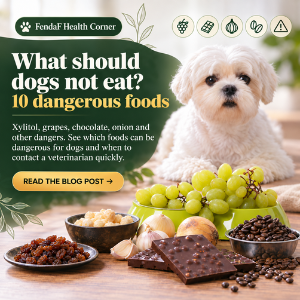
What Can Dogs Not Eat? 10 Dangerous Foods
Dogs are remarkably talented at finding exactly the thing they should not eat. Chocolate left on a table, sugar-free chewing gum found in a handbag, or rising yeast dough in the kitchen can turn into a veterinary emergency within seconds.
At the same time, not all “dangerous foods for dogs” are dangerous in the same way.
For some, even a very small amount can be a problem. For others, the risk depends on the dog’s body weight and the amount eaten. Some are not classic poisons at all, but can still cause problems such as an intestinal obstruction or pancreatitis.
And most importantly: the fact that someone else’s dog ate something and nothing happened does not prove that the same food is safe for another dog.
1. Xylitol
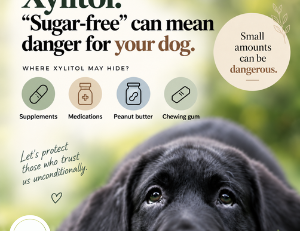
Xylitol, sometimes called birch sugar, is one of the most dangerous sweeteners commonly found in the home.
In dogs, xylitol can trigger a very rapid release of insulin and cause severe hypoglycemia. Larger doses can also cause serious liver injury.
Xylitol is not found only in chewing gum. It can be present in sweets, baked goods, toothpaste, oral-care products, supplements, medicines and even some nut butters.
If your dog has eaten a product containing xylitol, do not wait for symptoms and do not try to make the dog vomit on your own. The Merck Veterinary Manual notes that hypoglycemia can develop rapidly and activated charcoal does not bind xylitol effectively.
We have a separate in-depth article: Xylitol Poisoning in Dogs: How Dangerous Is It and What Should You Do If Your Dog Eats Xylitol?
2. Grapes and raisins
Grapes, raisins and sultanas can cause acute kidney injury in dogs.
For years, the exact cause was unknown. Tartaric acid is now considered one of the most likely toxic agents. Its concentration can vary between fruits, which may help explain why dogs can react so differently. Integrative veterinarians also point out that more research is still needed.
Because individual susceptibility varies so much, it is not useful to search the internet for a universal “safe number of grapes”.
If your dog has eaten grapes or raisins, contact a veterinarian promptly.
3. Chocolate
The main problematic compounds in chocolate are theobromine and caffeine.
They affect the central nervous system and cardiovascular system and can cause vomiting, restlessness, an increased heart rate, tremors and, in more severe cases, seizures or arrhythmias.
Not all chocolate is equal.
Cocoa powder and baking chocolate contain far more methylxanthines than milk chocolate, while white chocolate contains very little. The risk therefore depends on the dog’s weight, the amount eaten and the type of chocolate.
That obviously does not mean white chocolate should become a dog treat. We also have a separate article about chocolate, so there is no need to recreate the entire chocolate calculation here.
4. Caffeine
Coffee, coffee beans, coffee grounds, tea bags, caffeine tablets and various energy products and supplements can expose a dog to a very large caffeine dose.
Caffeine belongs to the methylxanthines together with theobromine and can cause central nervous system stimulation, tachycardia, restlessness, tremors and, at higher doses, seizures.
An accidental tiny sip of weak coffee and eating an entire bag of coffee beans are not the same situation. The dose matters.
Be especially cautious with concentrated caffeine products and supplements.
5. Onion, leek and chives
These plants belong to the Allium family, and in sufficiently large amounts their sulfur compounds can cause oxidative damage to red blood cells and hemolytic anemia.
Problems can occur with raw, cooked, concentrated or dried forms, and symptoms may be delayed.
Garlic also belongs to the Allium family, but the picture is considerably more nuanced because dose, form and how it is used all matter. We have covered this in detail in Garlic and dogs: poison, medicinal herb, or a matter of dose?.
We are therefore not going to place garlic back on this list simply under the label “poison”.
6. Alcohol
A dog does not need “just one sip”.
Ethanol is absorbed rapidly and can cause loss of coordination, vomiting, a drop in body temperature, central nervous system depression, metabolic disturbances and, in severe cases, seizures or coma.
Ethanol can be found not only in alcoholic drinks but also in some medicinal preparations, hand sanitizers and fermenting foods.
Antifreeze does not belong in this same category. Ethylene glycol poisoning is a separate and very serious toxicological emergency and should not be confused with alcohol intoxication.
7. Raw yeast dough
Raw rising yeast dough can do two harmful things in a dog’s stomach at the same time.
The warm, moist stomach is an excellent incubator for yeast. The dough can continue expanding and stretch the stomach significantly.
At the same time, fermenting yeast produces ethanol, which is absorbed into the bloodstream and can cause alcohol intoxication. Severe cases may involve central nervous system depression, hypoglycemia, seizures and dangerous gastric distension.
This is not a good candidate for the “let’s wait and see” approach at home.
8. Macadamia nuts
Macadamia nuts can cause vomiting, weakness, loss of coordination, tremors, lethargy and an increased body temperature in dogs.
The good news is that most dogs recover with supportive care and signs usually resolve within 12–48 hours.
So there is no reason to claim that one macadamia nut automatically means a fatal emergency.
But it is not an appropriate dog treat either.
9. Cooked bones
Cooked and heavily heated bones can become brittle and break into sharp fragments. A swallowed bone or bone fragment can also become lodged, for example, in the esophagus. In one retrospective study of 129 dogs, 45 had a bone lodged in the esophagus and all of those cases required intervention.
That still does not mean every raw bone is automatically risk-free.
Raw bones can also carry risks including tooth fracture, becoming lodged and gastrointestinal injury. The type and size of the bone, the size of the dog and the dog’s chewing style all matter.
That is why we have a separate in-depth article: Bones for dogs – which bone and for what purpose?
10. Very fatty table scraps and “feast meals”
This item differs from the others because fatty food is not a poison in the classic sense.
A piece of unseasoned cooked meat does not become dangerous to a dog merely because a human could have eaten it.
The problem is more likely to be an unusually fatty or unusually large meal. Dietary indiscretion is a recognized risk factor for pancreatitis in dogs, and extra caution is warranted in dogs that have had pancreatitis before or have other risk factors.
So the message is not “human food is bad”.
The message is: look at what the food actually contains and how much the dog is eating.
What should you do if your dog eats something dangerous?
The most useful information for a veterinarian is: what the dog ate, roughly how much, when it happened and how much the dog weighs. If you still have the packaging, take it with you or photograph the ingredient list.
Do not automatically induce vomiting at home. Whether vomiting is appropriate depends on the substance, the time elapsed and the dog’s condition, and in some situations it can increase the risk of aspiration or other injury.
For xylitol, grapes or raisins, a larger amount of chocolate or caffeine, alcohol and raw yeast dough, it is sensible to contact a veterinarian before symptoms develop.
“But my dog ate it and nothing happened”
This is one of the most misleading arguments when it comes to dangerous foods.
Toxicity often depends on the dose per kilogram of body weight. With chocolate, the type of product matters. With grapes, the concentration of the toxic substance can vary. Individual sensitivity also differs between dogs.
So one dog’s lucky experience is not a safety study for the next dog.
If Faddy ate something questionable and became ill, while Oscar ate exactly the same thing the next day and stayed completely fine, that would not mean Faddy was simply being a drama queen. Biology unfortunately loves inconvenient exceptions.
In summary
The most useful thing is not to memorize an endless list of things a dog “must never eat”.
It is better to know the most important hazards and be able to assess four things quickly: what substance, how much, when, and how big the dog is.
Xylitol, grapes and raisins, chocolate, caffeine, onion and other Allium plants, alcohol, raw yeast dough and macadamia nuts deserve particular attention.
Bones and very fatty foods carry a different kind of risk, but the risk is real nonetheless.
And if you are unsure, one “silly” phone call to a veterinarian is better than wishing three hours later that you had called.
Sources
- Merck Veterinary Manual: Food Hazards
- Merck Veterinary Manual: Grape, Raisin, and Tamarind Toxicosis in Dogs
- Downs J et al. (2024). Scoping review exploring the evidence base on Vitis vinifera toxicity in dogs after ingestion
- Merck Veterinary Manual: Chocolate Toxicosis in Animals
- Merck Veterinary Manual: Garlic and Onion (Allium spp) Toxicosis in Animals
- Merck Veterinary Manual: Toxicoses From Alcohols in Animals
- Merck Veterinary Manual: Bread Dough Toxicosis in Animals
- Barash NR et al. (2022). Outcomes of esophageal and gastric bone foreign bodies in dogs.
- Merck Veterinary Manual: Pancreatitis in Dogs and Cats
- Merck Veterinary Manual: Principles of Toxicosis Treatment in Animals
🐾 FendaF believes in informed choices
The purpose of the FendaF blog is not to tell you what you must do. Our aim is to share knowledge, introduce different evidence-based and integrative perspectives, and help you make more informed decisions for your pet.
Every animal is unique, and no article can replace a consultation, diagnosis or treatment provided by a veterinarian. If your pet has a health concern or you need individual advice, always contact a veterinarian.




Leave a Reply