


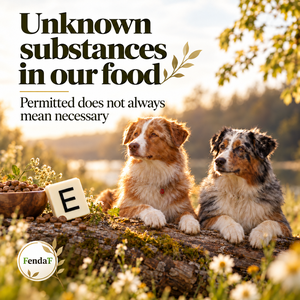
Unknown substances in our food
Reading time: about 9 min
I clearly remember when I decided to take a closer look at my own diet. I already cooked most of my meals at home and thought I was making fairly good choices. Then I began reading the labels of the few prepared foods that still found their way into my shopping basket: sausages, sauces, mayonnaise, bread and ham. What surprised me was not simply how long an ingredient list could be. I was more interested in why two seemingly similar products had completely different recipes.
Why write about human food on a dog-related blog? Because dogs frequently get food from our tables. I have heard enough stories along the lines of “we had pasta with smoked sausage left over, and the dog loved it!”. Liking the taste and being suitable to eat are two different things. Just as with dog food, one prepared human food is not necessarily equivalent to another.
Look beyond the price and packaging
Take frankfurter-style sausages. Two packs may look almost identical, yet one recipe can contain a substantial proportion of muscle meat while another contains more water, starch, skin, fat or mechanically separated meat. None of those ingredients is automatically banned or “poisonous”. They do change the composition, protein profile, flavour and often the price. We need to assess the actual ingredients and nutritional information, not the colour of the package or the word “meaty”.
The same reasoning applies to dog food. Manufacturers work within ingredient budgets and make choices when formulating recipes. Lower prices can result from more efficient manufacturing or lower margins, but also from cheaper ingredients. Price alone does not prove that a food is poor, yet it is not credible to claim that price can never have any relationship with ingredient quality. I examine this in more detail in Why food quality matters.
Start by looking at the actual ingredients: what is the principal protein source, how much salt and fat are present, and what additives are included? A single E number is not the full answer.
What are E numbers, and are all additives dangerous?
An E number identifies a food additive assessed and authorised for particular uses in the European Union. Additives can serve technological purposes: preserving a product, limiting microbial growth, maintaining texture, regulating acidity or adding colour and flavour. This does not mean that any approved substance is harmless in any possible quantity. Nor does it mean that a synthetically produced compound is necessarily more dangerous than the same compound obtained from a natural source.
Sometimes an additive is listed by its E number and sometimes by its chemical name. Potassium sorbate, for instance, is E202, not E451; sodium benzoate is E211. A chemical name on the label is not necessarily an attempt to hide something. What matters is understanding what the substance is and why it is used.
When an additive raises concerns, I think we should ask three things. What effects and risks are known? At what levels is it used? And do we actually have enough evidence about that food and that animal? The last question, I believe, is often overlooked.
For me, the issue is broader: authorisation today does not mean that an additive’s safety assessment can never change when new scientific information emerges. A good example is titanium dioxide (E171), whose authorisation as a food additive was withdrawn in the EU in 2022 because EFSA could not rule out a genotoxicity concern.
Nor is this an isolated case. The preservatives E216 and E217 were removed from the EU’s authorised food additive list in 2006, and use of the colour Red 2G (E128) was suspended in 2007. For other substances, permitted amounts were reduced; new limits for nitrites and nitrates (E249–E252), for example, became applicable in October 2025. These are not identical regulatory decisions and do not prove that every past exposure caused harm. They do illustrate how safety assessments can evolve as evidence accumulates.
Nitrites and processed meat products
Sodium nitrite (E250) is used in some processed meats. Its technological role is meaningful: it helps inhibit certain dangerous bacteria and influences colour and flavour. At the same time, under suitable conditions, nitrites can contribute to the formation of N-nitroso compounds, some of which are carcinogenic. Assessing the risks of nitrites and processed meat is therefore not just a matter of “natural versus synthetic”.
That is one reason I would not make frankfurters, other processed sausages or smoked sausage part of a dog’s daily diet. Salt, fat and potentially onion, garlic or other seasonings can also be problems for dogs. Even without a single E number, a heavily salted sausage would not become a balanced dog food.
Sorbates: is potassium sorbate genotoxic?
Potassium sorbate (E202) is a preservative used to inhibit yeasts and moulds. Online claims sometimes suggest that it inevitably damages blood cells, weakens immunity or causes cancer. Such conclusions cannot be drawn from isolated laboratory results without considering the dose and actual exposure in a living organism.
EFSA’s updated 2019 assessment found no evidence of genotoxicity for sorbic acid and potassium sorbate and established an acceptable daily intake. This is an assessment of human dietary exposure, not a separate study in dogs. It does not support the claim that E202 is genotoxic at any dose. Nevertheless, the existence of an official acceptable daily intake does not mean I personally have to want the substance in my food or my dogs’ food. A safety assessment and a personal dietary preference are two different questions.
The important point is that we can critically evaluate additives without presenting the worst conceivable hypothesis as a proven fact.
Benzoates, vitamin C and benzene formation
Sodium benzoate (E211) is also a preservative. Research on certain drinks has examined circumstances in which benzoate salts and ascorbic acid (vitamin C), in the presence of heat or light, may contribute to the formation of very small amounts of benzene. The US FDA investigated this phenomenon and found that most drinks tested had very low or undetectable levels of benzene; some manufacturers reformulated products to address the issue.
To be precise, having both a benzoate and vitamin C in a product does not automatically mean dangerous amounts of benzene will form. The reaction depends on the formulation and storage conditions. To assess a risk in dog food, we would need information about the specific product and actual exposure, not just a pair of ingredients on a label.
Flavour enhancers: does E621 cause addiction?
Monosodium glutamate (E621) gives food an umami taste. Glutamate also occurs naturally in foods such as tomatoes and cheese. The fact that processed food can taste very appealing and encourage larger portions does not automatically mean E621 produces addiction comparable to a narcotic drug.
EFSA reassessed glutamates (E620–E625) in 2017 and established a group acceptable daily intake. It also noted that estimated exposure in some population groups may exceed that amount. In my view, it makes sense to pay attention to consumption, but we cannot claim that all additives in the E620 range cause addiction.
For dogs, I would not focus solely on MSG. Prepared, seasoned food that contains a great deal of salt and fat, and possibly unsuitable seasonings, often gives us more immediate reasons not to feed it regularly.
Natural, nature-identical and synthetic are not a safety ranking
I used to view additives in quite black-and-white terms myself. The more I examine the subject, the clearer it becomes that the origin of an ingredient does not automatically determine its safety. Some natural compounds are toxic, while some synthetically manufactured substances are chemically identical to compounds found in nature. Their effects depend on the substance, purity, dose, duration of exposure and the organism involved.
That does not mean processing or the number of additives is irrelevant. I think it is entirely reasonable to ask why an additive is used and whether the product could be formulated differently. But a blanket list declaring “all these E numbers are dangerous” cannot be justified without examining each substance and its exposure. Ten E-number additives in one small salad would still be too many for my personal preference. That is my choice, not proof that ten additives automatically make every product unsafe.
What about our dogs? What can human food research tell us?
This is where particular care is required. Dogs and humans do not have identical metabolism. Some foods that are suitable for people are dangerous for dogs. Xylitol (E967), used in some sugar-free products, for example, can cause a rapid fall in a dog’s blood glucose and may damage the liver. Onion and garlic can also be hazardous, depending on the amount and circumstances.
On the other hand, human food-additive research does not automatically show that dogs are “even more sensitive” to every substance. Dogs are more sensitive to some compounds; for others, evidence is lacking. Sometimes the accurate answer is that we simply do not know enough. That does not prove an absence of risk, but neither does it justify inflating that risk without evidence.
EU rules for E-number additives in human food are also distinct from the feed-additive regulations applying to pet food. A dog food label cannot be assessed under exactly the same rules as a packet of sausages intended for humans.
What does integrative veterinary medicine emphasise?
Integrative veterinarians, including Judy Morgan and Peter Dobias, encourage owners to look at the entire diet: ingredient quality, digestive health, individual suitability and what an animal actually eats every day. I agree with that principle. For me, supporting health often begins with daily choices, not only when we arrive at a veterinary clinic.
But it does not follow that all processed foods are bad, that every additive is harmful or that raw feeding is the only good option. A balanced diet, a well-formulated complete food, controlled ingredient quality and the animal’s individual needs may matter more than a “natural” label. The influence of nutrition on health is a big topic, best evaluated as a long-term, multifactorial effect, not through a single E number.
FENDAF’S GOLDEN RULE: “Natural” is not synonymous with safe, and “synthetic” is not synonymous with toxic. What matters is the substance, dose, route of exposure and the individual animal.
FendaF’s practical advice
- If you share human food with your dog, read the complete list of ingredients, not just the E numbers. Pay special attention to salt, fat, onion, garlic and xylitol.
- Do not make frankfurters, smoked sausage or other heavily processed foods a dog’s daily “home-cooked diet”.
- Distinguish hazard from actual risk: dose, manner of exposure and the individual animal’s condition all matter.
- If an additive concerns you, consult official risk assessments and check whether the evidence concerns humans, dogs or both.
- Look at the whole picture: what does the dog eat over weeks and months, and is the diet balanced and individually suitable?
Conclusion
I have not abandoned the belief that foods differ in quality. Quite the opposite. The more we learn about ingredients, raw materials and additives, the better choices we can make for ourselves and our dogs. Yet a long, unfamiliar chemical name alone does not prove a food is bad, just as the attractive word “natural” does not automatically mean a food is good. In either case, we should ask why the substance is there.
So when I read an ingredient list, I am interested in more than whether an additive is permitted. I want to know why it was included and whether it really is essential. Could the food not be made without it, or could its safety and shelf life not be ensured in another way?
I want dog owners to ask more than “does my dog like the taste?”. The real questions are what the food provides to the body, how it was formulated and what part it plays in the dog’s everyday health. That is a much better reason to read a label than fear of individual E numbers.
References
- Regulation (EC) 1333/2008, EU list of food additives (consolidated version).
- EFSA (2019), Re-evaluation of sorbic acid (E200) and potassium sorbate (E202).
- US FDA, Questions and answers on benzene in soft drinks and other beverages.
- EFSA (2017), Re-evaluation of glutamic acid and glutamates (E620–E625).
- FEDIAF, Code of Good Labelling Practice.
- Judy Morgan, Choosing the Right Pet Food.
- Peter Dobias, The universal key to treating almost any disease.
- Commission Regulation (EU) 2022/63, ending authorisation of titanium dioxide (E171) in food.
- Directive 2006/52/EC, removal of E216 and E217.
- Commission Regulation (EC) 884/2007, suspension of Red 2G (E128).
- Commission Regulation (EU) 2023/2108, changes to nitrite and nitrate limits.
🐾 FendaF believes in informed choices
Our goal is not to frighten people, but to help them understand what is really in food. We share verified knowledge, integrative perspectives and personal experience. If your dog develops symptoms of illness, this article is no substitute for veterinary advice.
FAQ
No. An E number identifies an additive assessed and authorised for specific uses in the EU. Risk depends on the particular substance, the amount and how frequently it is consumed. It is still reasonable to ask why an additive is needed.
Yes. The EU ended authorisation of titanium dioxide (E171) as a food additive in 2022. The use of colour E128 was suspended earlier, and E216 and E217 were removed from the authorised list. For some substances, such as nitrites, permitted levels have instead been tightened.
They should not be an everyday food for dogs. Beyond additives, these products may contain high levels of salt and fat, or seasonings that are unsafe for dogs. A small accidental bite does not automatically mean poisoning, but risk depends on the product, the amount and the dog.




Leave a Reply