


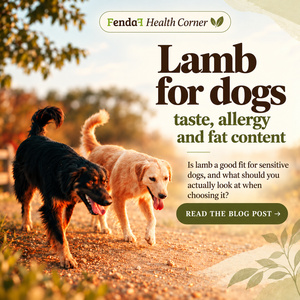
Lamb for dogs: taste, allergies and fat content
Reading time: about 6 min
When I first offered my dogs lamb-based food, their faces seemed to ask one question: do we really have to eat this? Today lamb, alongside duck, is one of their favourites. It has been fascinating to see how differently dogs respond to the same meat. I enjoy well-prepared young lamb myself, but older lamb with a pronounced ‘woolly’ flavour is not my first choice. Irene, on the other hand, says the stronger that flavour, the better.
Two quite different questions surround lamb: whether a particular dog likes and tolerates it, and whether lamb is inherently hypoallergenic or always very fatty. Neither generalisation stands up well when we look at actual cuts of meat, complete recipes and individual dogs instead of marketing labels.
Why do some dogs dislike lamb at first?
The smell and flavour of lamb depend partly on the animal’s age, fat composition, diet and preparation. It is therefore unsurprising that a dog readily accepts one lamb-based food but initially rejects another. That does not automatically mean the food is spoiled or poor quality. One unpleasant first experience does not prove an allergy either.
I have noticed with my own dogs that getting used to a new flavour can take time. Still, I do not believe in endlessly persuading a dog to eat something that does not suit them. If the dog normally has a good appetite but turns down a new recipe, I would first consider the taste, texture and previous preferences.
Is lamb a hypoallergenic protein?
Lamb can be a good option for a dog that has never eaten it before. This is the idea behind a novel protein: if the immune system has not previously encountered a particular protein source, it may be useful in a veterinary elimination diet. But lamb is not naturally allergen-free. If a dog has been eating lamb for years, it is no longer a novel protein for that dog.
When food allergy is suspected, an appropriate complete elimination diet should be planned with a veterinarian. Skin symptoms are often assessed through a strict trial lasting at least eight weeks, followed by a controlled challenge with the previous food to confirm the diagnosis. Saying ‘feed lamb for a month and you will know whether there is an allergy’ skips an essential part of diagnosis.
Some FendaF customers have dogs that did better on a lamb-based recipe than on another food. That is useful practical experience, but it does not mean lamb will suit every allergic dog.
Does lamb always mean a high-fat food?
A lean cut of lamb, a fatty belly cut and muscle meat do not have the same composition. The fat content of dog food depends on the entire recipe, not just the word ‘lamb’. We have offered lamb-based foods with relatively modest fat levels. There is no contradiction: manufacturers can choose different cuts, trim fat and balance the recipe with other ingredients.
Lamb provides animal protein and essential amino acids, as well as B vitamins and minerals. But a single figure such as ‘12.6 g of protein per 100 g of lamb’ cannot describe every cut: the result depends on the cut, fat content and whether the meat is raw or cooked. The same applies to omega-3 levels, which can vary with farming and feed.
If a dog has had pancreatitis or needs a low-fat diet, it is the actual fat level and the veterinary treatment plan that matter. We cannot approve or prohibit every food containing lamb on the basis of one ingredient name.
Should you rotate protein sources every few months?
With my dogs, I have often rotated foods for a very practical reason: they tire of a particular flavour. Lamb may alternate with duck, for example. When a dog tolerates several complete and balanced foods and transitions go smoothly, variety can be perfectly reasonable. Some integrative practitioners favour rotating proteins every three or four months, and I fully support that approach for my dogs. However, there is no convincing proof that every dog must do so to prevent allergies.
This matters especially when a food-related problem is being investigated. Frequent changes in protein sources make it harder to identify the cause. A new protein is not automatically a better one. What matters most is the dog’s skin, digestion, weight and overall wellbeing.
At FendaF, our lamb range has included lamb-and-rice and lamb-and-potato recipes. I would not judge either by its name alone. Check the analytical constituents, ingredients, calories, complete-feed designation and the individual dog’s needs.
What about raw lamb and bones?
A raw lamb’s head has been a real treat for my dogs. That is our home experience, not a safety recommendation for every dog. Raw bones can break teeth, lodge in the throat or obstruct the digestive tract. Because cooked bones pose additional risks, I never give my dogs leftover bones from cooking.
When I want to add lamb to the menu, a plain, boneless cooked piece is one of the easier options to control. Raw meat carries microbial risks, as the CDC also explains. I would not offer very fatty pan drippings either, regardless of the dog, and would be particularly cautious with sensitive digestion.
FendaF’s practical checklist
Check whether lamb is genuinely a novel protein for your dog; if allergy is suspected, plan a strict elimination diet and controlled challenge with your veterinarian; compare the fat and energy content of the whole recipe; do not buy a large bag immediately for a picky eater; and remember the risks of injury and microbial contamination with raw meat and bones.
In conclusion
Lamb is neither a miracle protein nor automatically too fatty. It suits some dogs wonderfully; others turn away, and a third dog may be allergic to it. I am happy to keep lamb on the menu, but ultimately I make decisions based on the dog, not the slogan. And when Faddu and Ossu come running at the sight of lamb, at least their taste preference is telling me something quite clearly.
Sources
- Olivry, Mueller and Prélaud (2015): duration of elimination diets in dogs Read source
- Merck Veterinary Manual: Food Allergies in Dogs and Cats Read source
- CDC: About Pet Food Safety (2025) Read source
- FendaF: Food allergy or intolerance in dogs Read source
🐾 FendaF believes in informed choices
The purpose of the FendaF blog is not to tell you what you must do. Our aim is to share knowledge, introduce different evidence-based and integrative perspectives, and help you make more informed decisions for your pet.
Every animal is unique, and no article can replace a consultation, diagnosis or treatment provided by a veterinarian. If your pet has a health concern or you need individual advice, always contact a veterinarian.










Leave a Reply