


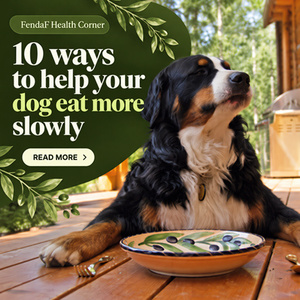
10 Ways to Help Your Dog Eat More Slowly
Reading time: about 5 min
Some dogs look at their food bowl, think for a moment and eat calmly. Others inhale an entire meal before their owner can finish saying “enjoy”. I’ve been fortunate with my own dogs: none has been a truly unstoppable food gulper. Ossu sometimes cannot be bothered to chew his kibble properly. With Faddu, though, the issue is different: after exercise he can drink an enormous amount of water in one go.
There are countless gadgets designed to slow a dog’s eating, but an effective solution does not necessarily cost anything. Dr Karen Shaw Becker has shared many practical suggestions. Let’s see which ones are worth trying and when we should look for a cause other than a strong appetite.
Why slow eating down?
Eating rapidly may increase the chance of choking, coughing, regurgitation or discomfort. But not every fast eater is sick. Gastric dilatation-volvulus (GDV), often called bloat or gastric torsion, is life-threatening, especially in certain large, deep-chested breeds. People often say that eating too quickly causes GDV. Research is not so straightforward: some observational studies have found an association and others have not. We therefore cannot claim that a slow-feeder bowl reliably prevents GDV.
Why is slowing down still worthwhile? Because it is usually a low-burden, observable intervention that may reduce gulping and make meals calmer. If a dog repeatedly has difficulty swallowing, regurgitates food, vomits or loses weight, the right answer is not an even more complicated bowl but a veterinary assessment.
1. A slow-feeder bowl
These bowls have raised sections or channels that require a dog to pick up smaller amounts at a time. Some dogs respond beautifully; others quickly learn the pattern and keep eating just as fast. Consider not only the shape but also the material, ease of washing and the size of the dog’s muzzle. The nose and tongue should not constantly rub against narrow spaces.
I prefer easily cleaned materials of reliable quality when possible. Stainless steel is one option, but other suitable food-contact materials can work too. A material’s name alone is not proof of quality. Any bowl that becomes damaged or rusty should be replaced. If a dog becomes frustrated, chews the slow feeder or tries to pick it up, it is not a good solution for that dog.
2. Make a simple obstacle yourself, but consider safety
One suggestion is to put a large smooth stone or ball in the middle of the bowl so the dog has to eat around it. The idea makes sense, but a foreign object can create a new hazard: if it can be swallowed, breaks apart or attracts chewing, don’t take the risk. A purpose-made, sufficiently large, stable food-safe object is preferable. Watch the first meals carefully.
3. Make use of the bowl’s shape
Turning certain deep-rimmed bowls upside down creates a wide ring-shaped surface on which food can be spread out. This only works if the surface is suitable for food, stable and free of sharp edges. A sliding or tipping bowl is an unnecessary source of stress.
4. Serve the meal on a large shallow tray
Spreading suitable dry food on a large clean baking tray or platter encourages a dog to pick up pieces individually instead of grabbing a whole pile. This suits a calm dog that will not chew or overturn the tray. Use a clean, non-slip surface for wet food.
5. Divide food between muffin-tin cups
A muffin tin is a surprisingly simple slow feeder: divide a meal into small portions in separate cups. The dog moves from one compartment to another rather than facing a large heap at once. Make sure the dog is not trying to chew the tin or swallow pieces of metal or silicone.
6. Try a snuffle mat, puzzle feeder or lick mat
A snuffle mat turns dry food into a searching game. A puzzle feeder asks the dog to think and manipulate objects to reach the food. Wet or soft food can be spread thinly over a lick mat. For the right dog, these tools can combine slower eating with mental enrichment.
Two things deserve attention. First, choose an appropriate difficulty level so that mealtimes do not become frustrating. Second, the device must be easy to clean. Raw food or moist leftovers trapped in deep crevices are a poor combination when the mat is only briefly rinsed afterwards.
7. Make part of the meal a training session
If a dog is food-motivated, use part of its normal daily ration to reward short exercises. A few easy cues, scent-work games or a new trick allow the food to arrive in small portions. That does not mean the dog should have to “earn” every bite. Eating should remain pleasant and the tasks should suit the dog’s abilities.
8. Play hide-and-seek with the meal
In a clean, safe space, hide small food portions in different places and let the dog find them by scent. Hiding kibble outside can work well, but only in places free from pesticides, animal faeces and dangerous objects. If the dog tends to swallow everything it discovers, choose a controlled indoor area instead.
9. Split the day’s food into smaller meals
Some dogs do better with three smaller meals instead of two larger ones. This changes the distribution, not the total daily energy requirement. Nor is there proof that several small meals automatically stop gulping or prevent GDV. What you can test is whether smaller portions and a calmer routine suit your dog.
If a dog has a specific medication schedule, gastrointestinal disease or therapeutic diet, coordinate mealtimes with veterinary advice. Keep the daily amount in check: three meals that are each “about the same size” can accidentally become extra food.
10. Offer some food by hand
When other options are unsuitable, feeding small portions by hand can help control the amount and create a calm moment of connection. It is not right for everybody: a highly excited dog may bite fingers, and raw feeding brings additional hygiene concerns. Use this method only when it is safe for dog and person and actually slows the meal.
What if your dog drinks too quickly as well?
Faddu is in a league of his own when it comes to water. I remember preparing for our BH obedience test, when he wanted to drink a great deal during breaks in cycling. Even after a walk, he sometimes tries to gulp down a huge quantity at once. I have learned to monitor this, but we must not draw one dangerous general conclusion: never routinely withhold fresh drinking water from a dog merely because it drank quickly.
Acute water intoxication, a dangerous drop in blood sodium, is rare but serious. Cases have been described when dogs swallow exceptional amounts of water while playing, swimming or chasing a hose. Sudden lethargy, poor coordination, vomiting, seizures or altered consciousness after intense water play require immediate veterinary help. A normally thirsty dog does not automatically have water intoxication.
For me, the practical approach is offering water calmly, taking regular breaks during exertion and preventing repeated mouthfuls of water during play. If a dog consistently drinks or urinates much more than usual, investigate possible medical causes rather than simply buying a smaller bowl.
What works best for your dog?
Start with the simplest option, not the most elaborate gadget. Time one ordinary meal, then change a single thing and see whether the dog eats more calmly, avoids coughing or regurgitation and does not become anxious. Some dogs enjoy sniffing, others prefer a shallow tray and still others benefit from a good slow-feeder bowl. Adding a little water to Ossu’s kibble has sometimes helped with his swallowing, but that is one dog’s experience, not a proven remedy for everyone.
FendaF’s three-day slow-eating trial
- Day 1: Time a usual meal and watch for coughing, regurgitation and signs of anxiety.
- Day 2: Try one low-risk option: a wide tray, snuffle mat or appropriate slow-feeder bowl. Don’t change the entire diet at the same time.
- Day 3: Compare the eating time and well-being. Keep the approach that works without frustration or injury risk.
- If swallowing difficulties, regurgitation, abdominal distension or pain recur, stop home experiments and consult a veterinarian.
- A rapidly enlarging abdomen, unproductive retching, restlessness, weakness or collapse may signal GDV. This is an emergency; do not wait for day three.
References
Buckley L, Lees J (2016). Go Slow Feeding Bowls. Veterinary Evidence. DOI: 10.18849/ve.v1i4.71.
Cornell University College of Veterinary Medicine. Summer safety tips: freshwater intoxication.
AAHA (2024). Fluid Therapy Guidelines for Dogs and Cats, hyponatremia.
Karen Shaw Becker (2022). How to Slow Down Food Gulping in Dogs.
🐾 FendaF believes in informed choices
The purpose of the FendaF blog is not to tell you what you must do. Our aim is to share knowledge, introduce different evidence-based and integrative perspectives, and help you make more informed decisions for your pet.
Every animal is unique, and no article can replace a consultation, diagnosis or treatment provided by a veterinarian. If your pet has a health concern or you need individual advice, always contact a veterinarian.




Leave a Reply