


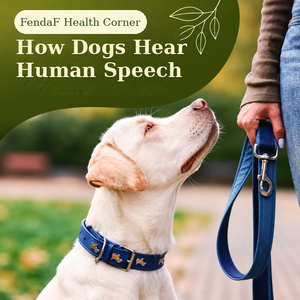
How does a dog’s brain process human speech?
Reading time: about 4 min
Does a dog understand what we say, or does it merely react to our tone of voice? I talk to my dogs quite a lot. Faddy and Oscar do not need to speak Estonian to understand us, but it would be unfair to suggest that words mean nothing to them. Sometimes one familiar word is enough to make two pairs of ears spring to attention.
Scientists have found ways to investigate this without relying only on whether a dog obeys a command. Brain measurements help distinguish recognition of a familiar word, response to intonation and the possible processing of meaning. These processes are related, but not identical.
The 2016 study: words and tone are not processed as one thing
In a study published in Science in 2016, Attila Andics and colleagues at Eötvös Loránd University investigated 13 dogs. The dogs had been trained to lie calmly in an MRI scanner while awake. This mattered: their brain responses to speech could be observed without anaesthesia and without asking them to perform an action for every spoken word.
The researchers played familiar praise words and neutral words spoken by the dogs’ trainers, in both praising and neutral tones. Brain imaging revealed a left-hemisphere preference for processing meaningful words and sensitivity to intonation in right auditory regions. Reward-related brain areas were more active when the praising word and praising tone matched.
That result is far more interesting than the familiar claim that ‘dogs only listen to our tone’. The study showed that familiar words and intonation produce distinguishable information in the brain, and that together they influence how rewarding speech is. At the same time, the study involved only 13 dogs and measured neural activity. It did not show that dogs understand whole sentences or use language as humans do. A particular brain region becoming active cannot automatically be equated with human-like language ability.
Does a dog recognise a word or understand what it refers to?
Recognising a word can involve several different processes. A dog may learn that ‘walkies’ predicts the lead, ‘sit’ asks for a particular behaviour and a toy’s name refers to a specific object. It may also notice the situation, our body language or a routine before we have even finished the word. Behaviour alone does not always reveal which information the dog is using.
In 2024, Marianna Boros and colleagues published another study in Current Biology, this time involving 18 dogs. Their owners named familiar objects and then showed either the matching object or a different one. The dogs’ EEG signals differed when the word and object did not match.
This supports the possibility that some familiar object names evoke a mental representation of the object, rather than merely an expectation to perform a certain movement. But the experiment does not prove that all dogs understand all nouns, let alone human language as a whole. It examined a limited set of known objects, and an EEG signal cannot tell us exactly how flexibly a dog uses that knowledge. Still, it makes the absolute statement ‘dogs understand none of the meanings of our words’ difficult to defend.
Why does tone of voice still matter so much?
Imagine cheerfully telling your dog ‘super!’ and then repeating the very same word without any warmth. The word has not changed, but its emotional significance may have. In the 2016 study, matching praise words and intonation were associated with greater activity in the brain’s reward-related regions.
That does not mean a familiar word becomes incomprehensible when said neutrally. It suggests that praise may be especially rewarding when both the word and the tone communicate the same positive message.
Faddy, Oscar and I have our own special word: ‘super’. During our protection-training days it was their greatest form of praise. They still get excited when they hear it. For me, that is a lovely example of a learned association, not proof that every dog must care about that particular word. Some dogs respond more to a voice, others to touch or food, and the situation matters too.
What does this mean in everyday communication?
There is no need to give a dog a lengthy lecture about why it should stay out of the bin. Longer sentences may contain several familiar words, but this does not establish that a dog understands our reasoning.
A clear, consistent cue, suitable tone, body language and well-timed feedback are usually more useful than offering a completely new explanation each time. That does not mean we must speak monotonously or abandon affectionate nicknames. Talking to our dogs is part of sharing our lives. The interesting question is which combinations of words, intonation and situations they have learned.
If a dog does not respond to a word, that alone does not prove it has failed to recognise it. Attention may be elsewhere, the surroundings may be more exciting, or the cue may not have been taught consistently.
Choose two or three important cues and use the same words each time. Teach new cues in a quiet setting and reward the desired response immediately. When praising, use a friendly tone that the dog knows. If a cue fails in a challenging situation, reduce the distractions and practise at an easier level rather than automatically raising your voice. Pay attention to whether the word, tone, context or your dog’s focus has changed.
In conclusion
A dog’s brain does not process human speech in exactly the same way as a human brain, and we have no basis for crediting dogs with full sentence comprehension. But science does not support the opposite extreme either: that our words are only meaningless sounds to them. Familiar words can be recognised, tone adds an emotional dimension, and some object names may even evoke an internal representation of what we are talking about.
I will certainly keep talking to my dogs. If someone in the street raises an eyebrow at my affectionate tone, so be it. Faddy and Ossu know perfectly well what I mean when I praise them with ‘super!’
Sources
- Andics A et al. (2016). Neural mechanisms for lexical processing in dogs. Science. DOI: 10.1126/science.aaf3777.
- Boros M et al. (2024). Neural evidence for referential understanding of object words in dogs. Current Biology. DOI: 10.1016/j.cub.2024.02.029.
- Dr Karen Becker (2016). Doing This Will Help Your Dog’s Brain Sing with Joy. Bark & Whiskers.
🐾 FendaF believes in informed choices
The purpose of the FendaF blog is not to tell you what you must do. Our aim is to share knowledge, introduce different evidence-based and integrative perspectives, and help you make more informed decisions for your pet.
Every animal is unique, and no article can replace a consultation, diagnosis or treatment provided by a veterinarian. If your pet has a health concern or you need individual advice, always contact a veterinarian.










Leave a Reply