


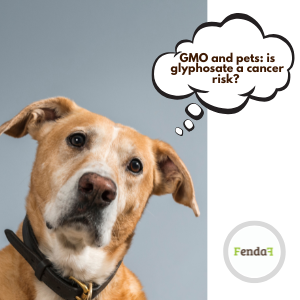
GMO – a carcinogen for pets?
The world is changing quickly, and so is the way food is produced for us and for our pets. One of the biggest changes has been the widespread use of genetically modified organisms, or GMOs. When we talk about GMOs, glyphosate inevitably enters the discussion. Glyphosate has been classified by the World Health Organization’s cancer agency as probably carcinogenic to humans, and animal studies have also provided evidence of carcinogenicity. We often hear about the benefits of GMOs: higher yields, cheaper production and the possibility of feeding a growing global population.
But we hear the other question less often: what is the price, especially when we consider the health of our pets?
GMO – saviour or risk?
Supporters of GMOs argue that feeding the world’s growing population would be difficult without them. The argument is simple:
- higher yields from a smaller area;
- more resilient crops;
- more efficient production.
Some scientists and organisations have even described GMOs as one possible answer to global food shortages. That is a strong argument and cannot simply be dismissed. But it raises another question: has the increase in quantity come at the expense of quality and health? In many widely grown GMO crops, genetic modification is linked to herbicide tolerance, and glyphosate may therefore be used within that production system.
Integrative veterinarians point to glyphosate exposure as one important concern associated with GMO crops. Many widely grown GMO crops have been engineered to tolerate herbicides, allowing glyphosate to be used during the growing season. Several integrative veterinarians regard glyphosate as an important health risk and discuss it as a possible carcinogen and a concern for pets’ long-term health.
It is important, however, to distinguish between two concepts: hazard and risk. The IARC classification describes an agent’s ability to cause cancer under certain conditions, meaning its potential hazard. By itself, it does not tell us the magnitude of cancer risk for a particular person or animal under ordinary exposure. Risk depends, among other things, on the amount, duration and route of exposure.
What does GMO actually mean?
Put simply, GMO means that the genes of an organism are altered or combined with genes from another organism. Jeffrey Smith, founder of the Institute for Responsible Technology, describes it this way:
“Scientists take genes from one species, such as a bacterium or virus, and insert them into another species, such as corn or soy.”
Many widely grown GMO crops have been developed to tolerate specific herbicides, allowing those herbicides to be used on the growing crop, particularly glyphosate-containing Roundup. This means crops can be sprayed repeatedly: the plant survives, while chemical residues can enter the food chain.
Glyphosate – an invisible passenger in food
The World Health Organization’s cancer agency has classified glyphosate as probably carcinogenic to humans. Animal studies have also provided evidence of carcinogenicity. At the same time:
- there is no complete scientific consensus;
- some regulatory authorities consider it safe within specified limits.
What is clear, however, is that:
- glyphosate is used very widely;
- exposure can be ongoing and cumulative;
- animal studies have found associations with cancer, although there is no complete agreement on how the findings should be interpreted.
This leads to a practical question: does “within permitted limits” also mean “optimal for health”? And is optimal health what we should be aiming for, both for ourselves and for our pets?
It is this combination of genetic modification, increased chemical use, and raw materials that may be of lower quality and more highly processed than human food that concerns some specialists, rather than GMO technology alone.
What does pet food actually contain?
When we choose food for ourselves, we think about quality. But do we do the same for our pets?
Pet food is not regulated according to exactly the same standards as human food. This means that ingredients not intended for human consumption may be used, such as various animal by-products or parts with lower commercial value.
That does not automatically make the food unsafe. But it does mean that quality can vary greatly.
In addition, many conventional pet foods are:
- highly processed;
- made from less expensive raw materials;
- often made with ingredients of GMO origin.
Add pesticide residues and processing designed to extend shelf life, and another question appears: is the food merely “adequate”, or does it genuinely support your pet’s health?
This is where conscious choice comes in.
More and more owners are looking for food that is:
- GMO-free;
- made with a simpler, more understandable ingredient list;
- as close to natural as possible.
For example, there are foods that are:
- completely GMO- and gluten-free;
- made from high-quality, carefully selected ingredients;
- suitable also for animals with sensitive digestion.
And this is no longer a niche. It is becoming a new standard. Ultimately, the question is not only whether food fills the stomach. The question is what that food does to your pet’s body every day.
Why are some veterinarians concerned?
This is where the discussion becomes particularly interesting.
Several integrative veterinarians, including Dr. Karen Becker, Dr. Judy Morgan, Dr. Peter Dobias and Dr. Katie Woodley, do not look at only one chemical or one study. They look at the bigger picture. In their view, the issue is not a single symptom but a pattern: an organism living with persistent low-grade inflammation. Their clinical observations include:
- more allergies;
- more gastrointestinal problems;
- more chronic disease.
These are observations from integrative veterinary practice. Karen Becker emphasises that when an animal is ill, one simple step is to reduce the amount of toxins in the diet. Judy Morgan links chronic disease with long-term exposure to processed, chemical-heavy food. Peter Dobias highlights the close connection between the gastrointestinal tract and the immune system, with food at the centre of both.
Could the problem begin in the gut?
There is growing discussion about the role of the gut in health and about so-called “leaky gut”. Dr. Marlene Siegel says:
“Inflammation is at the root of many diseases, and it often begins in the gastrointestinal tract, where chemicals, pesticides and GMO ingredients can also play a role.”
When the gut microbiome is disrupted:
- the immune system may become weaker;
- allergies can develop;
- the risk of chronic disease may increase.
This is not a dramatic explosion. It is more like a slow accumulation.
Does changing the diet really help?
Here, opinions diverge again. There are no large, unequivocal studies proving that GMO alone causes specific diseases in pets. At the same time:
- many veterinarians report seeing changes in their practice;
- pet owners describe improvements after changing the diet.
Dr. Karen Becker recommends:
- reducing the chemical load;
- choosing cleaner food.
Dr. Judy Morgan has observed improvements in:
- skin and coat problems;
- digestion;
- energy levels.
This may not be the effect of GMO alone. But it clearly points to the importance of overall food quality.
GMO-free does not automatically mean glyphosate-free
An important distinction is needed here. GMO and glyphosate are not synonyms. Glyphosate is also used in agriculture where the crop itself is not genetically modified, and practices may differ by country, crop and production system.
A GMO-free label can therefore be one quality indicator, but on its own it does not tell us the actual pesticide burden of the raw material. If the goal is to reduce possible exposure, it makes sense to look more broadly at ingredient origin, cultivation methods, the manufacturer’s quality control and the whole recipe, rather than at a single label on the package.
What can you do as a pet owner?
This is not a black-and-white issue. GMO is not automatically “poison”. But that does not mean it is completely neutral either. It is important to distinguish GMO technology itself from the way it is used in practice, for example in pesticide-linked production systems. The real question is: how much additional burden do we place on our pet’s body every day? Dr. Siegel puts it very directly:
“We need to start thinking differently. Until consumers demand better food, nothing will change.”
Practical recommendations
You do not have to change everything overnight. But you can make more conscious choices.
- Check the ingredients
- Prefer a simpler ingredient list
- Choose GMO-free or organic when possible
- Support gastrointestinal health
- Watch your animal, not just the package
For ingredient choice, avoid foods in which corn, soy and wheat are the main components unless it is specifically stated that they are non-GMO. In general, the less processed and unnecessarily complicated the ingredient list, the better. Even a partial shift towards GMO-free or organic choices may reduce the overall burden.
Support gut health with high-quality food, pro- and prebiotics, and fresh, less processed ingredients such as raw meat, organs, vegetables and fruit. Remember, however, that every diet, especially a raw diet, must be balanced and carefully planned to meet all of the animal’s needs.
Finally, look at your animal. Coat, energy, digestion and skin are among the best feedback systems you have.
Summary
- GMOs help increase food production and may play a role in alleviating global food shortages;
- at the same time, many GMO crops are associated with intensive pesticide use;
- there is no complete scientific consensus on the health effects of glyphosate;
- integrative veterinarians observe links between nutrition and chronic disease;
- food quality and chemical load may affect a pet’s long-term health.
This is not a story about everything being bad. It is a story about choices mattering.
Not once. But every day, quietly and almost unnoticed, in the bowl you place in front of your pet.
You are giving them something from which their body builds its health. The effect may not be immediately visible, but over time it builds either a strong foundation… or something that may later need repairing.
Every animal is unique, and no article can replace a consultation, diagnosis or treatment provided by a veterinarian. If your pet has a health concern or you need individual advice, always contact a veterinarian.
Sources used:
- Dr. Karen Becker. Pets and GMO’s.
- W. Jean Dodds. Food Contamination with Glyphosate and Other Herbicides.
- Dr. Peter Dobias. A natural cleanse protocol to keep your dog healthy.
- Dr. Judy Morgan. Glyphosate – What is it and Why should I care?
- Dr. Judy Morgan. Glyphosate Replacement That Is Worse & Lingers Longer.
- International Agency for Research on Cancer (IARC). Some Organophosphate Insecticides and Herbicides. IARC Monographs, Volume 112. 2017.







Leave a Reply