


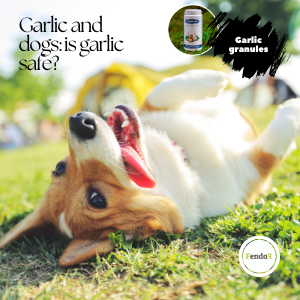
Garlic and dogs: poison, medicinal herb, or a matter of dose?
A quick search for foods that are dangerous to dogs will almost always put garlic on the list. At the same time, garlic is used in raw-feeding circles, integrative veterinary medicine, and supplements made specifically for dogs. How can both of those things be true?
The answer is a little annoying, but very true to real life: with garlic, the amount, form, frequency of use, and the individual dog all matter. “Garlic is poison to dogs” is too simple. But it would be just as simplistic to say that because garlic is natural, it is always safe.
We have used garlic with our own dogs, and I do not see it as something that must automatically be kept out of a dog’s bowl at all costs. At the same time, more research is now available, and it helps explain quite well why garlic has become such a controversial topic.
Why is garlic considered dangerous for dogs?
Garlic belongs to the Allium family, along with onions, leeks, and chives. These plants contain sulfur compounds that, in a sufficiently high amount, can cause oxidative damage to a dog’s red blood cells. This may lead to Heinz bodies and eccentrocytes, meaning structural changes in red blood cells, and in more severe cases to hemolytic anemia.
That risk is real. The important question is what a particular study or poisoning case actually tells us, and what we should not extrapolate from it.
In the frequently cited 2000 Hokkaido University study, eight healthy adult dogs were included. Four were given garlic extract for seven consecutive days at an amount equivalent to 5 grams of whole garlic per kilogram of body weight per day. The other four dogs were controls. In the garlic group, red blood cell count, hematocrit, and hemoglobin decreased, and markers of oxidative damage appeared in the blood. However, none of the dogs developed clinical hemolytic anemia.
So the study clearly shows that a large amount of garlic can damage a dog’s red blood cells. It does not show that every small amount of garlic is lethal to dogs. Those are two very different claims.
What have newer studies added to the picture?
The picture becomes even more interesting when we look at different forms of garlic. In 2018, aged garlic extract, or AGE, was studied in healthy Beagles. The dogs received 45 or 90 mg of AGE per kilogram of body weight per day for 12 weeks. The study found no hemolysis, Heinz bodies, or other clinically significant changes in blood or biochemical values. At the same time, the activity of several genes related to the Nrf2 pathway and antioxidant enzymes increased.
That does not mean we can use an AGE study to calculate a dose of raw garlic or garlic granules. Aged garlic extract is a different product with a different composition. But the study matters because it shows very clearly that the word “garlic” alone does not tell us either the safety or the effect.
In a small 2023 study, Beagles with mild gingivitis received AGE at 18 mg/kg per day for eight weeks. Gingivitis scores improved and no significant adverse effects were observed. This is a real canine study, but it concerns one specific preparation and one specific problem. It is not evidence that every form of garlic treats everything.
A 2025 laboratory study added another useful piece to the puzzle: in an in vitro experiment using canine red blood cells, both the form and concentration of garlic affected hemolysis. The strongest effect was seen with higher-concentration granulated garlic. Because this was a test-tube study, we cannot directly translate it into a dietary dose that would cause problems in a living dog, but it does reinforce one point: form and dose matter.
But are there real cases of garlic poisoning?
Yes. Merck Veterinary Manual notes that Allium toxicosis has been reported in dogs and cats after eating raw, cooked, and concentrated forms of garlic and onion. Powders, flakes, and other concentrated forms deserve particular attention because a small volume can contain a large amount of plant material.
A rare fatal case of garlic toxicosis in a dog was also published in 2026. That confirms that the risk cannot be treated as zero. At the same time, the amount of garlic found in the stomach cannot be used to calculate a universal “toxic dose”, because we do not know the exact total amount consumed or the individual dog’s sensitivity.
So the better question is not “Is garlic toxic?” but “When can garlic become a problem for a dog?”
Integrative veterinary medicine does not view garlic only as a toxin
Garlic is still used in integrative veterinary medicine. In her materials, Dr Judy Morgan recommends small amounts of fresh crushed garlic and describes it, among other things, as supportive for immunity, circulation, and parasite control. Her guideline for dogs is approximately half a clove per 20 pounds, or about 9 kilograms, of body weight per day; in different articles she sets an upper limit of 2–3 cloves. She recommends avoiding garlic in dogs with a history of hemolytic anemia and does not use it for parasite control in pregnant or nursing dogs.
I am deliberately emphasizing that this is the practical recommendation of a specific integrative veterinarian. It is not an official toxicological safety threshold, and it does not mean the same amount will automatically suit every dog.
This is also a good example of where integrative and conventional medicine do not necessarily have to cancel each other out. Toxicology is correct that garlic’s sulfur compounds can damage red blood cells when exposure is high enough. Integrative practice uses smaller, controlled amounts in dogs for specific purposes. The real questions are the dose, the preparation, and the individual dog’s risk.
Can garlic help against ticks and fleas?
This is one of the main reasons dog owners become interested in garlic. Dr Judy Morgan uses fresh crushed garlic as one part of a natural flea and tick control plan.
Laboratory studies have indeed found tick-repellent and tick-killing effects in garlic extracts, and there is also a canine study in which a topical combination product containing garlic worked against ticks. But we need to be precise: these studies looked at extracts or topical combinations, not whether eating a clove of garlic every day makes a dog “taste bad” to ticks. I could not find a good clinical canine study supporting that specific claim.
So garlic may be one component of an integrative parasite-control strategy, but I would not present it as a proven stand-alone method for preventing tick-borne disease. In a high-risk area or for a dog with heavy tick exposure, the whole prevention strategy deserves thought rather than relying on a single tool.
Read also: Chemical tick treatments and why we no longer use them
Which potential benefits can we honestly talk about today?
Garlic comes with a very long list of proposed benefits. The evidence in dogs is not equally strong for all of them. I think the most honest approach is to separate them.
|
Type of evidence |
What can be said |
|
Studied in dogs |
Aged garlic extract has shown good tolerability at specific doses, increased activity of genes related to Nrf2 and antioxidant enzymes, and, in a separate study, improvement in mild gingivitis scores. |
|
Used in integrative practice |
Support for immunity and circulation, natural parasite control, and antimicrobial support. Dr Judy Morgan uses garlic in these roles, but strong clinical evidence in dogs is not available for all of these uses. |
|
Mainly extrapolated from other species or laboratory research |
Claims about anticancer effects, cholesterol, liver “detox”, and treatment of many infections are based largely on human, laboratory, or other-animal data. They should not be presented as proven treatment effects in dogs. |
That does not make integrative uses worthless. It simply tells the reader honestly what weight to give the information they are looking at.
Our own experience with garlic
When the first version of this article was written, I started a course of garlic granules for Faddy and Ossu. They had the granules mixed with cottage cheese, and despite the rather powerful garlic smell, both ate it very happily. The plan was to finish one container and then take a break.
That is our experience, not proof that the same approach will suit every dog. But our experience is not meaningless simply because warnings about garlic exist. With what we know today, I would add something we did not emphasize as much at the time: during long-term use, or whenever there is doubt, a blood test can provide extra reassurance, especially if the dog has other risk factors.
Fresh, dried, granulated, or aged extract?
They are not the same thing. Fresh crushed garlic has a different compound profile from dried or granulated garlic. Aged garlic extract is produced through a long extraction process, and this is the form that has a 12-week safety study in dogs.
In the 2025 in vitro study, every tested form of garlic caused some degree of red blood cell damage, but the effect depended on both form and concentration and was greatest with higher-concentration granulated garlic. That does not give us a ready-made home dosing table, but it is another reason not to treat a clove of garlic, garlic powder, granules, and AGE as gram-for-gram equivalents.
If you choose a ready-made supplement for dogs, I prefer a product with a clearly stated composition and manufacturer dosing instructions rather than the “a little by eye” approach.
When would I be especially cautious with garlic?
First, in a dog with a history of hemolytic anemia or another red blood cell disorder. Dr Judy Morgan recommends avoiding garlic in such cases, and that caution also makes sense from a toxicology perspective.
The second group is certain Japanese and Korean breeds. Studies have described greater sensitivity to onion and its oxidizing compounds in Shiba Inu, Akita Inu, and Jindo dogs. That does not automatically mean they can never have any garlic, but I would not use a general “same amount for every dog” rule with these breeds.
For pregnant or nursing dogs, Judy Morgan recommends not using garlic at least for parasite-control purposes. I would also discuss regular garlic supplementation with a veterinarian if the dog is on medication, has a chronic illness, or has a history of anemia.
And a cat is not a small dog. Cats’ red blood cells are more sensitive to oxidative damage, so I would not carry dog dosing logic over to cats.
If you decide to use garlic
I would no longer put one universal “safe amount” table here because it gives a falsely simple impression. Fresh garlic, a granulated supplement, and aged extract are not directly comparable gram for gram, and integrative veterinary recommendations are also tied to a specific form.
If you use fresh garlic, Dr Judy Morgan recommends crushing or chopping it and letting it sit for about 10–15 minutes before adding it to food. If you use a ready-made product for dogs, follow that product’s instructions. And if you have a very small dog, a higher-risk breed, a dog with a chronic condition, or a dog taking medication, I would discuss it with a veterinarian first.
For longer courses, an occasional blood test is not a bad idea, especially if you want to use garlic continuously rather than for a short course of a couple of weeks.
Which symptoms could indicate a problem?
- pale or yellowish gums
- lethargy and weakness
- loss of appetite or vomiting
- increased breathing rate or heart rate
- a sudden drop in exercise tolerance
- dark or reddish urine
- collapse
Symptoms of Allium-related hemolysis may be delayed and do not necessarily appear immediately after ingestion. If a dog has eaten a large amount of garlic or develops symptoms like these, that is a veterinary issue, not a home-monitoring project.
In conclusion
Garlic has become one of those classic internet topics where a nuanced issue gets split into two opposing camps. At one end: “garlic kills dogs.” At the other: “garlic is a miracle cure.” I do not like either extreme, because life has shown again and again that the truth is often somewhere in between and depends on the individual.
We know that a sufficiently high or inappropriate exposure can damage a dog’s red blood cells, and genuine poisoning cases do exist. At the same time, canine studies have found that aged garlic extract was well tolerated at specific doses and also showed some potentially beneficial effects. Integrative veterinarians also deliberately use small amounts of fresh garlic. And our own experience, as well as that of our customers, has also been positive.
So I do not ask, “Is garlic good or bad?” I ask: in what form, how much, how often, for what purpose, and for which dog? That question already leads to a much smarter answer.
Sources:
- Yamato O. jt, 2000. Hematologic changes associated with garlic extract in dogs
- Yamato O. jt, 2018. Safety and efficacy of aged garlic extract in dogs
- Yamato O. jt, 2023. Therapeutic effect of aged garlic extract on gingivitis in dogs
- Beleć K. jt, 2025. Effect of garlic type and concentration on canine erythrocytes
- Merck Veterinary Manual, Garlic and Onion (Allium spp) Toxicosis in Animals
- Biasibetti E. jt, 2026. Fatal Garlic Toxicosis in a Dog
- Dr Judy Morgan, Flea and Tick Prevention Revisited
- Dr Judy Morgan, Intestinal Parasites in Cats & Dogs
- Dr Judy Morgan, Cancer Awareness Month
- Nchu F. jt, garlic extract tick repellency study
🐾 FendaF believes in informed choices
The purpose of the FendaF blog is not to tell you what you must do. Our aim is to share knowledge, introduce different evidence-based and integrative perspectives, and help you make more informed decisions for your pet.
Every animal is unique, and no article can replace a consultation, diagnosis or treatment provided by a veterinarian. If your pet has a health concern or you need individual advice, always contact a veterinarian.








Leave a Reply