


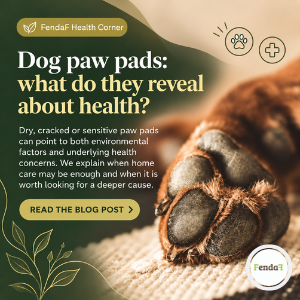
Paw pads and their care
A dry paw pad, an abrasion, a burn and a paw that is constantly being licked are not the same problem. The most useful first step is to look at what the damage actually is and only then decide whether it needs simple care, first aid or a veterinarian.
I have been a dog owner for more than 20 years, yet Faddu’s paw-pad problem once caught me completely by surprise. We had been walking a lot with the boys, and I had also been running with Faddu. One evening he went outside and, for a moment, his hindquarters seemed almost unsteady. Because he had been diagnosed with spondylosis, my thoughts naturally went straight to his back. But when I checked his paws, the pads were very dry and cracked, with lighter areas in places.
At the time, I gave his paws a mild povidone-iodine soak, applied coconut oil to the pads and let him rest. About an hour later he was moving much better again. Looking back, I cannot honestly say that the paw pads were the only cause or that those two home measures acted as a ‘treatment’. But it taught me one very practical lesson: if a dog suddenly limps, licks a paw or does not want to move, it is worth actually checking the paws rather than assuming the cause must be somewhere else.
What do paw pads do?
Paw pads carry a dog’s body weight with every step. They cushion impact, help with grip and balance, and protect deeper tissues from rough surfaces and temperature extremes. They are durable, but not indestructible.
The surface of a paw pad does not need to be baby-soft. Some roughness and a strong keratin layer are normal. It becomes a problem when the surface cracks deeply, bleeds, becomes painful, swells, develops discharge or a bad smell, or the dog begins licking the paw constantly or avoids putting weight on it.
If a dog licks or holds up a paw, ask why
Paw licking is a symptom, not a diagnosis. Allergy is one possible cause, but not the only one. Check the entire paw:
- paw pads – cracks, abrasions, blisters, burns, colour changes;
- between the toes – redness, moisture, swelling, painful nodules or discharge;
- nails and nail folds – breakage, splitting, an overgrown nail, inflammation;
- foreign bodies – thorns, glass, small stones or other material;
- odour and greasy skin – these may suggest overgrowth of yeast or bacteria, but diagnosis often requires cytology;
- pain pattern – if the skin looks almost normal, licking may also be driven by joint, muscle or nerve irritation.
If the pads are abnormally thickened and keratinised, see also FendaF’s article on hyperkeratosis.
If the main issue is itching and repeated licking, you may also find Itchy skin in dogs: 10 natural remedies helpful.
Dry and rough, but healthy paw pads
If a paw pad is simply dry and rough, but is not bleeding or oozing and the dog is not limping, gentle cleaning and a protective moisturising layer may help. A fragrance-free, non-irritating paw balm made for dogs and containing ingredients such as beeswax, shea butter, jojoba oil or coconut oil may reduce water loss and help keep the pad more flexible.
Coconut oil can act as an emollient, meaning it can soften the skin and reduce dryness, but I would not treat it as medication for an open wound or infection. The same applies to calendula, shea butter and other oils: they may be useful as care products, but ‘natural’ does not automatically mean suitable for every dog, every lesion or unlimited licking.
Abrasion, cut or torn paw pad: first-aid principles
Paw-pad wounds can be deceptively troublesome because the dog steps on the wound with every stride and pad tissue does not hold sutures as well as many other tissues. This does not mean paw-pad wounds are never sutured: some superficial or contaminated wounds may be left to heal open, while a deep or full-thickness tear may require surgical closure and reduced weight bearing. The decision depends on the depth and location of the wound, contamination and how old the injury is.
Home first aid is intended as temporary care for a minor injury, not as a way to ‘treat away’ a deep cut or a painful paw.
- Flush dirt out with plenty of clean lukewarm water or sterile 0.9% saline.
- If there is a small foreign body on the surface that is easy to remove, it can be removed carefully. Do not dig for an object embedded deeply.
- If there is bleeding, apply steady pressure with clean gauze or a towel for 10-15 minutes. If the bleeding does not stop, urgent veterinary care is needed.
- Avoid hydrogen peroxide and strong disinfectants in an open wound because they can damage healing tissue.
- If the paw needs a bandage, it should be well padded and not too tight. An incorrectly applied bandage can cause swelling and impaired circulation.
What about a povidone-iodine paw soak?
Povidone-iodine, such as Betadine, is a genuine antiseptic and is also used in veterinary medicine. In integrative practice, a diluted povidone-iodine paw soak is sometimes recommended for irritated paws. In Faddu’s case, it helped at least in the sense that the paws were cleaned and he seemed more comfortable afterwards.
There is, however, an important nuance: ‘add iodine until the water looks like iced tea’ is too imprecise to be the only instruction. Povidone-iodine products can come in different concentrations, and an overly strong antiseptic can irritate healing tissue. In conventional wound care, sterile saline is one of the gentlest irrigation fluids for healing tissue, and a correctly diluted antiseptic may be used when appropriate. If the paw is bleeding, deeply damaged, extensively burned or suspected to be infected, it is worth consulting a veterinarian rather than relying only on a povidone-iodine paw soak.
Hot pavement, cold, road salt and chemicals
In summer, pavement exposed to the sun can become hot enough to burn a dog’s paws. A useful simple guide is the 5-second hand test: place your palm or the back of your hand against the pavement or another hard surface. If you cannot comfortably keep it there for about five seconds, choose a cooler surface or walk later. Some guidance uses a 7-second version of the same test. It is not a precise temperature measurement and does not guarantee that prolonged walking is safe, but in everyday situations it can quickly flag a surface that is clearly too hot.
In winter, ice, cold, road salt and other chemicals spread on streets can cause problems; after winter walks in town, it is sensible to rinse and dry the paws.
If a dog begins licking its paws or limping after walking on a hot surface, cool the paw with room-temperature or cool water. Blisters, marked colour change, exposed tissue or obvious pain need veterinary attention. If a chemical gets on the paw, rinse with plenty of water and, if the substance is corrosive or of unknown composition, contact a veterinarian promptly.
Chamomile, calendula, salt and aloe: where do they fit?
What I like about an integrative approach is the idea of using the gentlest support possible when the problem truly is mild. Chamomile and calendula are interesting plants, and a systematic review in veterinary dermatology found antimicrobial, anti-inflammatory and wound-healing-related properties. At the same time, much of the evidence came from laboratory or other preclinical work, with less high-quality clinical evidence in dogs. I therefore see them more as complementary options in an appropriate preparation, not as primary treatment for an open or infected wound.
With the previously discussed salt-chamomile-aloe paw soak, it is worth separating the individual components.
A very salty solution can irritate and dry the skin, and the claim that sea salt is inherently a ‘fast-healing antibacterial agent’ is too strong. Plain water or sterile saline is a more reliable starting point for cleaning a paw. Chamomile can be considered a gentle complementary herbal option, while aloe is better used separately as a gel after cleaning when the paw is dry or mildly irritated rather than deeply open or suspected to be infected.
With aloe, the most important point is which part of the plant we mean. Use only the clear gel from inside the leaf. The green rind and the yellowish latex layer beneath it contain, among other compounds, aloin and should not be given to the dog or left attached to the gel. The ASPCA also distinguishes the problematic leaf components from the inner gel and notes the gel as edible. If you use a fresh leaf, remove the rind and yellowish layer completely and rinse the clear gel before use. If you buy a prepared gel, choose a product that is as pure and aloin-free as possible. A small amount of gel can be applied in a thin layer to a dry or mildly irritated paw pad, but a deep, bleeding or potentially infected lesion needs a different approach.
Chamomile tea around the eyes: an integrative option, but sterility matters
Cooled chamomile tea is also used in integrative veterinary medicine for mild irritation around the eyes and tearing. It can be used with a clean compress or cotton pad to gently clean the area around the eye. Some holistic veterinarians also describe well-strained chamomile tea as an eye rinse, but because tea prepared at home is not sterile, we prefer sterile saline for rinsing the eye itself. Pain, squinting, heavy discharge, injury or persistent redness warrants veterinary assessment.
When does a paw need a veterinarian?
- The dog will not bear weight on the paw, the limp is severe or the pain is getting worse.
- The paw pad is deeply cracked, torn, peeled back or continues bleeding after 10-15 minutes of pressure.
- There are blisters, an extensive burn, tissue that has turned black or white, or subcutaneous tissue is visible.
- There is a deeply embedded foreign body or puncture wound in the paw.
- Swelling, heat, a bad smell, pus or other discharge develops.
- The dog licks the paw constantly or the problem keeps recurring in the same place.
- Several paws become red or painful at the same time, which may point to allergy, contact irritation or another more widespread problem.
- A nail is traumatised or bleeding, or the nail fold is severely inflamed.
How can paw problems be prevented?
- Check the paws after longer walks, forest outings and runs.
- Increase unfamiliar exercise and time on rough surfaces gradually.
- Keep the nails at an appropriate length. Integrative veterinarian Dr Julie Buzby has long emphasised that overly long nails that contact the ground can alter paw placement, posture and movement; VCA also notes that very long nails can interfere with normal foot placement. At the same time, the first small instrumented gait study published in 2026 found in seven healthy dogs that shortening the nails by 5-8 mm did not significantly change overall gait parameters, although a small change in the local centre of pressure of the paw was detected. In other words, the evidence does not support the absolute claim that every longer nail disrupts gait, but nail length should not be treated as merely cosmetic.
- In summer, avoid hot pavement, plan longer walks for cooler times of day and use the 5-second hand test as a quick guide when needed.
- In winter, rinse road salt and chemicals from the paws when needed and dry especially well between the toes.
- For dry but healthy pads, use a protective dog paw balm or paw wax when needed.
- If the dog dislikes having its paws handled, build tolerance calmly with positive reinforcement rather than force.
For persistent licking and self-inflicted skin damage, also read Lick granuloma or acral lick dermatitis.
In summary
Paw pads do not need a daily ten-jar ritual. Most of the time they need three things: sensible loading, regular checks and the right response when something changes. A dry, rough but healthy pad may simply need protective moisturising. An abrasion needs cleaning and rest. A bleeding, burned, deeply cracked or persistently painful paw already needs a different plan.
When home care comes into play, the principle is simple: gentle does not automatically mean effective, and natural does not automatically mean safe. Use the simplest solution that works, watch how the dog responds and do not let the balm jar distract from the question of why the paw hurts in the first place.
Sources used
- Merck Veterinary Manual: Initial Wound Management in Small Animals
- VCA Animal Hospitals: First Aid for Torn or Injured Foot Pads in Dogs
- American Veterinary Medical Association: Warm weather pet safety
- ASPCA Animal Poison Control: Aloe
- VCA Animal Hospitals: Sterile Eye Wash
- Scientific Reports / PubMed: Medicinal plants as therapeutic options for topical treatment in canine dermatology? A systematic review
- Bark & Whiskers: Veterinary Care – Signs of True Medical Emergencies
- Dogs Naturally: Home Remedies for Sore Dog Paws
- RSPCA: Safe for Summer
- Bark & Whiskers: Could This Soothe Your Dog from Nose to Toes?
- Dogs Naturally / Dr. Edward Bassingthwaighte: Why Are My Dog’s Eyes Red?
- Whole Dog Journal: Keeping Your Dog’s Feet Healthy
- VCA Animal Hospitals: Successful Nail Trims
- Frontiers in Veterinary Science (2026): Trimming of nails in healthy dogs does not change gait parameters when comparing pre- and post-nail trim
🐾 FendaF believes in informed choices
The purpose of the FendaF blog is not to tell you what you must do. Our aim is to share knowledge, introduce different evidence-based and integrative perspectives, and help you make more informed decisions for your pet.
Every animal is unique, and no article can replace a consultation, diagnosis or treatment provided by a veterinarian. If your pet has a health concern or you need individual advice, always contact a veterinarian.



Leave a Reply