


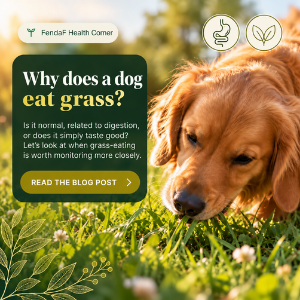
Why does my dog eat grass?
As spring arrives, many dogs become very interested in nibbling fresh grass. Some pick out only the longest, softest blades, others eat almost by the handful, while some show no interest in grass at all.
And then the owner starts wondering: why does a dog eat grass in the first place?
Does their stomach feel upset? Are they lacking something? Are they trying to make themselves vomit? Or is there simply something in grass that their body needs at that moment?
The most important thing to know is that grass eating is very common in dogs and, in most cases, does not mean that the dog is ill.
In a study published in 2008, 79% of healthy dogs with regular access to plants ate grass or other plants at least occasionally. In a larger survey, 68% of plant-eating dogs did so daily or weekly. Only 9% of dogs frequently appeared ill before eating plants, and only 22% frequently vomited afterwards. The authors concluded that eating plants, especially grass, is probably normal behaviour in dogs.
So a dog that eats a few blades of grass on a walk does not automatically need either a probiotic or a veterinarian. But, as with most things involving dogs, context matters.
Do dogs eat grass to make themselves vomit?
This is probably the most common explanation. And sometimes grass eating can indeed occur together with nausea or gastrointestinal discomfort. A dog may, for example:
- lick their lips;
- swallow more frequently;
- drool;
- be restless;
- search very intensely for grass;
- eat it quickly and in large amounts;
- vomit afterwards.
In that situation it can seem quite logical that the dog is looking for grass because their stomach feels bad. However, scientific studies do not support the idea that dogs generally eat grass in order to make themselves vomit.
In a 2010 study, 374 grass-eating events were recorded, but only two were followed by vomiting. In addition, the dogs actually ate less grass while a mild gastrointestinal disturbance was induced experimentally. This does not rule out the possibility that some dogs may seek grass during certain types of nausea or discomfort, but vomiting does not appear to be the main purpose of grass eating.
In other words: a dog may eat grass and then vomit, but we cannot automatically conclude that the dog ate the grass specifically in order to vomit.
Can eating grass indicate a digestive problem?
It can, especially when the behaviour changes. If a dog has nibbled grass occasionally throughout life and continues to do so happily, there is probably nothing unusual about it.
But if the dog:
- suddenly starts eating a lot of grass;
- frantically searches for it every day;
- frequently vomits after eating it;
- has diarrhoea at the same time;
- has mucus or blood in the stool;
- loses appetite;
- loses weight;
- has abdominal pain or lethargy,
then it is worth looking beyond the grass eating itself. In that situation, eating grass may simply be one sign that the gastrointestinal tract is not feeling well.
I currently have a very concrete personal example with Faddy. When he started his heart medication, I noticed that he began eating more grass than before. It became most pronounced during the period when he clearly had more discomfort and nausea. By now, as he is feeling better, the grass eating has essentially subsided as well.
Of course, the experience of one dog does not prove cause and effect, but a change in a familiar behavioural pattern can be a very valuable clue. This is especially interesting because the 2010 grass-eating study looked at a mild diarrhoeal gastrointestinal disturbance, not nausea specifically. The authors also noted that the role of other types of gastrointestinal discomfort, including nausea, needs to be studied separately.
And as we always say at FendaF: a symptom is not a diagnosis.
Do dogs eat grass because of a nutrient deficiency?
It is a possible hypothesis, but we do not have good evidence that grass eating usually means a deficiency of any specific nutrient. Older integrative literature has linked grass eating, among other things, with a need for chlorophyll. Chlorophyll is the green pigment in plants, and green plants also contain fibre, minerals, polyphenols and other bioactive compounds.
I have also seen with my own dogs that adding green vegetables to the diet can reduce interest in grass in some dogs.
For example, Faddy used to nibble grass quite often, but after I started adding green vegetables to his food regularly, his grass eating decreased considerably.
Was chlorophyll the reason? We do not know. It could have been fibre, another plant compound, greater dietary variety, or simply a coincidence.
So today I would not confidently say: “a dog eats grass because it is deficient in chlorophyll.”
Rather: if a dog actively seeks a lot of plant material, it is worth reviewing the variety of the diet and the sources of fibre as well.
Grass as a source of fibre
This is a completely realistic possibility. Grass contains fibre, and plant material can influence gastrointestinal motility and stool consistency.
Dogs cannot digest long blades of grass particularly efficiently, and they often emerge from the other end in a fairly recognisable form. That does not mean, however, that grass has no effect at all in the digestive tract.
From an integrative perspective, the more interesting question for me is: does the dog get enough different types of fibre and plant compounds from its everyday diet?
For a suitable dog, the diet can be enriched with small amounts of, for example:
- broccoli;
- green beans;
- zucchini;
- spinach;
- kale;
- parsley;
- fermented vegetables.
That does not mean that every grass-eating dog needs half the salad counter tipped into the bowl.
The Homeostasis Fairy reminds us again that more does not automatically mean better.
Could grass eating be related to the microbiome?
This is a very interesting field, but one that still contains many unanswered questions. Grass contains different types of fibre, and eating plant material can influence the gastrointestinal environment and microbial metabolism.
But that does not mean we can say: “a dog eats grass in order to improve its microbiome.”
Such a mechanism has not been demonstrated in dogs.
We do know, however, that dietary fibre influences the microbiome and that dietary diversity can affect the microbial community in a dog’s gut. So grass eating can be viewed as one part of a dog’s natural exposure to plant material and the environment, but I would not turn it into a theory of microbiome self-medication.
What about parasites?
This is where things get especially interesting.
Grass eating is also seen in wolves and other wild canids. One evolutionary hypothesis is that eating plant material may have helped wild canids reduce intestinal parasite burdens, for example by increasing the movement of intestinal contents or helping to remove parasites mechanically.
Similar self-medication with plants, known as zoopharmacognosy, has also been described in other animal species. Scientific literature has proposed that grass eating in domestic dogs may be a behaviour retained from their wild ancestors.
I find this a very interesting integrative perspective. But the important word here is hypothesis. We have no evidence that your dog is eating couch grass by the roadside today because it has worms.
And grass eating is certainly not an alternative to a faecal test or parasite treatment when those are genuinely needed.
Maybe it simply tastes good
Next to complicated biological theories, this explanation can feel almost too simple. But sometimes the answer really is simple.
Fresh spring grass:
- is juicy;
- has a strong smell;
- has a different texture;
- gives the dog something to chew;
- may simply taste good.
Many dogs are also very selective about the type of grass they eat. They do not mow the lawn evenly; they seek out particular soft or longer blades.
Sometimes I think it is worth trusting the dog a little as well. If the dog calmly chooses a couple of blades, eats them and happily walks on, there is no need to build a diagnosis around every mouthful.
Boredom and behaviour
For some dogs, chewing plants may simply be an activity. Dogs explore the world with their mouths and noses. Young dogs in particular chew, taste and try many different things. In the 2008 study, younger dogs ate plants more often than older dogs and showed fewer signs of illness before grass eating.
If a dog spends a long time in the garden and the only interesting activity is sampling the lawn, the reason may simply be that there is nothing more exciting to do.
Can dogs eat dandelions?
Faddy was an absolute dandelion fan as a puppy. The roots went first, and only then the rest of the plant.
Dandelion is used in both traditional and integrative herbal medicine, and its leaves and roots contain a number of bioactive compounds. So if a dog occasionally eats a dandelion leaf or flower from a clean area that has not been treated with chemicals, this is generally not considered a problem.
This is also where zoopharmacognosy comes in: the ability of animals to seek out and select plants according to their needs. Integrative veterinarians discuss this as well, and my own experience with my dogs supports the idea. Dogs can be very selective about plants: my dogs have never eaten anything that I know to be dangerous to them, yet at different times they have chosen very specific plants. For that reason, I would not simply dismiss the dog’s own choices. Scientifically, targeted plant-based self-medication in domestic dogs is still poorly studied, but zoopharmacognosy has been described in other animal species, and plant eating in dogs is also considered an evolutionarily retained behaviour.
That said, I would add one small warning. If your dog indiscriminately eats everything and is essentially a mobile rubbish bin, it may not be wise to let them sample every plant and simply label it “zoopharmacognosy.”
The grass itself may be safe, but the place where it grows may not be
To me, this is the most practical warning when it comes to grass eating.
Do not let your dog eat grass in a place where you do not know what it has been treated with. Poisoning related to herbicides is uncommon when the products are used correctly, and vegetation treated with a product that has already dried is generally not a major hazard to animals. However, contact with freshly treated vegetation can cause gastrointestinal, skin, eye and respiratory signs, among others.
So I would avoid:
- freshly sprayed lawns;
- roadsides where weed killers are used;
- public areas with unknown maintenance practices;
- places where fertilisers or other chemicals may be present.
Of course, there are also plants in nature and gardens that can be toxic to dogs. To me, that does not mean we should automatically distrust a dog’s natural selection behaviour. Rather, it is worth distinguishing between a dog choosing plants in a familiar, clean environment and a situation where the dog is in an unfamiliar garden or area with ornamental plants or chemical treatments.
So for me, the more practical question with grass eating is not whether the dog is capable of choosing something, but whether the growing area itself is safe and free of chemicals.
When should you talk to a veterinarian?
There is generally no reason to worry about a happy, healthy dog that eats grass occasionally. I would investigate further if:
- grass eating suddenly becomes very intense;
- the dog eats grass almost compulsively;
- grass eating is repeatedly followed by vomiting;
- there is recurrent diarrhoea;
- there is blood or a lot of mucus in the stool;
- appetite decreases;
- the dog loses weight;
- the abdomen seems painful;
- the dog is lethargic or behaves differently from usual.
In that situation, the question is no longer: “How can I stop my dog from eating grass?” But: “Why has this need or urge to eat so much grass appeared?”
Should I stop my dog from eating grass?
If the dog:
- eats it occasionally;
- is otherwise completely healthy;
- does not vomit repeatedly;
- the grass is in a safe location;
- the plant itself is safe,
then I do not see a reason to forbid it automatically.
A dog does not need to live in a sterile bubble. Sniffing outdoors, digging in soil, chewing grass and interacting with the world are all part of being a dog.
Of course, common sense still applies. There is no reason to let a dog eat grass from a freshly sprayed lawn at home, and unfamiliar plants should not simply be swallowed on trust.
In summary
Eating grass is very common in dogs and is usually completely normal behaviour.
Current research does not support the common belief that most dogs eat grass in order to make themselves vomit. Nor has it been demonstrated that grass eating automatically means a deficiency of chlorophyll or any other specific nutrient.
There may be several possible reasons:
- the grass simply tastes good;
- plant eating is a natural, evolutionarily retained behaviour;
- the dog is seeking plant material or fibre;
- in some cases, the behaviour may occur together with nausea or other gastrointestinal discomfort;
- the microbiome or an evolutionary parasite-related behaviour may play a role, but much remains unknown;
- some dogs simply enjoy chewing grass.
So above all, pay attention to your dog’s usual behavioural pattern. If the dog calmly eats a few blades on a spring walk and then runs on, there is probably no reason to worry.
But if the dog stands at the roadside every day like a little lawn mower, desperately swallowing grass while also licking its lips, vomiting or having an upset stomach, it is worth looking at gastrointestinal health as a whole.
Grass eating itself may not be the problem. A change in grass-eating behaviour, however, can be a clue.
And when it comes to a dog’s body, noticing clues is often far more valuable than simply suppressing one symptom.
Sources used
- Sueda KLC, Hart BL, Cliff KD. Characterisation of plant eating in dogs. Applied Animal Behaviour Science. 2008;111:120–132
- McKenzie SJ, Brown WY, Price IR. Reduction in grass eating behaviours in the domestic dog, Canis familiaris, in response to a mild gastrointestinal disturbance. Applied Animal Behaviour Science. 2010;123:51–55.
- Hart BL. Behavioural defences in animals against pathogens and parasites: parallels with the pillars of medicine in humans. Philosophical Transactions of the Royal Society B. 2011.
- Merck Veterinary Manual. Plants Poisonous to Animals.
- Merck Veterinary Manual. Overview of Herbicide Poisoning in Animals.
🐾 FendaF believes in informed choices
The purpose of the FendaF blog is not to tell you what you must do. Our aim is to share knowledge, introduce different evidence-based and integrative perspectives, and help you make more informed decisions for your pet.
Every animal is unique, and no article can replace a consultation, diagnosis or treatment provided by a veterinarian. If your pet has a health concern or you need individual advice, always contact a veterinarian.









Leave a Reply