


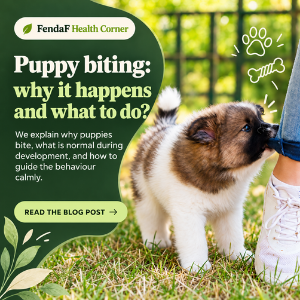
Puppy biting: why does it happen and how can you teach gentle play?
Reading time: about 10 min
When a puppy bites hands, sleeves, trouser legs or feet, it can be surprisingly painful. Especially when you live with a tiny German Shepherd-type shark whose teeth appear to have been manufactured in a sewing-needle factory. At the same time, it is important to distinguish between two things: normal mouthing and play biting, and behaviour that points to fear, pain, serious frustration or an aggression problem.
The first version of this article was written in 2020 after one of our social media posts. At the time, I also described a technique in which the puppy’s own paw or upper lip was placed between its teeth so that biting too hard caused discomfort. Based on what we know today and on current behaviour recommendations, I no longer recommend this. Not because boundaries do not matter, but because the same boundary can be taught without pain or physical discomfort.
A puppy needs to learn very clearly that human skin and clothing are not chew toys. The question is how to teach this so that the puppy also learns what it should do instead. If you want a broader look at puppy training, see “10 things to teach your puppy”.
Why do puppies bite in the first place?
Using teeth does not automatically mean that a puppy has a bad temperament or is aggressive. Puppies explore the world with their mouths, play with their teeth and learn through interactions with other dogs how hard a bite can be before play stops. The RSPCA describes play biting as a normal part of puppy-to-puppy communication and notes that play often ends after a bite becomes too hard. That gives the puppy clear feedback: biting too hard makes the fun stop.
Another major reason is teething. The gums can be sore and chewing can bring relief. Biting also tends to increase when a puppy is overexcited, frustrated or simply tired. Dogs Trust specifically points out that overtired puppies can look “too energetic”: they may get the zoomies, become restless and use their teeth more. This is one of those moments when more activity may not be the answer. Sometimes the puppy actually needs sleep.
If biting starts suddenly, becomes much stronger than before or appears when a particular body area is touched, pain or another health problem should also be considered. Behaviour does not exist separately from the body.
Are play biting and aggression the same thing?
No. A puppy that is play biting usually has a softer, more mobile body, the behaviour occurs during play or excitement, and the puppy is seeking interaction. Biting related to fear or aggression may come with stiffness, freezing, attempts to move away, growling, avoiding eye contact, visible tension in the tail or body posture, resource guarding or biting in a situation where play is not taking place.
A single body-language signal is not a diagnosis. The whole situation matters. If the biting is hard, repeated, breaks skin, is directed at children, is linked to fear or resource guarding, or feels unpredictable, the answer is not simply “be stricter”. In that situation, it makes sense to involve a veterinarian and, if needed, a qualified behaviour professional.
What should you do in the moment when the puppy uses its teeth?
The simplest lesson can be this: teeth on human skin or clothing stop the game, while an appropriate toy keeps the game going. There is no need to frighten or hurt the puppy to teach that rule.
- Become still for a moment. Pulling your hand away quickly, waving it around or squealing can turn the situation into an even more exciting chase game for some puppies. If the teeth reach your hand or clothing, stop the movement and stop the game.
- Offer an appropriate alternative immediately. Redirect the puppy to a toy, tug toy or safe chewing option. RSPCA, Blue Cross and other modern behaviour guidelines recommend redirecting play biting to an appropriate object rather than turning biting into a physical confrontation.
- If the puppy keeps biting you, briefly stop the interaction. Turn your body away, stand up or, if necessary, step behind a gate or door for a moment. The aim is not to punish the puppy but to make the consequence very clear: rough play ends social interaction.
- When the puppy settles, start again. Reward what you want to see more of: calm interaction, choosing the toy, keeping all four paws on the floor or using a soft mouth. Food does not always have to be the reward; continuing the game, attention or access to a pleasant activity can also be rewarding.
- Look at what happened before the biting. If the “shark attack” arrives every evening at the same time, after a long play session or on days when the puppy has barely slept, work on the trigger. More commands will not solve overtiredness.
Why does redirecting to a toy not “teach a dog to bite people”?
One real dog story in the original article described a Staffordshire Bull Terrier whose owner had been advised to offer a toy when the puppy bit, and who later, as an adult, invited the owner to play by grabbing their hand. That is a useful observation about one individual dog, but it does not allow us to conclude that redirecting to a toy caused the later hand-grabbing behaviour.
The idea behind redirecting to a toy is the opposite: to teach the puppy which object may be grabbed with teeth. If the dog learns at the same time that grabbing a human hand ends the game, while grabbing the toy starts it, the rule becomes clearer. If an adult dog still grabs people, the whole learning history, arousal level, play rules, impulse control and the behaviours that may have been unintentionally rewarded over the years need to be considered.
What I no longer recommend based on what we know today
I no longer recommend putting the puppy’s paw or upper lip between its teeth so that biting causes pain or discomfort. Nor do I recommend hitting, tapping the nose, physically pinning the puppy down or other techniques whose effect relies on fear, pain or discomfort.
The American Veterinary Society of Animal Behavior (AVSAB) recommends reward-based methods for dog training in its 2021 position statement and advises against aversive techniques. Its 2025 puppy-training material says the same thing directly about puppy biting: do not use punishment; redirect the puppy to an appropriate activity and watch the body language before biting escalates.
This does not mean raising a puppy without boundaries. Reward-based training does not mean the puppy may do whatever it wants. A very clear boundary can be that teeth on human skin stop the game immediately, while an appropriate toy allows it to continue.
But what if “gentle methods” do not work?
Before making the method harsher, ask why the current plan is not working. Does everyone in the family respond in the same way? Is the puppy already completely overaroused before you even begin the exercise? Is it getting enough sleep? Does it have safe opportunities to chew and tug? Does the game stop immediately, or only after ten bites? Could the behaviour be connected to fear, frustration or pain?
The more complex the behaviour, the less useful a generic “be stricter” recommendation becomes. For a more serious problem, the most practical next step is an experienced trainer or behaviour professional. AVSAB emphasises that more difficult behaviour problems may require environmental management, a behaviour-modification plan and sometimes medical assessment in addition to training.
Breed matters, but it does not change the principles of learning
Some puppies use their mouths more than others. Working-line puppies in particular can be highly energetic, quick to become aroused and very enthusiastic about using their teeth. Blue Cross also notes that some working-line puppies may play-bite more often or with greater intensity.
As a German Shepherd owner, I have seen this many times in real life. After starting sleeve work, Faddy went through a phase of thinking that if a sleeve was fair game in training, perhaps the same idea was worth trying at home. That does not mean sleeve work “turns a dog into a biter”. It shows how important context is: in training there is specific equipment, a specific cue and a specific situation; at home, a person’s clothing does not start that game.
The same logic applies to ordinary tug play. Tug on the toy, not on hands. Teach “take it”, “give” or another clear play cue. If the teeth move onto a person, the game stops. If the puppy chooses the right object, the game continues.
FendaF’s real dog stories: what is actually worth taking from them?
Mouthy contact that seems funny in puppyhood can become genuinely uncomfortable or dangerous in a large adult dog. One dog grabs a hand to invite play, another approaches children with its teeth when excited, a third jumped onto a sleeve during a game around taking out the rubbish, and a fourth put a person’s hand into its mouth as a sign of affection.
These stories do not prove which puppy-training method caused later behaviour. They do, however, give us one very practical reason to set rules around teeth early. We do not need to wait until a 30-40 kg dog’s play biting becomes a problem before teaching an alternative behaviour.
Children and a biting puppy
With a child and a puppy, “just say no” is not enough. Children’s movements, running and squealing can raise a puppy’s arousal very quickly, and a child may not know when to stand still or end the game. An adult therefore needs to manage the situation: use a baby gate when necessary, give the puppy rest breaks and do not leave a child and a highly mouthy puppy to sort the situation out between themselves.
If the puppy chases children, grabs their clothing, bites repeatedly and hard, or the child starts to fear the dog, it is not sensible to wait for the puppy to “grow out of it”. Get help sooner rather than later.
Practical FendaF action plan: when your puppy bites
1. Stop moving and stop the game. Do not pull your hand away quickly or turn the situation into a chase game.
2. Immediately offer an appropriate toy or safe chew. Teach the puppy what it is allowed to use its teeth on.
3. If the teeth come back onto a person, briefly end the interaction. Turn away or step away for a moment, then begin again once the puppy has settled.
4. Check tiredness and arousal. If biting gets worse in the evenings or after a long play session, the puppy may need more sleep and calm breaks, not more activity.
5. Get help earlier if the biting is severe or unusual. Bites that break skin, stiffness, fear, resource guarding, targeting children or a sudden behaviour change need professional assessment.
When should you contact a veterinarian or behaviour professional?
- the biting changed suddenly or appears when a particular body area is touched;
- the puppy stiffens, freezes, growls, guards food or objects, or bites out of fear;
- the bites repeatedly break skin or are directed at the face or at children;
- the puppy is practically unable to settle or sleep;
- a consistent reward-based plan and environmental management do not produce a clear improvement trend;
- the owner or another family member starts to feel afraid of the puppy.
If the behaviour is connected to fear, pain or serious aggression, the aim is not to find a “stronger correction”. The aim is to identify the cause and create a safe plan.
In summary
A puppy needs to learn that human hands, children and clothing are not for biting. My view on that has not changed since 2020. What has changed is how I recommend teaching that boundary.
Today I would choose a very clear, consistent and reward-based system: teeth on a person end the game, an appropriate toy keeps it going; an overaroused puppy gets a break, an overtired puppy gets sleep, and unusual or severe biting gets professional assessment. The rule remains clear without requiring us to cause pain or physical discomfort to teach it.
Sources used
- American Veterinary Society of Animal Behavior (AVSAB) – Humane Dog Training Position Statement (2021)
- AVSAB – Starting off on the Right Paw: Puppy Biting (2025 presentation notes)
- Dogs Trust – Mouthing, nipping and biting
- RSPCA – Understand mouthing and play biting behaviour
- Blue Cross – Puppy biting and mouthing
- VCA Animal Hospitals – Teeth, teething and chewing in puppies
🐾 FendaF believes in informed choices
The purpose of the FendaF blog is not to tell you what you must do. Our aim is to share knowledge, introduce different evidence-based and integrative perspectives, and help you make more informed decisions for your pet.
Every animal is unique, and no article can replace a consultation, diagnosis or treatment provided by a veterinarian. If your pet has a health concern or you need individual advice, always contact a veterinarian.




Leave a Reply