


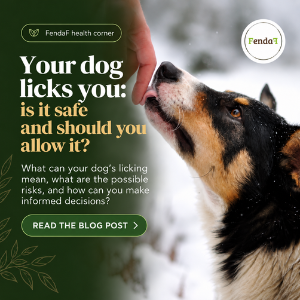
Dog Licks You: Is It Safe, and Should You Allow It?
Reading time: about 7 min
Dogs have a habit of licking people. Some aim for the face, others for a hand or leg, and some would happily keep at it all day. To me, licking has always felt like one of a dog’s ways of saying, “you are my person.” As I have got older, though, I have stopped allowing it quite so automatically. Not because a dog kiss has suddenly become something dirty or dangerous, but because I have become more interested in the question: is it actually safe?
The answer is fairly calm: healthy, intact human skin usually handles an ordinary dog lick very well. But a dog’s mouth is not sterile, and an open wound, a bite or a weakened immune system changes the situation. So there is no need to choose between two extremes. “A dog’s mouth is cleaner than a human’s” and “one kiss will land you in hospital” are both oversimplified stories.
Why does a dog lick people?
The simplest answer is that there can be several reasons. Licking is completely natural behaviour for dogs. It can be a greeting, a sign of affection, a request for attention or simply a learned behaviour. If every lick earns eye contact, conversation or a cuddle, the dog has learned a pretty effective lesson: the tongue is an excellent remote control.
Sometimes the reason is even more ordinary: human skin is salty and smells interesting to a dog. Licking can also have a calming or self-regulating role. If licking suddenly becomes very intense, difficult to interrupt, or extends to floors, carpets and other objects, it is worth looking beyond behaviour alone. Stress, boredom, pain, itching or gastrointestinal discomfort can all play a part.
If your dog is no longer just licking you but repeatedly and compulsively licking floors, carpets or other surfaces, see also “Dog licking the floor or carpet? Excessive licking and the gut”.
Is a dog’s mouth cleaner than a human’s?
No. But honestly, there is not much value in ranking human and canine mouths by “cleanliness”. Both contain large communities of microorganisms, and the canine oral microbiome differs markedly from the human one. Studies show that the bacterial communities in dog and human mouths are quite different. That does not make a dog’s mouth automatically dangerous. It is simply a different ecosystem.
Another old claim is also too simplistic: that dog saliva has no antibacterial activity at all. Researchers have identified several proteins and peptides in canine saliva with immune and antimicrobial functions. But that does not justify calling saliva a “natural antiseptic”. Saliva contains both substances involved in host defence and microorganisms, some of which can cause problems in the right circumstances.
How big is the infection risk in real life?
For most healthy people, ordinary contact with a dog is low risk. For example, the CDC notes that Capnocytophaga infection is rare and that most people who have contact with dogs or cats do not become ill. The situation matters more when a dog bites, or when saliva gets into an open wound or damaged skin.
Capnocytophaga bacteria normally live in the mouths of some dogs and cats and can, rarely, cause severe infection in people, including sepsis. Risk is higher in people with weakened immune systems, people without a spleen, and people who drink heavily. The CDC’s guidance treats this as a risk to manage, not a reason to avoid close contact with dogs.
So if Faddu or Ossu gives my healthy hand a lick, I do not treat it as a medical emergency. But if I have a fresh wound on that hand, I do not let a dog’s tongue near it. That is the most practical boundary for me.
What if the dog has a bacterial infection?
It is worth thinking separately about a dog with an active bacterial skin, ear, oral or wound infection. In that situation, the pathogen may be present on the skin or mucous membranes and, depending on the site of infection and the dog’s behaviour, may also reach the mouth or the area around it, for example when the dog licks an infected area. This does not mean that every bacterial infection automatically puts the same bacterium into the saliva, but licking an open wound is not quite the same risk situation as it is with a completely healthy dog.
A useful concrete example is staphylococcal infection, particularly Staphylococcus pseudintermedius. This bacterium can be part of the normal canine microbiota, and the mouth is one of its common carriage sites. Studies have frequently found S. pseudintermedius in the mouths of healthy dogs, and the bacterium can cause skin and ear infections, among other problems. Dogs with MRSP may remain carriers even after the clinical infection has resolved.
The principle is not limited to staphylococci. If a dog has a known bacterial infection caused by an organism that can also colonise the skin or mouth, or can be carried to the mouth when the dog licks an infected area, it makes sense to be stricter about preventing licking of open wounds. Dog saliva can also introduce other bacteria into a wound, including Pasteurella multocida, for which wound infections after dog licking have been reported.
This does not mean that every wound a dog licks will become infected. Infection depends on factors such as the condition of the wound, the bacterial strain, the bacterial load and the immunity of the person or animal. But I would not allow a dog with a known active bacterial infection to lick an open wound on a person or another animal.
Risk is not binary. Healthy skin + a healthy dog is not the same situation as an open wound + a dog with a known bacterial infection.
The dog licked a wound or bit someone: what should you do?
If dog saliva gets into an open wound, wash the area thoroughly with soap and running water straight away. A bite deserves extra attention even if the wound initially looks small, because a puncture can carry bacteria deeper into the tissues.
- Wash the wound immediately with soap and water.
- Seek medical advice if the wound is deep, very painful, on the hand or near a joint, becomes red or swollen, or if you develop a fever.
- If you are in a higher-risk group for infection, seek advice earlier after a bite or after saliva gets into a wound.
- Do not decide on your own that antibiotics may only be used after a culture. Unnecessary antibiotic use is a problem, but bite wounds are managed according to the clinical picture and level of risk.
FendaF’s dedicated antibiotic article is currently available only in Estonian, so I have not added a cross-language internal link here.
Should you stop your dog from licking you?
I do not see a reason to make ordinary licking completely forbidden just because bacteria live in a dog’s mouth. At the same time, it is completely fine if you do not like your dog licking your face or hands. Setting a boundary does not make you a worse dog owner.
If you want to reduce licking, calm redirection usually works better than pushing the dog away or scolding. Withdraw attention, offer another activity and reward the behaviour you actually want. If the licking is new, very intense or compulsive, it is worth asking whether the dog may be trying to tell you something about how they feel before labelling it a “bad habit”.
In short: a dog kiss isn’t sterile, but it isn’t a reason to panic
A dog’s mouth is not cleaner than a human’s, and dog saliva is not wound treatment. At the same time, there is no need to turn an ordinary dog kiss into a biohazard operation. Intact skin is an excellent protective barrier, and everyday contact with dogs is low risk for most healthy people.
For me, licking is still one of the ways a dog seeks closeness. The boundary is simply a little more deliberate now: I no longer let them lick my face much, an open wound is definitely off limits, and after a major licking attack I can simply wash my hands or face. Affection does not have to be sterile. It is about balance.
Used sources:
- CDC – About Capnocytophaga (26.08.2025)
- CDC – Dogs: Healthy Pets, Healthy People
- Torres et al. 2018 – Salivary proteomics of healthy dogs, PubMed
- Dewhirst et al. 2012 – The canine oral microbiome, PubMed
- Pavlova et al. 2023 – Oral microbiomes of dogs and owners, PubMed
- AKC – Why Does My Dog Lick Me?
- Paul et al. 2012 – Staphylococcus pseudintermedius colonization patterns and strain diversity in healthy dogs. PMID 22770516
- Bergstrom et al. 2012 – Carriage of methicillin-resistant Staphylococcus pseudintermedius in dogs: a longitudinal study – PMID 22444911.
- Pasteurella multocida wound infection transmitted by a pet dog. PMID 30775341
- Somayaji et al. 2016 – Human infections due to Staphylococcus pseudintermedius, an emerging zoonosis of canine origin: report of 24 cases – PMID 27241371.
🐾 FendaF believes in informed choices
The purpose of the FendaF blog is not to tell you what you must do. Our aim is to share knowledge, introduce different evidence-based and integrative perspectives, and help you make more informed decisions for your pet.
Every animal is unique, and no article can replace a consultation, diagnosis or treatment provided by a veterinarian. If your pet has a health concern or you need individual advice, always contact a veterinarian.






Leave a Reply