


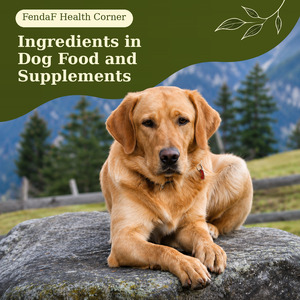
Ingredients to watch in dog food and supplements
Reading time: about 10 min
I am quite critical of what goes into my dogs’ food bowls, particularly Oscar’s. His problems as a puppy prompted me to explore what different ingredients do, why they are added to a product and whether they are actually necessary. Sorbitol and glycerine were among the first substances to catch my attention. Not because their names sounded alarming, but because I wanted to understand why they were included in something a dog would swallow.
That has become one of FendaF’s principles: “natural” does not automatically mean beneficial, and “synthetic” does not automatically mean dangerous. Another equally important question often goes unanswered on the label: how much of a substance does the dog actually receive in one day’s serving? With supplements, dental care products and treats in particular, it pays to read beyond the first ingredient.
What is the difference between an ingredient, an additive and an excipient?
Dog food contains main ingredients such as meat, grains, vegetables or oils and, when needed, feed additives including vitamins, minerals, preservatives and flavouring substances. Supplements and tablets may also contain technological excipients: binders, fillers, coating agents and substances that give a powder or chewable tablet its intended form.
Some substances make manufacture possible; others protect the stability of active ingredients or make administration easier. That does not automatically make them undesirable. But when I pay for a supplement, I want to know how much of the active ingredient it contains and why it is there, not merely receive a large, attractive tablet.
European pet food labels are governed by rules too. EU Regulation 767/2009 and FEDIAF’s labelling guidance explain how ingredients, feed additives and analytical constituents are declared. Not every technical detail of manufacturing is necessarily visible in the same way, so it is reasonable to ask the manufacturer for missing information.
Xylitol: more than a matter of preference
Xylitol is a sweetener found in some chewing gums, sweets, toothpastes and supplements made for people. It can be extremely dangerous to dogs, potentially triggering rapid insulin release, severe hypoglycaemia and, in more serious cases, liver injury. If you suspect your dog has eaten xylitol, contact a veterinarian immediately. Waiting for symptoms is not sensible. Do not use human toothpaste or oral-care products on dogs without veterinary guidance.
However, xylitol should not be lumped together with every other sugar alcohol. Sorbitol has a different metabolic pathway and risk profile. Losing that distinction would do pet owners a disservice.
Sorbitol and glycerine: what do they actually do?
Sorbitol is used as a sweetener and humectant. Glycerine, also called glycerol, helps soft treats and chews retain moisture and texture. In larger quantities, both can exert an osmotic load on the digestive tract and contribute to soft stools or diarrhoea. That does not mean that a small technological amount harms every dog. Risk depends on dose and individual tolerance.
I often prefer products with simpler compositions, particularly for dogs with sensitive digestion. If two products serve the same purpose and deliver effective amounts but one has a shorter ingredient list and the dog tolerates it well, that is a reasonable choice for me. Equally, I would not declare a product poisonous because of a small amount of glycerine. I want to know why it was added, how much there is and how the dog responds.
Maltodextrin: many claims, but do they apply to dogs?
Maltodextrin is a readily available carbohydrate that can serve as a carrier or filler. In human nutrition, its high glycaemic index is often discussed. That alone tells us little about the effect of a tiny quantity in a particular dog’s probiotic powder. The study design, administered dose and dog’s health matter.
Nor can we jump from observations that maltodextrin affects microorganisms in some laboratory models to the conclusion that every maltodextrin-containing supplement harms a dog’s microbiome. Integrative veterinarians have good reasons to investigate simpler formulations and gut health, but not every claim circulating online is backed by controlled clinical evidence in dogs.
A useful practical question is this: if a product is intended to supply certain microbial strains or an active substance, can I find out the quantity per dose, how stable it remains, and whether an equivalent formulation with ingredients I prefer is available?
Titanium dioxide: regulation changed the assessment
Titanium dioxide, also known as E171, has been used to give products a white colour. In 2021, the European Food Safety Authority concluded that its safety as a feed additive could not be established because concerns about genotoxicity could not be ruled out. Under Commission Implementing Regulation (EU) 2021/2090, authorisation for this feed additive was denied, with withdrawal deadlines in 2022.
That is more accurate than describing every product that once contained titanium dioxide as “cancer-causing”. EFSA did not demonstrate that every ordinary exposure causes tumours. The assessment was that safe use could not be established from the available evidence. Similarly, the prohibition on its use as a feed colourant does not automatically mean every pharmaceutical use is treated identically under the law. If E171 appears on the label of a current feed product, check the formulation and its labelling with the manufacturer or competent authority.
Cellulose, rice flour and other fillers
Cellulose is a major component of plant cell walls. Dogs cannot break it down with their own enzymes in the way they digest starch, but that does not automatically make cellulose useless “sawdust”. Some fibres have technological and physiological roles in the digestive tract. Amount, particle size and the rest of the diet matter. Likewise, the presence of rice flour or corn starch does not by itself prove that a product is poor. These ingredients can provide energy or help hold a formulation together.
My question remains: how much active substance or valuable raw material does this particular product provide? If a large proportion of a tablet consists of filler, compare the price per effective dose, not the price per tub. This is different from asking whether an ingredient is dangerous. Both questions deserve their own answers.
Binders, coatings and capsule materials
Tablets can contain starch, cellulose derivatives, magnesium stearate or silicon dioxide, among other substances. Each has a technical function. You may see strong online claims that certain compounds suppress the immune system or damage the gut. Without knowing the dose, route of use and relevant studies in dogs, such conclusions cannot be drawn from an ordinary tablet ingredient list.
The same principle applies to capsules. Animal gelatine is made from collagen-rich animal materials; plant-based capsules often use cellulose derivatives. Shellac comes from the secretion of the lac insect, not its wings. None of these names tells us a product’s quality or safety in isolation. Ingredient sourcing, manufacturing standards, actual quantities and a dog’s tolerance all matter.
Is a powder better than a capsule or tablet? I sometimes prefer powder because it can be easier to mix into food and adjust the dose. But powder is not inherently purer, more stable or better absorbed. Some active ingredients need protection from moisture or stomach acid; others keep better in capsules. The claim that powder manufactured below 48°C is always higher quality would require data on the particular ingredient and process. A pleasantly low temperature is not a quality certificate.
Preservatives and vitamins: why “synthetic = bad” does not work
A preservative can prevent fats from becoming rancid or microbes from growing, thereby helping protect the dog. Vitamins E and C come in various forms, but their addition is not automatically a problem. The bioavailability of vitamins and minerals is not determined solely by whether an ingredient sounds “natural”. Its chemical form, the overall diet and whether the dog needs extra supplementation are what matter.
Integrative care often favours food-first approaches with as few unnecessary additives as possible. That raises a useful question: is the diet built on good food, or are we trying to repair a poor foundation with supplements? Yet a properly formulated complete food or an appropriately indicated supplement does not become inferior simply because it contains precisely measured added vitamins. Even “natural” vitamins can be supplied in excess.
How long should a supplement be given?
Based on our own experience, Oscar seems to do well when we give Arthro-Elastina in courses rather than continuously. The same was true for Peku. To me, that is a valuable practical observation, not proof that every joint supplement becomes less effective over time or that the body always “gets used to it”. Some supplements may suit short courses, others should be continued when there is an ongoing need, while some may not be necessary in a given case. The answer depends on the product, dose, reason for use and the dog’s response.
I do not think it is ideal for owners to have to research every ingredient themselves. But before labels such as “natural”, “veterinary” or “premium” make our decisions for us, we should at least check what the product actually does. If the branding disappeared from the packaging, would we still choose that composition? That may be the most useful question of all.
Sources
European Commission. Feed marketing: Regulation (EC) No 767/2009 and pet food labelling. https://food.ec.europa.eu/food-safety/animal-feed/feed-marketing_en
European Commission. Commission Implementing Regulation (EU) 2021/2090 refusing authorisation of titanium dioxide as a feed additive. https://eur-lex.europa.eu/legal-content/EN/TXT/?uri=CELEX:32021R2090
EFSA (2021). Titanium dioxide: no longer considered safe as feed additive. https://www.efsa.europa.eu/en/news/titanium-dioxide-no-longer-considered-safe-feed-additive
U.S. FDA. Paws Off! Xylitol is Toxic to Dogs. https://www.fda.gov/animal-veterinary/animal-health-literacy/paws-xylitol-toxic-dogs
FEDIAF. Understanding Pet Food Labels. https://europeanpetfood.org/pet-food-facts/fact-sheets/nutrition/understanding-pet-food-labels/
WSAVA. Global Nutrition Guidelines and pet food selection tools. https://wsava.org/global-guidelines/global-nutrition-guidelines/
🐾 FendaF believes in informed choices
The purpose of the FendaF blog is not to tell you what you must do. Our aim is to share knowledge, introduce different evidence-based and integrative perspectives, and help you make more informed decisions for your pet.
Every animal is unique, and no article can replace a consultation, diagnosis or treatment provided by a veterinarian. If your pet has a health concern or you need individual advice, always contact a veterinarian.








Leave a Reply