


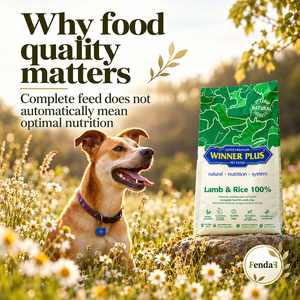
Why food quality matters
Reading time: about 9 min
Those who have followed FendaF for a while or stopped to talk with me know how passionate I am about dog food and health. To me, food is not merely something that fills a dog’s stomach. It is what the body uses every day to renew muscles, skin and other tissues, support the immune system and maintain the functions we take for granted in a healthy dog.
I often say that one chicken is not necessarily the same as another. What matters is what the chicken was fed, how it was raised and which part of the animal is used. The same applies to beef, pork and lamb. If we distinguish between muscle meat, organs and cheap fillers in human food, why should we forget those distinctions when choosing dog food?
I have never believed that every dog should eat one particular type of food. But I do believe owners deserve to understand what they are paying for and what their dogs actually obtain from their food.
Why complete feed does not automatically mean optimal nutrition
Let us begin with a term found on many labels: complete feed. Under EU Regulation 767/2009, complete feed is compound feed that, by reason of its composition, is sufficient for a daily ration. FEDIAF’s nutritional guidelines provide recommended nutrient levels for manufacturers and take factors such as digestibility and bioavailability into account. This is an important foundation, not an empty marketing claim.
But it does not follow that all complete foods are equivalent, or that every complete food is optimal for every dog. A properly formulated complete food should meet the nutritional requirements of the species and life stage for which it is intended. Optimal nutrition asks another question as well: how well does this particular food suit this particular dog? Does the dog maintain a healthy weight and muscle mass? Is digestion comfortable? Are the skin and coat in good condition? Does a health condition call for a different nutrient balance?
These are not identical questions. Adequate nutrient levels are one essential part of the picture. Ingredient quality, amino acid balance, mineral forms, fat quality, actual digestibility and the dog’s health are others. A well-formulated, carefully controlled complete food can meet all these considerations very well. Yet the words “complete feed” on a label do not, by themselves, prove that it is the best choice among other suitable foods.
Consider two foods containing 25% crude protein. That figure tells us neither how much of the protein consists of essential amino acids nor how effectively the body can use them. Similarly, two foods with the same iron content may not provide the same amount of available iron. A study of iron absorption in dogs showed that the chemical form of iron and the conditions of administration can influence absorption.
That is why, when I examine a food package, I ask more than “does it contain everything necessary?” I want to know what the dog actually gets from it and how it may support long-term health.
Edible, inedible and genuinely nutritious ingredients
There is much discussion of “human-grade” ingredients. This expression requires care, because European feed law and the rules governing food for human consumption are different regulatory systems.
Pet food commonly uses Category 3 animal by-products, whose origin and safety are regulated by EU law. These may originate from animals that passed ante-mortem inspection and may also include parts deemed unfit for human consumption, provided they show no signs of disease transmissible to people or animals through the material concerned. Bodies of animals that died on farms or were killed as part of disease-control measures are not suitable ingredients for ordinary pet food. The fact that a part is not sold for human consumption does not automatically mean it has poor nutritional value. Equally, legal compliance does not prove that all permitted animal ingredients have the same nutritional value or quality.
For example, liver and kidneys can supply protein and many micronutrients. But liver is not a food of which “the more, the better” necessarily applies: excessive amounts can create imbalances, including too much vitamin A or copper. Muscle meat offers valuable amino acids, B vitamins and minerals. Skin and connective tissue contain a great deal of collagen, whose amino acid profile differs from muscle protein. Hooves, horns and hair consist largely of keratin, and their digestibility and usability depend greatly on processing. These truly are very different raw materials.
It makes little sense to treat every animal by-product as identical. It makes even less sense to treat all animal-derived proteins as equal, as if the word “animal” were itself a mark of quality. You can read more about muscle meat, organs, collagen and meat meal in our separate article on protein in dog food.
What does the price of food tell us?
Price is not an irrelevant detail. Ingredients really do cost manufacturers money. Imagine two recipes, one with an ingredient budget of €0.30 and the other €2.40 per kilogram of finished food. That is an eightfold difference. It does not prove the more expensive recipe is better, but it creates very different possibilities for choosing ingredients and their quality.
Here is a transparent calculation. If an 18 kg bag of dog food costs €90 in an Estonian shop, that is €5 per kilogram. With Estonia’s 24% VAT, the price excluding VAT is approximately €72.58 per bag, or €4.03 per kilogram. But this is not the manufacturer’s ingredient budget. Retail and import costs, transport, packaging, production, quality control, business overheads and mark-ups all have to fit into that figure. The purpose is not to pretend we know the actual production costs of any particular bag. It is to show that price and the available choice of ingredients can have a real relationship, although production scale also influences costs.
The form of an ingredient matters when comparing costs. Fresh meat contains a lot of water, while dried meat meal is more concentrated. For that reason, the first ingredient listed on the package cannot, on its own, tell us which food contains more animal protein. Sometimes a meat ingredient comes first, but the next four ingredients are differently named sources of carbohydrates or plant protein. We must read the whole recipe, not just the first line.
A higher price may also reflect branding and advertising. An inexpensive ingredient is not always a bad one. But the opposite claim, that “price tells us nothing at all”, is hardly convincing either. To understand why one food costs more than another, we need to look at the type and quantity of ingredients, processing, testing and transparency rather than marketing copy alone.
My own question is this: if the ingredient budget for one kilogram of finished food were just 30 cents, while the recipe contained around 30 ingredients including vitamins and minerals, how much freedom would the manufacturer really have to choose ingredient quality? And would that food truly be optimal for my dog?
Nutrition and health: what does integrative veterinary medicine emphasise?
One of the most valuable questions in integrative veterinary medicine, to my mind, is this: when a dog develops a health problem, do we look only at the symptom, or also at the everyday factors supporting or burdening the body? Nutrition is a central part of that bigger picture, alongside exercise, environment, body condition, sleep and appropriate veterinary care.
Integrative veterinarians Judy Morgan and Peter Dobias emphasise food quality, digestion, gut health and individual suitability in their work. Morgan recommends considering both the animal’s needs and the family’s circumstances, rather than reducing quality nutrition to a single feeding method. Dobias draws connections in his clinical experience between nutrition and broader health patterns and highlights the effects of ingredients and processing. These are valuable clinical and integrative perspectives, but they are not proof that a particular food cures cancer or prevents infectious diseases.
There is also a biological and research basis for the relationship between food and immune function. Proteins and amino acids are needed to renew immune cells and tissues. Fatty acids influence inflammatory signalling, and vitamins and minerals play roles in defence mechanisms. Research has described links involving vitamin E, vitamin D, zinc and omega-3 fatty acids, although evidence about the effects of many individual supplements in dogs remains limited. More is not always better: excessive supplementation can also cause harm.
What I appreciate about an integrative approach is that nutrition is considered before a diagnosis appears. A good everyday diet should support normal bodily functions every day. But when disease occurs, diagnosis, vaccination, medicines when required, and other preventive measures remain just as important. A dog can contract leptospirosis even while eating excellent food.
What have I seen with my own dogs?
I have written before about the health problems of both Bemmu and Oscar, also known as Ossu. I remember especially clearly the period when I took Ossu to the clinic repeatedly for skin and other issues. After changing his diet, I observed improvements in his wellbeing and skin, and veterinary visits became much less frequent. Over the last few years, we have been to the clinic only twice: once for a staphylococcal infection and once for an ear infection. This experience strongly shaped the way I evaluate dog food.
I am not claiming that this one experience proves the cause of all his problems or that the same food would produce identical results in another dog. But it is a very real reason why I refuse to treat nutrition as a minor detail. If a dog responds noticeably to a dietary change, it is worth recording what changed, considering other possible explanations and investigating further with a veterinarian when needed.
Which signs are worth watching in everyday life?
Alongside the food label, look at the dog. Are body weight and muscle mass stable? Is the stool regular and appropriately formed? Are the coat, skin and energy levels consistent? Are digestive or skin problems recurring? These signs may offer clues about the food’s suitability, but none of them alone measures digestibility or absorption of every nutrient. Changes in the coat may also take time to become visible.
For example, a large volume of stool does not automatically prove that food is “not absorbed”. But it is an important sign that makes me ask why the volume is so high. Could it be related to fibre, how much food was eaten, water content, or how well that particular dog digests and uses the food? Some of our customers have seen considerable differences in stool volume even between lamb and duck recipes from the same manufacturer’s range. This observation alone cannot tell us which differences in the recipes caused it.
Nor is a recurring ear infection automatic proof that a dog eats too much protein. A food change may help in some cases; in others, the problem requires diagnosis and different treatment. That is why the whole picture matters.
Optimal nutrition does not mean always buying the most expensive bag. It means investigating the composition, choosing on a reasoned basis and assessing whether the food suits the particular animal. A puppy, a senior dog, a sporting dog and a dog with a chronic illness may not all need the same recipe.
FENDAF’S GOLDEN RULE: The label tells you what should be in the bag. Quality control tells you what the manufacturer actually measures. Those are not the same question.
FendaF’s practical advice
- Check whether the product is a complete feed and which species and life stage it is intended for.
- Read the entire ingredient list: which animal sources, organs, fats and plant-protein sources are identified?
- Compare more than crude protein: where possible, ask about amino acids, digestibility and quality control.
- Ask the manufacturer for clarification when ingredient descriptions are very general. A generic term does not automatically mean a bad food, but it provides less information.
- Monitor your dog’s body condition, stool, skin, muscle mass and general wellbeing over time. Investigate persistent symptoms with a veterinarian.
Conclusion
A dog can live a long, healthy life on many different complete foods. But that does not mean all foods are equal. Meeting nutritional standards is an essential foundation. Optimal nutrition also involves suitability, usable nutrients, quality and attention to how the individual animal actually functions.
I have said for years that there is a difference between one food and another. To me, this is not a slogan or an argument that more expensive must mean better. It is an invitation to ask more questions: not only “what does the label say?” but “what does this food actually mean for my dog’s health?”
References
- EU Regulation (EC) No 767/2009, definition of complete feed: EU law.
- FEDIAF, Nutritional Guidelines for Complete and Complementary Pet Food for Cats and Dogs (2025): Guidelines.
- Lipschitz et al. (1979), Absorption of monoferric phytate by dogs: Study.
- European Commission, Animal by-products.
- FEDIAF, Animal Proteins.
- Murray et al. (1997), Raw and rendered animal by-products as ingredients in dog diets.
- Judy Morgan, Choosing the Right Pet Food (integrative veterinary perspective).
- Peter Dobias, The universal key to treating almost any disease (author’s integrative perspective).
- Functional nutrition in livestock and companion animals to modulate the immune response (2020).
- Vitamins, Minerals and Phytonutrients as Modulators of Canine Immune Function (2024).
- Regulation (EC) No 1069/2009, Articles 9, 10 and 35: EU law.
- Estonian Agriculture and Food Board, Pet food.
- Commission Regulation (EU) No 142/2011: EU law.
🐾 FendaF believes in informed choices
FendaF’s blog is not here to tell you what you must do. We share evidence-based information, integrative viewpoints and experiences to help you make informed choices for your pet. If your dog has a health problem, our blog cannot replace veterinary examination or treatment.
FAQ
No. Two complete foods can have the same crude protein percentage while differing in ingredients, nutrient availability, recipe formulation and manufacturer quality control. What matters is also how well the food suits the individual dog.
Not necessarily. Complete feed is formulated to meet the nutritional requirements of a particular species and life stage. Choosing the best fit for an individual dog also involves body condition, digestion, activity level and health status.
No. Price may reflect ingredients and quality control, but also production volume, packaging and marketing. Assess quality through the composition, the manufacturer’s transparency and your dog’s response, not the price tag alone.











Leave a Reply