


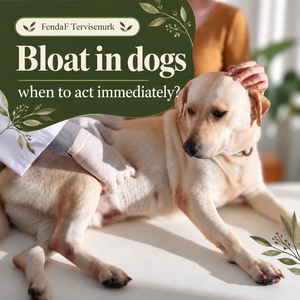
GDV in dogs: what can you prevent and when must you act?
Reading time: about 8 min
Gastric dilatation-volvulus is one of those conditions where I would never want a dog owner to keep searching online for one last tip or discussing with AI whether this really could be a twisted stomach. If a large, deep-chested dog suddenly becomes very restless, tries to vomit without bringing anything up, and develops a swollen abdomen, go to an emergency veterinary clinic immediately. This applies even when the abdomen is not yet visibly enlarged. Gas remedies, massage and waiting at home will not solve this.
Prevention is worth discussing too. As an owner of large breeds, I have tried to think carefully about feeding arrangements. For years, my dogs also ate from raised bowls. Reading a study that linked these bowls with a higher risk of GDV came as quite a surprise. Does that mean raised bowls cause GDV? No. But it is exactly the kind of question where we need to look at what the research actually shows.
What happens during GDV?
Gastric dilatation means that the stomach fills with gas, fluid or food and expands. If it also rotates around its axis, this is gastric dilatation-volvulus, or GDV. The twist can obstruct both the passage of stomach contents and blood flow, potentially causing shock, abnormal heart rhythms and organ damage. This is a surgical emergency, rather than ordinary bloating after overeating.
The risk is not limited to Great Danes or St Bernards. Other large, deep-chested dogs, including German Shepherds, are also at risk. Smaller dogs can develop GDV too. Breed, body shape and the medical history of close relatives help assess risk, but cannot predict any individual dog’s future.
How can you recognise GDV?
Typical early signs include sudden restlessness, pacing, inability to settle comfortably, excessive drooling, dry retching or repeated unsuccessful attempts to vomit, looking at the abdomen and abdominal pain. The abdomen may become tight and enlarged, but swelling may initially be difficult to see in a deep-chested dog. Rapid breathing, weakness, pale gums and collapse can follow.
When should you seek immediate veterinary help?
If you suspect GDV, go straight to an emergency clinic and, if possible, phone ahead on the way. Do not give food, water, simethicone or other medication, and do not try to induce vomiting. Do not wait for every sign on the list to appear: by then it may already be too late.
Seven everyday habits: what do we actually know?
1. Raised feeding bowls are not proven protection
A long-term study published in 2000 found an association between raised feeding bowls and GDV in large and giant breeds. Later studies have not produced consistent results. A 2017 critical review concluded that there was no evidence that raised bowls reduce GDV; as a precaution, a bowl on the floor may be preferable for dogs at risk, unless a veterinarian recommends otherwise for another health problem. We therefore cannot honestly say either that raised bowls definitely cause GDV or that they prevent it.
We discuss the studies and practical choices in more detail in our article Raised feeding bowls.
2. One large meal may not be the best choice
Studies in dogs at risk have associated larger meals with a higher incidence of GDV. In practice, dividing the daily ration into two or three meals, according to the dog’s needs, is reasonable. The volume in the stomach matters, rather than just the number of grams on the bag: 500 grams of one food may occupy a very different volume from 500 grams of another. When I first started feeding my dog cold-pressed food, the 500-gram daily portion looked incredibly small. That was when I realised how easily our eyes can misjudge a serving.
3. Slower eating makes sense, but offers no guarantee
Dogs that gulp their food often swallow air too. Some studies associate rapid eating with GDV, but their findings do not all agree. A calm feeding environment, splitting portions or using a suitable slow-feeder bowl may help a dog that eats too quickly. A very complicated puzzle bowl should not turn mealtimes into a stressful competition, however.
4. Calm before and after meals is a practical precaution
I remember my dogs sometimes wanting to run or play outside straight after eating. A quiet walk or getting up from the floor is not the same as a full-speed ball game. Separating strenuous exercise from a large meal is a reasonable precaution, but a universal instruction to avoid all movement for exactly two hours is not an established, clinically proven prevention rule. It is more useful to avoid a combination of gulping a large meal, overexcitement and immediate intense running. Movement itself is not forbidden, but taking a dog running on a full stomach is not a good idea.
5. Combining dry and wet food is not a GDV prevention measure in itself
I have added water to my younger dog’s kibble and given my older dog kefir after meals. These are my dogs’ feeding habits, rather than evidence that they prevent GDV. My own observation is simply that adding water slowed their eating, meaning they swallowed less air with their food. Moistening food may suit some dogs, and added water can support fluid intake, but there is no reliable basis for promising that mixing dry and wet food prevents GDV. Kefir, supplemental enzymes and probiotics cannot replace a prevention plan for a dog at risk either.
6. Simethicone is not first aid for GDV
Older advice sometimes suggests keeping a simethicone product such as Espumisan at home because it acts on gas bubbles. But GDV is much more serious than ordinary intestinal gas: the stomach may be twisted and its blood supply compromised. Simethicone neither untwists the stomach nor treats shock. Giving tablets or drops is especially dangerous if it delays the journey to an emergency clinic.
7. Water should remain available
Fear of GDV is no reason to hide a dog’s normal drinking water. Continuous access to clean water matters. If a dog suddenly drinks unusually large amounts or gulps water after strenuous exercise, assess the dog’s condition and how water is being offered. Simply restricting water is not a method of preventing GDV. Health and exercise always need to be considered together.
Can rolling onto the back cause GDV?
I have heard this old warning myself: do not let a dog roll over its back or its stomach might twist. Fortunately, the question has been studied. In a randomised study of 90 dogs in 2015, some dogs were rolled over their backs and others were not. None developed GDV, and the authors concluded that rolling over the back did not itself cause GDV. The study was small, however, and did not cover every situation, such as wild play after a large meal. There is no reason to forbid gentle rolling solely for fear of GDV, while vigorous activity after eating still deserves caution.
My own experience is similar. Faddy particularly enjoys going out onto the grass to roll after eating. He does not just roll once from right to left or left to right: he can keep going for minutes. I am not saying that Faddy proves rolling can never cause GDV, but every roll is not a reason to panic.
Can surgery prevent GDV?
For dogs at high risk, discuss preventive gastropexy with a veterinary surgeon. This operation attaches the stomach to the abdominal wall. It is sometimes performed at the same time as spaying or separately using a minimally invasive technique. An important distinction is that gastropexy does not prevent all stomach dilatation, but reduces the risk of the dangerous twist. For a dog at risk, it is a more concrete measure than hoping that kefir or a feeding bowl will provide reliable protection. Anaesthetic and surgical risks must also be weighed individually.
Integrative veterinarian Peter Dobias does not support preventive gastropexy. His reasoning is that fixing the stomach restricts its natural movement; he also refers to energy channels. This is his published position, rather than proof that the operation’s harms outweigh its benefits. Veterinary surgical sources support considering gastropexy in high-risk dogs because it reduces the risk of twisting, although it does not prevent stomach expansion. Declining surgery is also a decision that should take breed, family predisposition, age and surgical risk into account. I would not base the choice solely on the recommendation of one school of thought.
What does an integrative approach add?
An integrative veterinarian may consider meal timing, stress, food tolerance, gas, mobility and a generally calm living environment. These are sensible questions, but must not be confused with proven prevention of GDV. Some approaches discuss spinal mobility, muscle tension or digestive enzymes; there is insufficient clinical evidence of a causal link between these mechanisms and preventing GDV. Looking at the whole dog can improve wellbeing, but suspected GDV still requires immediate surgical care.
FendaF’s practical recommendation
If you have a large, deep-chested dog, ask about their individual GDV risk and preventive gastropexy at the next health check. At home, split large portions, provide calm mealtimes, keep water available and learn to recognise the combination of unsuccessful retching and sudden restlessness. Save an emergency clinic’s contact details in your phone before you need them.
Conclusion
There are no seven tips that provide sevenfold protection against GDV. There are risk factors supported by different strengths of evidence, sensible everyday decisions and clear warning signs that demand immediate action. If we take anything from old advice, let it be the habit of asking why: does this really reduce GDV risk, or merely sound reassuring? Effective prevention starts with knowing the difference.
Sources
- American College of Veterinary Surgeons: GDV, treatment and preventive gastropexy
- Cornell: GDV signs and risk factors
- Glickman et al. (2000): prospective risk factors in large dogs
- Raghavan et al. (2004): meal size and GDV risk
- Buckley (2017): evidence review on raised bowls
- Buckley (2016): evidence review on eating speed
- Harms, Langer and Fehr (2015). Should dogs be rolled over their backs? Kleintierpraxis 60, 297–303. DOI: 10.2377/0023-2076-60-297.
- Peter Dobias. Preventing Bloat (GDV) in Dogs. peterdobias.com; personal integrative position on gastropexy.
- Allen and Paul (2014): gastropexy indications and techniques. DOI: 10.1053/j.tcam.2014.09.001.
- Study of preventive gastropexy complications in 766 dogs (2023). PMID: 37908004.
🐾 FendaF believes in informed choices
The purpose of the FendaF blog is not to tell you what you must do. Our aim is to share knowledge, introduce different evidence-based and integrative perspectives, and help you make more informed decisions for your pet.
Every animal is unique, and no article can replace a consultation, diagnosis or treatment provided by a veterinarian. If your pet has a health concern or you need individual advice, always contact a veterinarian.
FAQ
Go to an emergency veterinary clinic immediately and phone ahead if possible. Do not give food, water or medication, induce vomiting, or wait for the abdomen to become visibly swollen.
There is no reliable evidence that raised bowls prevent GDV. Some research found an association with increased risk, but findings are not uniform. Discuss individual needs with your veterinarian.
No. It reduces the risk of dangerous twisting but does not prevent every episode of stomach dilatation. A veterinary surgeon should weigh breed, family history, age and anaesthetic or surgical risks.





Leave a Reply