


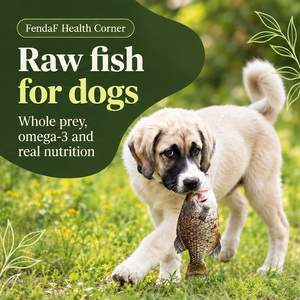
Raw fish for dogs: whole prey, omega-3 and real nutritional value
Reading time: about 6 min
A single small Baltic herring can be far more than a piece of fish flesh. When a dog eats the entire fish, including skin, head, eyes, soft tissues, bones and organs, it receives several kinds of animal tissue at once. That is what makes whole fish such an interesting addition to the diet.
I have offered my dogs whole Baltic herring and sprats for years. To me, it makes perfect sense: instead of taking only a fillet, I offer the chance to eat a small animal in its entirety. It is one of the simplest ways of including genuine nose-to-tail food in a dog’s diet. Of course, fish differ from one another, and fish alone does not automatically make a balanced diet. To understand its nutritional value, though, it helps to look beyond the fillet.
Why choose a whole small fish?
When we talk about whole prey, we often imagine a chicken, rabbit or another larger animal. A whole fish offers a different, practical possibility. For a suitable dog, a small Baltic herring or sprat can be offered with its head, skin, bones and internal organs. The diet then contains more than muscle meat: it includes various tissues with different nutrients.
The Food and Agriculture Organization of the United Nations (FAO) points out that the heads, bones and viscera of small fish eaten whole are often valuable sources of micronutrients. Those data mainly concern human nutrition and food composition, but they help explain why whole fish differs nutritionally from a fillet. Health outcomes in dogs must be evaluated separately.
| Part of the fish | What it contributes | Important nuance |
|---|---|---|
| Muscle | Highly digestible animal protein and amino acids; EPA and DHA in fattier fish. | Fat and omega-3 content depend on species and season. |
| Skin and subcutaneous fat | Fatty acids and other fat-soluble compounds, plus connective tissue. | Keeping the skin on does not automatically provide a high EPA/DHA dose. |
| Bones and backbone | Calcium and phosphorus; bones change the nutritional profile compared with fillets. | The amount and ratio of minerals may not meet the requirements of the entire diet. |
| Head, eyes and nervous tissue | Tissues beyond muscle, including fats characteristic of nervous tissue. | There is no proof that eating the head or eyes specifically provides an independent clinical benefit. |
| Liver, other organs and roe (when present) | May contribute vitamins, minerals and fats that are less abundant in fillets alone. | Amounts vary and too much of certain nutrients is also possible. |
This does not mean that every whole Baltic herring contains all the nutrients a dog needs in the correct amounts. Rather, the different parts of a fish complement each other, so a whole small fish has a broader nutrient profile than a fillet consisting only of muscle.
Omega-3: one of the strongest arguments for fish
Oily fish supply the long-chain omega-3 fatty acids EPA (eicosapentaenoic acid) and DHA (docosahexaenoic acid). These are not merely ‘good fats’ in the advertising sense. EPA and DHA contribute to cell-membrane structure and the regulation of inflammatory responses. DHA is particularly important in nervous tissue and the retina.
Baltic herring, herring, sardines and other fattier small fish can be valuable EPA and DHA sources. But a fish’s name or size cannot tell us the exact dose: fat content, fishing area, season and whether the fish is whole or processed all matter. Saying ‘I give a couple of herring’ cannot replace calculating EPA/DHA intake when the goal is targeted support for a health problem.
What do we know clinically? Studies and reviews in dogs support EPA- and DHA-rich foods or supplements as an adjunct, for example, in relieving pain associated with osteoarthritis. Studies on skin and coat conditions have more variable results, though some dogs with atopic dermatitis may benefit. This is evidence about EPA and DHA, not direct proof that whole raw Baltic herring treats joint or skin disease.
Here lies both the strength and limitation of whole raw fish. I can offer my dog real food with naturally occurring fatty acids, but if I need an exact therapeutic amount, I must know how much EPA and DHA the animal is getting. Salmon oil, fish-based complete food and whole fish can all be useful, but they are not directly comparable without considering the dose.
Beyond omega-3: what else does fish provide?
Fish is a source of high-quality animal protein. Depending on the species, body parts and preparation, it may also provide vitamin B12, vitamin D, selenium, iodine, phosphorus and, when eaten with bones, calcium. Its vitamin and mineral content varies considerably: for example, iodine levels differ among marine species, and lean white fish may provide far less omega-3 than oily fish.
What I particularly like about whole fish is that I do not have to get every nutrient from a separate bottle. Nevertheless, ‘natural’ is not the same as ‘perfect’. A complete diet must also consider vitamin E, the total amount of fatty acids, the calcium-to-phosphorus ratio and other ingredients. I therefore regard whole fish as a valuable part of the diet, not as a single food that automatically meets every need.
Baltic herring, sprats or fillets: which should you choose?
If the aim is to provide as many different parts of the fish as possible, I prefer a whole small fish of a suitable size. Baltic herring and sprats have a clear practical advantage over fillets: they can often be offered intact, with the bones, skin and organs included. Naturally, the size must suit the dog’s mouth and chewing habits.
If the aim is simply to provide good-quality protein, a fillet is a good food too. If a dog tends to gulp down whole fish, there is no reason to insist on swallowing bones merely for the sake of the ‘whole prey’ idea. In nutrition, the deciding factor is what suits the individual animal, not a slogan.
Whole fish and fish oil are also different foods. Oil supplies fatty acids but not the protein and minerals from fish flesh and bones. Conversely, whole fish may not provide a known, consistent dose of EPA/DHA. Both have their place; the aim simply needs to be clear.
Faddu and Ossu’s Baltic herring story
My boys love Baltic herring, but they were far from convinced at first. I remember Faddu taking a herring into his mouth and almost immediately dropping it again. I offered it to him on later occasions until he eventually decided to chew. Once the taste became familiar, herring quickly turned into a favourite. Ossu has made friends with fish as well.
By now they have also eaten frozen Baltic herring. I like that it is not just a treat: they get a whole small fish with its different tissues. This is my experience, not proof that raw or frozen fish is best for every dog. Some dogs do better with gently cooked or boneless fish, while others do not like fish at all. That is perfectly normal.
What about thiamine? Why shouldn’t fish always be the main part of the diet?
One particular feature of whole fish makes a second question necessary alongside ‘what does fish provide?’: ‘what might an overly one-sided fish diet reduce?’ Some raw fish species contain thiaminase, an enzyme that breaks down thiamine (vitamin B1). B1 is important for the nervous system and energy metabolism, and a long-term deficiency can be serious.
This is not merely a theoretical concern. Baltic herring and sprats have been studied directly for thiaminase. In one Baltic fish study, activity in Baltic herring was on average around ten times higher than in sprats, although it varied even among individuals of the same species. This does not establish what portion would cause a deficiency in a particular dog, but it is a sound reason not to base a long-term diet on one raw fish species.
Freezing does not inactivate thiaminase; heat does. Taking Baltic herring out of the freezer therefore does not resolve the vitamin B1 issue. A small amount of fish in a varied diet is different from a situation where most daily food consists of raw herring.
The nutritional value and safety of raw fish are not opposites
The fact that whole fish is nutritious does not make the questions around feeding it raw disappear. Raw fish may carry bacteria or parasites. Freezing under controlled conditions can reduce the risk from some parasites, but does not make fish free of microbes, remove thiaminase or eliminate environmental contaminants. Gently cooked fish is a more sensible choice for some dogs, and it still provides protein, many minerals and some omega-3 fatty acids.
When choosing Baltic Sea fish, we cannot rely solely on the claim that ‘small fish contain fewer heavy metals’. Small fish often contain less mercury than large predatory fish, but fatty Baltic fish raise a separate concern about dioxins and dioxin-like PCBs. Species and origin matter. I may give my dog chlorella for another purpose, but there is insufficient evidence that it automatically makes contaminated fish safe.
Bones also deserve attention. Bones in suitably sized fresh small fish may be more flexible than hardened processed bones, yet a dog that gulps its food may swallow a fish or bone whole. Watch how your dog chews and consider dental and oral health. Preserving all the nutritional value is not a reason to take unnecessary risks.
How much whole fish can a dog have?
There is no universal ‘number of herring’, because fish differ in size and fat content, while dogs have different energy needs. A small whole herring might be a varied addition for one dog and a substantial part of the meal for another. First consider what the dog already gets from its main food, then decide what the fish adds.
If fish is simply a supplement to balanced complete food, a conservative starting point is to keep all unbalanced extras combined to roughly 10% of daily calories. That does not mean a larger quantity of fish is necessarily bad. If you want more fish or other fresh ingredients, the entire ration must be deliberately balanced. This is especially important for growing puppies and dogs with special needs.
FendaF’s practical recommendation
If your dog enjoys whole Baltic herring or sprats, this is a lovely way to enrich the diet with more than just fillets. Think about what the whole fish provides: protein, fatty acids, minerals from the bones and extra nutrients from the organs. Choose fish carefully, supervise chewing and vary fish species and food sources. If you need an exact EPA/DHA dose or want to replace a large share of the diet with fresh food, calculate the nutritional balance of the entire diet.
Frequently asked questions
Is whole Baltic herring better than a fillet for dogs?
If a dog chews calmly and the fish is suitably sized, whole herring provides bones, skin and organs as well as muscle. A fillet may be safer for dogs that gulp food or have problems with bones.
Does one whole fish contain all the nutrients a dog needs?
No. Whole fish provides several kinds of nutrients, but it is not automatically a balanced complete food. Everything depends on the species, quantity and rest of the diet.
Do Baltic herring and sprats contain omega-3 fatty acids?
Yes, both can provide EPA and DHA. The exact amount varies, and for therapeutic purposes the dose should not be estimated from the number of fish alone.
Does freezing remove thiaminase from Baltic herring?
No. Freezing is not a reliable way to inactivate thiaminase. Heat treatment inactivates the enzyme; this is particularly important when raw fish makes up a large or one-sided part of the diet.
Can I give cooked whole fish instead of raw fish?
Yes, but take care with cooked fish bones because their properties may change. With cooked fish, removing the bones is often safer.
In summary
I would not give my dog whole Baltic herring simply because it is ‘raw’. I would choose it primarily because a whole small fish is an exceptionally practical way to provide muscle, skin, bones and organs in one portion, alongside EPA, DHA and other nutrients. That is more nutritionally interesting than thinking of fish only as a replacement for an omega-3 capsule.
At the same time, a whole fish does not mean the diet is balanced, and ‘raw’ does not mean that all nutrients are necessarily more available. For me, the right question is: which fish, in what quantity and in what form will benefit this particular dog most?
Sources
- FAO (2022). The State of World Fisheries and Aquaculture; utilization and processing of whole fish. https://www.fao.org/4/cc0461en/online/sofia/2022/utilization-processing-fisheries-production.html
- FAO (2022). The State of World Fisheries and Aquaculture; whole small fish and micronutrients. https://www.fao.org/4/cc0461en/cc0461en.pdf
- NIH Office of Dietary Supplements. Omega-3 Fatty Acids: Health Professional Fact Sheet. https://ods.od.nih.gov/factsheets/Omega3FattyAcids-HealthProfessional/
- 2025 systematic review. Exploring the efficacy and optimal dosages of omega-3 supplementation for companion animals. https://pubmed.ncbi.nlm.nih.gov/40495687/
- Barbeau-Grégoire et al. (2022). Systematic review and meta-analysis of omega-3 diets and supplements in canine and feline osteoarthritis. https://pmc.ncbi.nlm.nih.gov/articles/PMC9499673/
- Mueller et al. (2004). Effect of omega-3 fatty acids on canine atopic dermatitis. https://pubmed.ncbi.nlm.nih.gov/15206474/
- FEDIAF. Nutritional Guidelines for Complete and Complementary Pet Food for Cats and Dogs (2025). https://europeanpetfood.org/self-regulation/nutritional-guidelines/
- Merck Veterinary Manual. Nutritional Requirements of Small Animals: thiamine and thiaminases. https://www.merckvetmanual.com/management-and-nutrition/nutrition-small-animals/nutritional-requirements-of-small-animals
- Wistbacka & Bylund (2008). Thiaminase activity of Baltic salmon prey species. Journal of Fish Biology. https://doi.org/10.1111/j.1095-8649.2007.01722.x
- ESCCAP. Guidelines for Control of Intestinal Worms in Dogs and Cats and raw feeding risk management. https://www.esccap.org/
- FDA. Selecting and Serving Fresh and Frozen Seafood Safely. https://www.fda.gov/food/buy-store-serve-safe-food/selecting-and-serving-fresh-and-frozen-seafood-safely
- EFSA (2026). Update of the risk assessment on dioxins and dioxin-like PCBs in feed and food. https://doi.org/10.2903/j.efsa.2026.10103
- FEDIAF. Chews and treats for dogs: 10% complementary feeding guideline. https://europeanpetfood.org/pet-food-facts/fact-sheets/quality-and-safety/chews-and-treats-for-dogs/
🐾 FendaF believes in informed choices
The purpose of the FendaF blog is not to tell you what you must do. Our aim is to share knowledge, introduce different evidence-based and integrative perspectives, and help you make more informed decisions for your pet.
Every animal is unique, and no article can replace a consultation, diagnosis or treatment provided by a veterinarian. If your pet has a health concern or you need individual advice, always contact a veterinarian.











Leave a Reply