


Cold-pressed dog food: what our water test really shows
Reading time: about 8 min
When we first started introducing cold-pressed dry food at FendaF, these granules seemed quite unusual. Instead of a regular kibble, it’s more like a small pellet. And when a product is different, I naturally wonder: why? Is the difference only in appearance, or does something different happen when the food reaches the dog’s stomach?
This question prompted us to do a very simple experiment. We put cold-pressed and regular kibble in water, waited, and saw what happened. The result surprised me. But in the meantime, I’ve come back to this experiment with another, more important question: what can you really conclude from a glass of water and what not?
What is cold-pressed food?
Cold-pressed dog food is made by forming the ingredients into pellets using pressure. Pressing differs from conventional extrusion, which changes the temperature, moisture, and mechanical stress of the food mass, giving the kibble its characteristic porous shape.
The word “cold-pressed” can give the impression that the food has not been subjected to any heat at all. This is usually not the case. For example, some ingredients may have been previously heat-treated and the pressing process itself takes place at a lower temperature. In our original introduction, the processing temperature for a particular food was listed as around 72°C. This does not automatically describe all the processing steps of every cold-pressed product, nor does it mean that every vitamin is definitely preserved intact.
Why is this important? Because the value of food is not determined by a single temperature reading. The quality of the raw materials, processing time, humidity, pressure, availability of nutrients, and the composition of the finished product are also important.
Our experiment: two foods, same amount of water

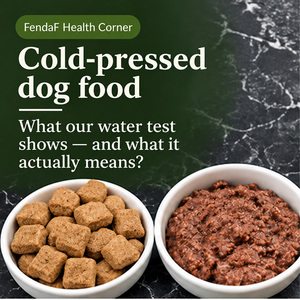
We took comparable amounts of conventionally prepared dry food and cold-pressed pellets. We added the same amount of water to both and left the dishes to stand overnight.
The difference was noticeable right from the start: some of the kibble stayed on the surface of the water, while the cold-pressed granules sank to the bottom. By morning, the regular kibble had largely retained its shape, but the cold-pressed granules had turned into a soft mush. This was clearly visible and a pretty exciting result for me.
Does this mean that cold-pressed food is better digested?
Not necessarily. Disintegration in water and digestibility are not the same thing. In the dog’s digestive tract, stomach acid, enzymes, gut motility and many other processes work together. Food that quickly turns to mush in water does not necessarily provide more absorbable protein or energy. Also, kibble that retains its shape longer does not automatically mean that it is poorly digested.
A study published in 2024 used different methods to prepare a similar corn-based recipe. In this particular study, the extruded version was more digestible than the pelleted and baked versions. This is not a direct test of the Winner Plus cold-pressed food, and it does not prove that all extruded foods are better. However, the study does show why a processing method cannot be declared a winner based on name alone. For the same reason, I do not avoid extruded foods.
According to the manufacturer of Winner Plus, a veterinarian monitored cold-pressed food passing through a dog’s digestive tract and found that it left the stomach more quickly than the comparison food. To me, this is an interesting additional observation to our water test: it suggests that cold-pressed food may be better tolerated by some dogs during digestion. However, faster emptying of the stomach is not the same as better digestibility or absorption of nutrients, and it does not prove a lower risk of gastric torsion. However, this practical observation from the manufacturer is worth considering in conjunction with the individual dog’s well-being and suitability of the food.
Our customers have occasionally described that when switching to cold-pressed food, there is less stool. This is a completely valuable practical observation. However, the amount of stool also depends on the portion size, fiber, energy density, water content and the individual reaction of the dog. A smaller amount is not in itself a laboratory digestibility test.
Does less swelling of the food mean a lower risk of GDV?
It is worth being very precise here. Gastric torsion, or gastric dilatation-volvulus (GDV), is a much more complicated emergency condition. The risk is influenced, among other things, by the dog’s body type and deep chest, age, individual predisposition, and eating habits. Studies have also found associations with eating very quickly and eating large, single meals. There is currently no good clinical evidence that the disintegration of the cold-pressed pellet itself, as seen in our water test, would reduce the risk of gastric torsion. However, there is an important nuance here for me – less swollen food behaves differently in the stomach.
I am not promoting cold-pressed food as a means of preventing gastric torsion. Rather, the feeding routine, or less food at a time, plays a role.
If your dog’s stomach suddenly swells, he repeatedly tries to vomit without success, he is restless, in severe pain, weak, or his gums turn pale, you should go to the emergency clinic immediately. This is not a situation where we wait and see if different kibbles will help.
What about vitamins, corn, and processing?
In the case of extrusion, heat can affect some heat-sensitive vitamins, but at the same time, heat treatment improves the availability of starch and can reduce the effects of certain undesirable compounds found in raw materials. This is why the topic of food processing is more interesting than the simple opposition of “hot is bad, cold is good”.
Corn is not automatically an unsuitable ingredient for dogs either. Its digestibility depends on the processing and the entire recipe. Hydrothermally processed corn can be a good source of carbohydrates for dogs. If a dog really has an intolerance to a specific ingredient or a proven food allergy, this must of course be assessed separately. In my experience, cold-pressed food has also been suitable for some dogs whose owners suspected a chicken allergy, but no general conclusion can be drawn from this regarding allergy treatment. Because it all comes down to the raw material and how the chicken was raised.
Is cold-pressed food suitable for a dog that doesn’t drink enough water?
Softening in water does not automatically make dry food a “wet food”. The water content of cold-pressed dry food itself remains typical of dry food. If the dog drinks too little, its actual fluid intake should be monitored and, if necessary, water should be added to the food or another suitable moist feeding option can be considered. The method of food decomposition in a glass is not a substitute for drinking water.
But maybe some dogs just like the texture of the cold-pressed granules. In our showroom, many dogs have tried this food with pleasure. We have estimated at the time that as many as 80–90% of the dogs who came to try it preferred it in the comparison offered. This was an unofficial observation by our store, not a blind preference study, but for the owner, taste preference is still quite important. The most beautiful ingredient list in the world is not of much help if the dog does not eat its food at all.
How to choose cold-pressed food wisely?
I would first check if the product is complete food and suitable for the dog’s life stage. Then I would read the composition and analytical parameters, consider the dog’s health and examine the manufacturer’s own quality control. Only then does the processing method become an important additional piece of information for me.
When transitioning, I would monitor appetite, stool quality, weight, gas, and overall well-being for a few weeks. If a dog has chronic digestive issues, I wouldn’t jump to conclusions based on just one better stool. Then I would still ask: but why did this problem arise in the first place?
FendaF’s practical checklist
When you hear the claim “cold-pressed food is significantly more digestible,” ask three things: is it digestibility measured in real dogs, a test conducted on a single food, or simply a change seen in water? These are three different pieces of evidence. And it is distinguishing between them that helps you make an informed choice.
In conclusion
I still like the different texture of cold-pressed food, and our own water experiment was a worthwhile endeavor. It showed something really visible. However, I don’t think it’s right to attach conclusions to this experiment that it couldn’t measure.
Cold-pressed dry food can be a great choice for some dogs. However, its suitability is not determined by the word “cold-pressed,” but by the entire recipe, quality, and how a particular dog copes with the food.
I like to offer my dogs variety. So sometimes they eat cold-pressed food, sometimes a single-protein formula and sometimes a holistic formula. For me, this is more important than getting stuck in the mindset that cold-pressed food is definitely better than others. The question is which food is right for which dog.
Sources
- Corsato Alvarenga et al. (2024). Processing of corn-based dog foods through pelleting, baking and extrusion and their effect on apparent total tract digestibility and colonic health of adult dogs. Journal of Animal Science. https://doi.org/10.1093/jas/skae067
- Morin, Gorman, Lambrakis (2021). A literature review on vitamin retention during the extrusion of dry pet food. Animal Feed Science and Technology. https://doi.org/10.1016/j.anifeedsci.2021.114975
- Tran, Hendriks, van der Poel (2008). Effects of extrusion processing on nutrients in dry pet food. Journal of the Science of Food and Agriculture. https://doi.org/10.1002/jsfa.3247
- Glickman et al. (1997). Multiple risk factors for the gastric dilatation-volvulus syndrome in dogs. Journal of the American Animal Hospital Association. https://pubmed.ncbi.nlm.nih.gov/9138229/
- O’Neill et al. (2017). Gastric dilation-volvulus in dogs attending UK emergency-care veterinary practices: prevalence, risk factors and survival. Journal of Small Animal Practice. https://doi.org/10.1111/jsap.12723
🐾 FendaF believes in informed choices.
We share scientific research, integrative veterinary perspectives and practical experience so that you can make well-informed decisions for your pet. Every animal is unique, and no article can replace veterinary assessment, diagnosis or treatment. If your pet is unwell, consult your veterinarian.
Author: Piret Oper





Leave a Reply