


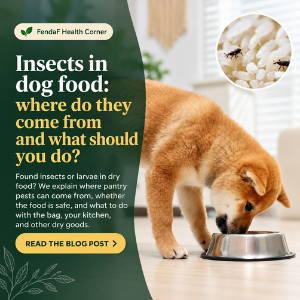
Insects in dog food: where do they come from and what should you do?
Reading time: about 13 min
In 2020, a photo was posted in a dog owners’ Facebook group showing black, hard-shelled insects found in a bag of dry dog food. Based on the photo, we thought they might be flour beetles, and that became the starting point for FendaF’s first article on “Insects in dog food?!”
Six years later, the topic deserves a more precise treatment. Finding an insect in dry dog food does not automatically mean that the manufacturer used spoiled raw materials. An intact, hermetically sealed package substantially reduces the chance of a pest entering the food after packaging. It does not, however, completely rule out earlier contamination or microscopic damage to the package. Dry dog food belongs to the same broad world of dry goods as flour, rice, pasta, seeds and bird feed: a range of pantry or stored-product pests can infest it, and contamination can occur anywhere from production to retail, transport or home storage.
The most practical question is therefore not “whose fault is it?”, but: what should you do with the food, how should you preserve batch information, how should you check other dry goods, and when should you report the problem to the seller or manufacturer’s representative?
What insects can get into dry dog food?
Dry dog food and other dry goods may contain, for example, flour beetles (Tribolium spp.), warehouse beetles, grain weevils and Indian meal moth larvae. Species cannot always be identified reliably by appearance alone, and for the first decision at home, exact species identification is usually not the most important issue.
The key point is that these insects do not simply “appear” in food by themselves. Some life stage, an egg, larva, pupa or adult insect, must reach the product or package somehow. University of Minnesota Extension notes that dry foods may become infested at any stage from production to the home, and pests may enter even unopened thin paper, cardboard, plastic or foil packages through folds, seams or tiny defects. The risk is not the same for every package: a strong, hermetically sealed package provides better protection than one with air vents, folds or thin material.
This also means that a visible adult insect may not be the only life stage present. Eggs, larvae, pupae and adult insects can all be present in the same package at the same time.
Do insects mean the food was already spoiled?
Not necessarily. Pantry pests feed on dry plant or animal material and can be found in foods that are not microbiologically “spoiled” in the usual sense.
The low moisture content of dry dog food helps inhibit the growth of many microbes. FEDIAF describes heating, drying and cooling during dry pet food production and emphasizes that reducing moisture is important for preventing spoilage. Packaging is closed to reduce contamination, but dry dog food is not the same type of sterilized, hermetically sealed product as canned food.
So an insect found inside a bag is not enough on its own to determine whether the problem began in the raw material, during production, in a warehouse, in transport, in a shop or at home. Sometimes the answer becomes clearer only after looking at the batch, the condition of the package and complaints involving other bags from the same batch.
Is this kind of food dangerous for a dog?
Typical pantry pests do not bite or sting people or pets, and accidentally swallowing one is usually not the main toxicological concern. That does not mean it makes sense to keep feeding dry food that is visibly infested.
An infestation means the food’s quality and hygiene are no longer what the manufacturer intended. Insects, shed larval skins, droppings, webbing or moisture damage can contaminate food, and an opened or damaged package also increases the possibility of other quality problems. If you find live insects, larvae or large amounts of their traces in the bag, FendaF’s practical recommendation is to set the food aside rather than trying to “sieve the insects out” and continue feeding it.
Where are the insects most likely to come from?
There is no single universal answer. In practice, it helps to think about four possible stages:
- Production or raw materials. The manufacturer has to control raw materials, processes, pests and package integrity, but no system means absolute zero risk.
- Warehouse and transport. Long storage periods, warm conditions, damaged packaging or proximity to other dry goods can increase the chance of infestation.
- Pantry pests can spread from one dry-food package to another, and damaged or poorly sealed packages are particularly vulnerable.
- The insect may already be present in another dry food such as flour, rice, pasta, nuts, seeds, bird feed or treats and then move to the dog food. That is why throwing away only one bag of dog food is not always enough.
Does a hermetically sealed bag reduce the risk?
Yes. Package type matters. An intact, hermetically sealed bag mainly reduces the chance of infestation after packaging because pests have far fewer entry points than they do with vented, folded, poorly sealed or damaged packaging. Packaging studies also show that material thickness, multilayer construction and even very small openings affect how well a package resists stored-product insects.
Most dry-food bags in FendaF’s range are hermetically sealed, and for us this is a meaningful advantage rather than just a packaging detail. Hermetic sealing still does not reduce the risk to zero: if an egg or larva was already in the product before sealing, or if the package has an unnoticed microscopic defect, a problem can still appear in a closed bag. If live insects or larvae are found inside a hermetically sealed bag that looks completely intact, keep the batch information and notify the seller or manufacturer, because in that situation it is especially important to investigate production or an earlier stage of the supply chain.
Does “human-grade” raw material mean a lower insect risk?
Many pantry pests are associated with grains, plant-based dry ingredients and storage conditions. “Fit for human consumption” also does not automatically mean better pest control throughout the entire production and supply chain. FEDIAF places more emphasis on supplier control, raw-material specifications, HACCP-based risk management, production hygiene, package-integrity checks, traceability and testing of finished products.
So today FendaF would rather ask the following when evaluating a manufacturer: does it have a functioning food-safety management system, pest control, traceability, supplier control and a clear complaint-handling process?
What about ISO 22000?
ISO 22000 is still a very relevant quality signal, but it also needs to be described accurately. ISO 22000 defines a food-safety management system that combines, among other things, HACCP principles, prerequisite programmes, management-system requirements and communication.
The certificate shows that the company’s management system meets the requirements of the standard. It is not a guarantee that an insect or another deviation can never be found in an individual package. ISO 22003 explicitly emphasizes that certification of a management system does not demonstrate the safety or suitability of every individual product. So the certificate is a positive point, not a magic shield.
There is also a broader European framework: Regulation (EC) No 183/2005 on feed hygiene requires clean and dry storage areas and appropriate pest-control measures where necessary. FEDIAF’s Guide to Good Practice for the Manufacture of Safe Pet Food covers storage and distribution as well as manufacturing.
Should dry dog food be poured straight into another container?
The FDA recommends keeping dry pet food in its original bag whenever possible. If you want to use a large storage bin, a good solution is to place the entire original bag inside it. This preserves the batch number, best-before date and production information, and the food does not remain in constant contact with fat and crumb residues from the previous bag.
If you do pour food directly into a container, the container should be clean and completely dry before a new bag goes in, and the batch information should be kept. Do not pour new food on top of old leftovers. Regardless of the container, store dry food in a cool, dry place and close the package after every use.
Integrative perspective: visible insects are not the only storage problem
Integrative pet-nutrition discussions point out that dry-food problems are not limited to flour beetles or larvae visible to the naked eye. Under suitable conditions, microscopic storage mites such as Tyrophagus putrescentiae can also multiply in dry food. They are particularly relevant for allergic and atopic dogs because storage mites may act as allergens and can worsen itching or other allergy signs in some sensitive dogs.
This is not only an integrative theory. Veterinary dermatology studies have shown that dry dog food can provide a suitable environment for storage mites, especially at higher temperatures and humidity. At the same time, mite counts in freshly opened packages are usually very low or undetectable. The practical conclusion is therefore not “dry food is always full of mites”, but that storage conditions and the age of an opened bag matter.
Dr Karen Becker/Bark & Whiskers summarize the main enemies of dry food rather neatly: time, heat, light, moisture and oxygen. A 12–18 month “best before” date on an unopened bag does not mean opened kibble keeps the same quality for months. Their practical guideline is to use an opened bag within about 4–6 weeks. Dr Judy Morgan takes an even more conservative approach and recommends buying a bag size that is used up in roughly 2–3 weeks, mainly to reduce fat oxidation and rancidity.
FendaF’s practical freezer rule for large bags
If buying a large bag makes sense financially or logistically, the answer does not have to be buying only small bags. FendaF has recommended to clients, and has also used personally, a system where about one month’s worth is kept in use and the rest of the dry food is divided into smaller airtight portions and frozen. In our practical experience, freezing has not caused any problems with the kibble; on the contrary, aroma and taste stay fresher and low temperature slows fat oxidation.
The key is to avoid condensation: take out only the portion you will use soon and allow the sealed package to warm to room temperature before opening it. This prevents moisture from room air condensing on the cold kibble. There is no point in repeatedly freezing and thawing the same portion.
In practice, you can choose between two simple approaches: a smaller bag that is used within about 4–6 weeks, or, with a large bag, keeping roughly one month’s supply in use and freezing the rest in airtight portions. In both cases, keep the original packaging or at least the batch number, best-before date and other traceability information.
What should you do if you find insects in the bag?
This is the most important practical part for FendaF. Do not throw the bag away in the first moment of shock before you have recorded the information you may need.
- Stop feeding from that bag. Keep it separate from other dry goods so a possible infestation does not spread.
- Take photos and video. Photograph the insects or larvae, the outside of the bag, any possible hole or damaged seam, and the food itself.
- Keep the batch number, best-before date and exact product name. These are more useful to the manufacturer and seller than a photo of an insect alone.
- Contact the seller or importer. If possible, do not destroy the product until you have been told whether the bag or a sample needs to be returned.
- Check nearby dry goods. Look through flour, cereals, rice, pasta, nuts, seeds, treats, bird feed and other animal foods.
- If you find pests in several products or cupboards, treat it as a pantry-pest problem in the home rather than only as a defect in one bag of dog food.
How do you actually get rid of pantry pests?
A common recommendation is to wash surfaces with vinegar solution. Cleaning surfaces is sensible, but vinegar is not the key factor here and it is not a reliable way to “kill” the eggs. University of Minnesota Extension emphasizes that even detergent, ammonia or bleach will not prevent infestation if the contaminated food source is still present.
The more effective plan is much less dramatic:
- Find and remove the contaminated food source. Check all nearby dry goods, not just dog food.
- Vacuum cupboard corners, cracks, shelf joints and places where crumbs or larvae may remain. Empty the vacuum afterwards or discard the bag.
- Wash shelves normally and let them dry completely. The goal is to remove food residues, not to “marinate” the kitchen in vinegar.
- Store new dry goods well sealed in sturdy glass, metal or thick plastic containers, or keep them in the original packaging inside a closable storage bin.
- Monitor for a few weeks to see whether adult insects appear again. If they do, there is probably another source of infestation somewhere.
FendaF’s practical 10-minute check
- Before buying: make sure the bag is not torn, the seam is not open, and the package is not wet or dirty. When possible, choose an intact and well-sealed package; hermetic sealing reduces the chance of infestation after packaging.
- At home: store the bag in a cool, dry place. If you use a storage bin, prefer keeping the original bag inside it. If a large bag will not be used within about a month, divide the rest into airtight portions and store them in the freezer.
- If your dog has persistent itching or recurrent ear problems: include storage mites in the possible allergen load, especially if dry food is stored for a long time, in warm conditions or in high humidity.
- If you find one insect: do not immediately assume either “factory disaster” or “your home is to blame”. Isolate the bag and check the batch information plus other dry goods.
- If you find larvae, webbing or several insects: stop feeding, document the finding and contact the seller.
- If the same problem appears in several dry foods: deal with the whole pantry/storage area, not only the dog-food bag.
- If the dog became ill after eating the affected food: keep the packaging and batch information and contact your veterinarian.
In summary
Insects in dry dog food are unpleasant, but their presence does not automatically prove that the food was made from spoiled raw materials or that the entire manufacturer is unreliable. Pantry pests can enter food at different stages of the supply chain and can also spread between dry goods at home.
The most useful approach is to preserve calm and traceability: do not keep feeding an infested bag, retain the packaging and batch information, document the finding, check other dry goods, and notify the seller or manufacturer. When evaluating a manufacturer, look beyond one slogan to the whole system: supplier control, HACCP, traceability, package integrity, pest control and complaint handling.
There is no need to pour dry dog food out of the original bag simply to make it “safer”. Often the most practical solution is to place the original bag itself inside a clean, closable storage container. If a large bag will not be used within about a month, the remainder can be divided into airtight portions and frozen, allowing each sealed portion to warm to room temperature before opening.
Sources used
- FDA – Proper Storage of Pet Food & Treats – https://www.fda.gov/animal-veterinary/animal-health-literacy/proper-storage-pet-food-treats
- FDA – How to Report a Pet Food Complaint – https://www.fda.gov/animal-veterinary/report-problem/how-report-pet-food-complaint
- University of Minnesota Extension – Pantry pests: Insects found in stored food – https://extension.umn.edu/product-and-houseplant-pests/pantry-pests-insects-found-stored-food
- FEDIAF – Safety / Guide to Good Practice for the Manufacture of Safe Pet Food – https://europeanpetfood.org/self-regulation/safety/
- FEDIAF – How dry pet food is made – https://europeanpetfood.org/pet-food-facts/fact-sheets/quality-and-safety/how-dry-pet-food-is-made/
- FEDIAF – The safety of pet food – https://europeanpetfood.org/pet-food-facts/fact-sheets/quality-and-safety/the-safety-of-pet-food/
- ISO – ISO 22000:2018 Food safety management systems – https://www.iso.org/standard/65464.html
- ISO – ISO 22003-1:2022 – https://www.iso.org/standard/74410.html
- EUR-Lex – Regulation (EC) No 183/2005 on feed hygiene – https://eur-lex.europa.eu/legal-content/EN/ALL/?uri=celex:32005R0183
- PubMed – Evaluation of storage mite contamination of commercial dry dog food – https://pubmed.ncbi.nlm.nih.gov/18494758/
- PubMed – Critically Appraised Topic: Storage Mites in Commercial Pet Foods – https://pubmed.ncbi.nlm.nih.gov/31672139/
- Bark & Whiskers / Dr. Karen Becker – Common Contaminants in Dry Dog Food (2024) – https://www.barkandwhiskers.com/2024-03-04-contaminants-in-dry-dog-food/
- Bark & Whiskers / Dr. Karen Becker – How to Handle and Store Your Pet’s Convenience Food – https://www.barkandwhiskers.com/2019-03-30-nl-pet-food-storage-mistakes/
- Judy Morgan – Rancid Food for Your Pets? – https://drjudymorgan.com/blogs/blog/rancid-food-for-your-pets
- Journal of Stored Products Research (2025) – Comparison of the resistance of various food packaging materials to stored product insect pests – https://www.sciencedirect.com/science/article/abs/pii/S0022474X25002401
🐾 FendaF believes in informed choices
The purpose of the FendaF blog is not to tell you what you must do. Our aim is to share knowledge, introduce different evidence-based and integrative perspectives, and help you make more informed decisions for your pet.
Every animal is unique, and no article can replace a consultation, diagnosis or treatment provided by a veterinarian. If your pet has a health concern or you need individual advice, always contact a veterinarian.






Leave a Reply