


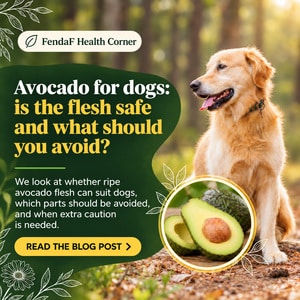
Avocado for dogs: is the flesh safe and what should you avoid?
Reading time: about 4 min
When I began reading about avocado years ago, I noticed an odd contradiction. One website described it as a forbidden fruit for dogs; another explained that a small amount of flesh could be perfectly acceptable. I have occasionally offered avocado to my dogs. Neither was particularly interested at first, until one day things changed completely: Ossu was so delighted that he was drooling. 😄
That is a lovely experience, of course, but a dog’s enthusiasm does not prove a food is safe. Let us look at which part of the avocado we mean, where the warnings come from and when caution is sensible.
Why is avocado considered dangerous for dogs?
Avocado contains persin, a plant compound that can be particularly harmful to several animal species. Horses, birds and some other animals are much more sensitive than dogs. Information about different species should not automatically be treated as interchangeable.
For dogs, historical references include a 1994 report involving two dogs near a South African avocado plantation. They had eaten whole avocados and other plant parts. That case does not directly establish that a small amount of peeled flesh is poisonous to every dog. Equally, the limitations of one case report do not establish that every part of an avocado is safe.
How do the flesh, skin and stone differ?
When I offer avocado, I mean only ripe, peeled flesh. The stone, or large seed, does not belong in a dog’s bowl. Swallowing it may obstruct the oesophagus or intestines. This foreign-body risk is much clearer in practical terms than the potential toxicity of a small amount of flesh.
I would also leave out the skin, leaves, stems and, naturally, the tree’s bark. These are unnecessary as food and may irritate the digestive tract or increase exposure to persin. Peeling and removing the stone are simple steps, not excessive precautions.
My approach is to offer dogs the same part of the avocado that I eat myself.
What do studies and animal poison services say?
In a study abstract published in 2012, forty adult beagles were fed diets containing up to 1.1% specially processed avocado extract for six months. No significant adverse health effects were seen at the amounts studied. This is interesting, but there is an important limitation: it was a defatted, water-soluble extract, not a conventional feeding study of avocado fruit, stones or skin. The study was also industry-funded and published as a conference abstract.
Pet Poison Helpline generally does not describe avocado as a typical toxic food for dogs, while highlighting the stone’s obstruction risk and the flesh’s fat content. ASPCA describes possible digestive signs associated with persin and differences in sensitivity between species. These positions are less contradictory than headlines sometimes suggest. “Not a typical poison” does not mean “offer without limits”.
Does avocado benefit dogs?
Avocado flesh supplies fat, fibre, several vitamins and folate. It can be a small addition that brings variety. One aspect of integrative nutrition I appreciate is using fresh, whole foods where possible rather than looking for a separate capsule for every nutrient.
However, we cannot claim that eating avocado itself treats inflammation or prevents specific diseases in dogs. An interesting laboratory effect of a compound found in avocado is not the same as proven clinical benefit in a dog’s bowl. Even if avocado appears to benefit one dog’s health, that does not guarantee the same effect in another.
When would I avoid avocado?
Avocado is relatively high in fat. For a dog with previous pancreatitis, a need for a low-fat diet or current digestive trouble, it would not be my first choice. The relationship between fat and pancreatitis depends on the individual and the disease context. I would not claim every piece of avocado causes pancreatitis, but there is no reason to dismiss the risk entirely either.
Monitor the response if a dog has sensitive digestion or is trying a new food. Avocado is not necessary for good health. If it does not suit your dog, there are plenty of other fresh foods.
How can you offer avocado at home?
Choose a ripe avocado, completely remove the skin and stone, and offer only a small piece of plain flesh. Do not give guacamole or other human avocado dishes that may contain onion, excess salt or other unsuitable ingredients.
I would start with a tiny amount and observe wellbeing and stools the following day. I do not need to put avocado in every bowl simply because a dog loves it. Even Ossu’s enthusiasm did not turn it into a compulsory daily addition in our home.
FendaF’s practical recommendation
If a healthy dog tolerates avocado flesh and you would like to offer it for variety, a small amount of peeled, stone-free, unseasoned flesh is more appropriate than a whole avocado. I would definitely leave out the stone, skin and other plant parts. If a dog swallows the stone, I would contact a veterinarian immediately rather than wait for symptoms.
Frequently asked questions
Is an avocado stone poisonous to dogs?
The main immediate danger is the large stone becoming lodged in the digestive tract. Seek prompt veterinary advice even if the dog initially seems well.
Can a dog eat an avocado sandwich?
It is better to offer only a small piece of plain flesh. A sandwich or avocado spread may contain onion and other unsuitable ingredients.
Can dogs have avocado every day?
It is not necessary, and the fat and energy must be included in the overall diet. I would start with small amounts offered occasionally.
Sources
- Pet Poison Helpline: avocado
- ASPCA Animal Poison Control: avocado risks
- Davenport et al. (2012), avocado extract study
- Dr Karen Becker: original context of the avocado overview
🐾 FendaF believes in informed choices
The purpose of the FendaF blog is not to tell you what you must do. Our aim is to share knowledge, introduce different evidence-based and integrative perspectives, and help you make more informed decisions for your pet.
Every animal is unique, and no article can replace a consultation, diagnosis or treatment provided by a veterinarian. If your pet has a health concern or you need individual advice, always contact a veterinarian.








Leave a Reply