


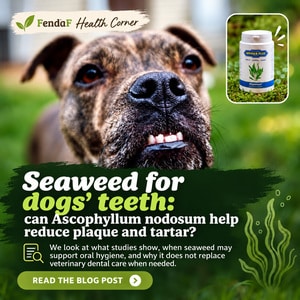
Seaweed for dogs’ teeth: can Ascophyllum nodosum help reduce plaque and tartar?
Reading time: about 6 min
Seaweed has been part of FendaF’s range for years, but at first I mainly discussed Algomar tablets in relation to pigmentation and general wellbeing. Then we received feedback from a Chihuahua owner who had a persistent problem with tartar. She had brushed her dogs’ teeth every day for about six months, but, in her words, the only change was that the tartar became yellower. After two months of using seaweed tablets, she felt the tartar had almost disappeared and was brushing only a few times a week. Later, an owner of two Papillons told me about a similarly positive experience in our showroom.
Hearing these stories made me look into what might explain the effect. Does seaweed really do something for teeth, or are we simply seeing natural variation? And if there is an effect, does it reduce tartar that has already hardened, or help new plaque form more slowly? Those are two quite different questions.
First, plaque, tartar and gum disease are different things
Dental plaque is a bacterial biofilm that forms on teeth. If it is not removed, minerals can cause it to harden into tartar. Tartar provides a rough surface to which new plaque readily sticks. Gingivitis is the tissues’ inflammatory response to bacteria, while periodontitis can also damage the tissues and bone supporting the teeth. The colour of the visible tooth surface therefore does not always tell us how healthy a mouth really is. Important changes can take place below the gumline, where an owner cannot see them.
This distinction also determines the goal. Regular home care can slow the accumulation of new plaque and tartar. But if teeth already have a thick mineralised layer or periodontitis is present, veterinary dental treatment may be needed, including dental X-rays where appropriate and cleaning under general anaesthesia. No seaweed tablet is a reason to leave a diseased mouth untreated.
What do studies in dogs show?
In 2018, a double-blind, randomised, placebo-controlled study was published involving 60 dogs, mainly of smaller breeds. The dogs first underwent professional dental cleaning and then received either edible treats containing Ascophyllum nodosum or similar placebo treats for 90 days. Researchers assessed them on days 30, 60 and 90. On average, dogs receiving seaweed accumulated less new plaque and tartar, and had lower levels of the volatile sulphur compounds responsible for unpleasant breath. Several other oral hygiene measures also improved.
This is direct evidence from dogs, rather than just a laboratory experiment. But its limits matter: the study lasted three months, all teeth were professionally cleaned at the start, and a specific product was tested. It therefore mainly shows the potential to reduce new plaque and tartar accumulation after cleaning. It does not prove that every seaweed powder dissolves old, thick tartar or treats advanced periodontitis. The study was also funded by the manufacturer of the tested product. That does not automatically invalidate the findings, but it is part of assessing the evidence.
There is also a human study first published online in 2014. It enrolled 61 people, of whom 55 completed the study, and used a daily dose of 500 mg of Ascophyllum nodosum. Compared with the control period, the researchers reported a mean reduction of 52% in calculus formation. This is interesting and helped lead me to the subject, but a human result cannot be directly converted into a dog’s dose or a treatment promise. Fortunately, we now also have research in dogs.
How might swallowed seaweed affect teeth?
Ascophyllum nodosum is a brown seaweed that does not have to rub against a dog’s teeth to have an effect. Integrative discussions include possible systemic effects on saliva composition, the oral bacterial community and plaque adhesion. However, its precise mechanism in dogs is not fully established and should not be presented as a conclusively proven explanation. A measured study result is a stronger claim than a hypothesis about why it occurred.
Even the same seaweed species does not automatically mean the same finished product. Origin, processing, actual quantity, composition testing and consistent use may all matter. For example, some products containing Ascophyllum nodosum appear on the Veterinary Oral Health Council’s accepted-products list, but that acceptance applies to the specific products and claims listed. It cannot simply be transferred from one brand to another.
Seaweed is not necessarily suitable for every dog
Seaweeds contain iodine, and the amount can vary considerably between raw materials. This is particularly important for dogs or cats with thyroid disease, and for animals already receiving iodine-containing supplements or a special diet. The 2018 dog study monitored participants’ thyroid parameters and used a product with a defined composition. At home, it is not sensible to assume the same safety for an entirely different powder or dose.
Before buying, I therefore look beyond the word “seaweed” to the species Ascophyllum nodosum, the recommended daily amount, the iodine content and, where possible, batch testing. If a dog has a thyroid condition, takes medication or has another chronic disease, discuss the supplement’s suitability with a vet. More seaweed does not automatically mean cleaner teeth sooner.
Why have I preferred chewing?
I have never brushed my own dogs’ teeth regularly. I tried it with my first dog, but we did not get very far with cooperation. Chewing has therefore had an important place in our home, and I have offered both natural dried treats and raw meaty bones. This is our experience, and one reason I also appreciate other options that support oral health.
However, the fact that wolves do not have their teeth brushed does not mean every pet dog can go without brushing. Domestic dogs, especially small breeds, can have a high risk of oral disease, and regular brushing remains one of the best-supported methods of home care. Chewing may help reduce plaque on some tooth surfaces, but an overly hard antler or bone can fracture a tooth. Preventing tartar is hardly a good trade for a broken tooth.
If a dog will not allow brushing, training can begin with brief, calm touches. You can try a suitable brush and pet toothpaste, and consider chew products or supplements supported by evidence for that particular product.
With Algomar, too, I want to understand the goal before recommending it: are we trying to keep professionally cleaned teeth clean for longer, or deal with a mouth that is already inflamed and painful?
FendaF’s practical recommendation
If plaque tends to return quickly, Ascophyllum nodosum with a controlled composition and an appropriate iodine content may be a reasonable additional option. Assess its effect over weeks rather than days, comparing photographs taken under similar conditions and also monitoring the gums and breath. It does not replace brushing or necessary veterinary dental care. If gums bleed, the mouth smells strongly, a dog chews on one side or avoids hard food, I start with a vet rather than a new tablet.
Our customers’ Chihuahua and Papillon stories remain valuable to me. They are why I began looking into seaweed more closely. Today, alongside those stories, we have a controlled study in dogs. That gives us a much better basis for asking which animals might benefit, and under what conditions.
Frequently asked questions
Does seaweed remove old tartar?
The strongest controlled evidence in dogs shows less accumulation of new plaque and tartar after professional cleaning. It does not prove that seaweed dissolves thick, hardened tartar in every dog.
How long should I monitor the effect?
The dog study assessed results on days 30, 60 and 90. At home, it makes sense to look for a trend over several weeks to a few months, without assuming every dog will respond in exactly the same way.
Is Ascophyllum nodosum suitable for a dog with thyroid disease?
Not automatically. Seaweed can contain substantial amounts of iodine, so a vet should review the product’s composition and dose for a dog with a medical condition or taking medication.
Can I stop brushing if I give seaweed?
It would not be sensible to abandon effective brushing just because of a supplement. Seaweed may be an additional tool, rather than a replacement for a toothbrush and necessary dental treatment.
Are all seaweed tablets equally effective?
No. Ascophyllum nodosum content, iodine levels and processing may differ. Results for one tested product cannot serve as evidence for all other products.
Sources
Gawor et al. (2018). Randomised study of treats containing Ascophyllum nodosum in 60 dogs: https://pubmed.ncbi.nlm.nih.gov/30109236/
Gawor et al. (2018). Full study, including funding and iodine-content information: https://www.frontiersin.org/journals/veterinary-science/articles/10.3389/fvets.2018.00168/full
Controlled human study of Ascophyllum nodosum and oral health, published online in 2014 and in print in 2015: https://pubmed.ncbi.nlm.nih.gov/25511384/
Veterinary Oral Health Council. Lists of accepted dental-care products: https://vohc.org/accepted-products/
WSAVA Nutrition Committee. Dog treats and the safety of hard chewing items: https://wsava.org/wp-content/uploads/2024/06/Feeding-treats-to-your-dog-v2.pdf
🐾 FendaF believes in informed choices
The purpose of the FendaF blog is not to tell you what you must do. Our aim is to share knowledge, introduce different evidence-based and integrative perspectives, and help you make more informed decisions for your pet.
Every animal is unique, and no article can replace a consultation, diagnosis or treatment provided by a veterinarian. If your pet has a health concern or you need individual advice, always contact a veterinarian.







Leave a Reply