


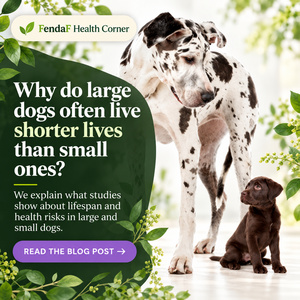
Why do large dogs often live shorter lives than small dogs?
Reading time: about 5 min
A German Shepherd, Saint Bernard or Great Dane can take up a considerable amount of space at home. Sadly, many large and giant breeds have a shorter average lifespan than smaller dogs. I previously wrote about a study comparing the health histories of tens of thousands of dogs in an attempt to explain this difference. The question is fascinating because across animal species, larger animals often live longer. Why does the relationship seem to reverse within a single species?
There is no magic answer. Body size, growth rate, genetics, breed history and disease risks can all play a role. None predicts an individual dog’s date of death. Statistics give us reasons to ask better questions, not permission to write a dog’s future in advance.
What did the study of more than 27,000 dogs show?
In 2024, Dog Aging Project researchers published an analysis of 27,541 dogs representing 238 breeds in PLOS ONE. They compared body weight, age and owner-reported health histories. Larger dogs had more reports of cancer, bone and joint conditions, gastrointestinal disorders, ear, nose and throat problems, and certain neurological, endocrine and infectious diseases. Smaller dogs had more reports of eye, heart, liver and pancreatic, and respiratory conditions.
Kidney and urinary tract conditions did not show the same clear difference by weight. A small dog is not simply a healthy dog and a large one an unhealthy dog. Their risk profiles differ. Risk is not a diagnosis: a German Shepherd need not develop cancer, nor a small terrier heart disease.
The key limitation is methodology. This was a cross-sectional analysis of owners’ retrospective reports, not an experiment changing dogs’ body sizes and measuring subsequent illnesses. It shows associations, not proof that weight itself caused a given illness. Owners may also notice and describe illnesses differently.
Do large dogs age faster?
One important explanation concerns ageing speed. A 2013 study analysed death records from over 56,000 dogs of 74 breeds. The shorter lives of large breeds were associated with a faster age-related rise in mortality risk. This does not mean each body part ages at a fixed multiple, or that dog age can be translated using one universal human-years formula.
At population level, growth and care requirements change with life stage. Rapid puppy growth needs balanced nutrition, suitable activity and protection of joints against excessive strain. In adulthood, body condition, muscle preservation, dental health and early disease detection become more important. No life stage replaces another.
You may encounter a rule of thumb suggesting that roughly two additional kilograms are associated with one month less life expectancy. This cannot be applied to an individual dog. It is a population-dependent statistical average, not a biological clock deducting a month for each two kilograms.
Why is the pattern often the opposite between species?
Elephants generally live longer than small rodents, yet within a species the size–lifespan relationship may work differently. Species differ in growth, metabolism, reproduction and evolutionary history. Comparing an elephant with a mouse cannot simply be transferred to a Great Dane and a Yorkshire Terrier.
Metabolism also requires comparing like with like. Larger mammals generally expend more energy in total, but less per kilogram of body weight than smaller ones. An old simplification suggesting small mammals always have slower metabolism actually reverses the mass-specific comparison. Explaining canine lifespan by metabolic rate alone would still be too simple.
Does rapid growth mean more cancer?
One plausible biological hypothesis is that rapid growth and a larger number of cells place different demands on regulating cell division and repairing damage. Risks of some tumours may indeed be higher in larger dogs. But cell number alone cannot explain all cancer risks or breed differences. Heredity, environment, age and random cellular events also matter.
Breed history is relevant too. During selective breeding, certain traits and disease risks can become more common together. Thus two dogs of equal weight from different breeds do not necessarily have identical risks or lifespans. Skull shape, body type and sex may interact in population studies.
Oxidative stress and antioxidants: is this the key?
I have previously shared the interesting idea that rapid growth in large-breed puppies may increase oxidative burden. Put simply, oxidative stress is an imbalance between reactive molecules and the body’s protective mechanisms, potentially damaging cells. This is a plausible research direction.
But it must not become a promise that giving a giant-breed puppy extra antioxidants will certainly prolong life. Obtaining necessary nutrients and supplementing indiscriminately are different things. A young dog’s diet should not be altered on the strength of a cell experiment or preliminary hypothesis. Especially during large-breed growth, excessive minerals and energy may do more harm than good.
Integrative veterinary medicine rightly considers food quality, exercise, recovery, inflammation and environment. These are sensible foundations. However, no proven supplement combination eliminates a large breed’s genetic or anatomical risks. Aim to support quality of life and healthy years, not sell promises science cannot support.
What can an owner of a large dog actually do?
First, maintain appropriate body condition. Excess weight puts added strain on joints and can worsen many conditions. Becoming too thin, especially in old age, is not a health victory either: muscle mass matters. Regular appropriate activity helps preserve it. Increasing activity should account for age, breathing, heart, joints and recovery.
Food should match the dog’s life stage. For fast-growing large or giant puppies, choose a diet with an appropriate energy and mineral balance for growth rather than adding calcium just in case. For adults, follow appetite, body weight and digestion. Reduced activity in senior dogs does not automatically mean they need less protein or that quality food should be replaced by ever-smaller portions.
Discuss breed-specific risks and suitable health checks with your vet. One dog may benefit most from orthopaedic monitoring, another from cardiac screening or early tumour detection. A new lump, unexplained weight loss, persistent lameness or changed breathing or exercise tolerance should not simply be blamed on ageing.
Does choosing a smaller dog guarantee more years together?
No. Smaller dogs live longer on average, but averages do not dictate one animal’s fate. Population studies show substantial variation across breeds and body types; disease, access to treatment and everyday care also matter. Some large dogs live long active lives; some small dogs become seriously ill while young.
When choosing a dog, consider breed health information, tests of the parents and your ability to meet its needs. Once the dog is home, concentrate on what you can control. Constant worry will not prolong its life. Good care can help make the time you share healthier and more meaningful.
In summary
The shorter average lifespan of large dogs is a real population trend without a single cause. Research points to faster ageing, breed-specific risks and differing disease patterns. Oxidative stress and growth biology are interesting mechanisms to study, not finished treatment protocols. Owners gain most from attentive health monitoring, appropriate nutrition, activity and seeking help early when something changes.
FendaF’s practical recommendation
A wellbeing plan for a large dog need not be complicated: monitor body condition and muscle mass, provide life-stage-appropriate food, notice changes in movement or breathing and discuss breed-specific examinations with your vet. Do not give puppies extra calcium or large quantities of antioxidants solely in the hope of extending their lives.
Sources
Nam et al. (2024), PLOS ONE: Dog size and patterns of disease history across the canine age spectrum
Kraus et al. (2013): The Size–Life Span Trade-off Decomposed, The American Naturalist
McMillan et al. (2024): Longevity of Companion Dog Breeds, Scientific Reports
Bark & Whiskers: Dog Size and Disease Risk (original interpretive article)
FendaF believes in informed choices. We share scientific and integrative perspectives so you can make thoughtful decisions for your pet. No article replaces veterinary examination, diagnosis or treatment.
FAQ
No. Disease risk profiles differ. In owner-reported data, some conditions were more common in larger dogs and others in smaller dogs.
No. That is an oversimplification of a statistical association, not a prediction for an individual dog.
There is no clinically established evidence for that promise. A balanced diet matters, but supplements need a specific reason and a safety assessment.







Leave a Reply