


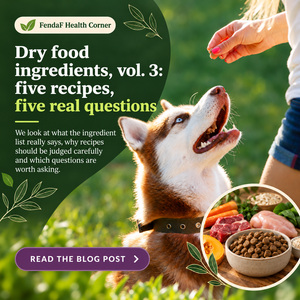
Dog food ingredients, vol. 3: five recipes, five real questions
Reading time: about 6 min
When someone asks me for an opinion about a dog food, I cannot honestly answer from the brand name or front of the bag alone. I want to know what the recipe contains, how precisely the composition is disclosed and whether the claims hold up against the numbers. So I have returned to five recipes I compared in the past: Ziwi Peak lamb, Alpha Spirit puppy food, Bonaventura Premium Adult and Barking Heads lamb dry and wet foods.
This is not a ranking competition. I have always said these are my assessments and choices for my own dogs. There is also an inconvenient fact: recipes change, ranges may differ between countries and a translated product page from years ago may not match today’s packaging. Each example is therefore a comparison of a particular formulation, not a verdict on the brand now or in the future.
A note about sources: I originally analysed these formulations years ago. Because manufacturers may have changed recipes since then, I do not present current product-page links as proof of the historical ingredient lists I reviewed. Today’s products may differ. Read this as a historical comparison of formulations, not a description of all current versions.
Before comparing, what does an ingredient list tell us?
The order shows roughly which ingredients were added in greater or smaller amounts, but cannot alone establish digestibility, amino acid quality or the quantity of every compound. Fresh meat contains substantial water, which affects its position in the list. “85% lamb” may include meat and broth; percentages in air-dried and wet foods cannot be compared directly.
Quality assurance, ingredient traceability, food safety management, nutritional analysis and recipe consistency all matter. FSSC 22000 and similar certifications describe processes but do not automatically make every formulation ideal. The same applies to “human-grade” and “zero kilometres”: what exactly is being promised, and who verifies it?
1. Ziwi Peak air-dried lamb recipe
Ziwi’s high proportion of animal ingredients and range of organs interested me from the start. The listed components have included lamb meat, tripe, lungs, heart, liver, kidneys, spleen and bone, as well as New Zealand green-lipped mussels. This is not a monotonous single-protein ingredient. The current public recipe also lists dried kelp, minerals and salt, with a different order than I may have seen previously on an Estonian page.
My original question was simple: why does a food with so much meat and organ tissue need extra salt? When I saw salt listed before parsley, I suspected a relatively large amount. Today I would phrase that more precisely. Position alone provides no sodium grams. Dogs require sodium, and supplementation can be justified for mineral balance. I would ask for actual sodium content, preferably per 1,000 kcal, and compare it with complete-food requirements.
Ziwi’s air-dried food provides approximately 4,950 kcal/kg, compared with 3,555 kcal/kg for Winner Plus Lamb & Rice. You might expect a much smaller daily portion of Ziwi. But the manufacturers’ feeding recommendations for a 40 kg dog are about 380 g Ziwi and 425 g Winner Plus. Those portions provide approximately 1,881 kcal and 1,511 kcal respectively. Energy density alone therefore does not establish how much food a dog will use. Feeding charts reflect different assumptions, and the actual ration must suit energy needs and body condition.
Compare more than price per kilogram or calories. Look at composition, nutritional value, actual portion size and daily cost together to judge what you receive for the money.
2. Alpha Spirit semi-moist puppy food
I initially liked Alpha Spirit’s high proportion of fresh meat and fish. Different ingredient versions have listed turkey, fish, pork, duck and chicken liver. But this is a multi-protein recipe, not a single-animal-source food, which matters when investigating suspected allergies.
My first questions concerned glycerine and eggs. Glycerine retains moisture in semi-moist foods. Large amounts of glycerol can affect digestion, but that does not establish that every technological dose causes diarrhoea. The quantity, product and individual tolerance matter. With eggs, I prefer to know their origin and quality. That is a fair sourcing question, but eggs are not automatically a flaw: cooked eggs provide usable protein, and raw eggs are not inherently safer microbiologically.
For me, the egg question also comes down to price: would the producer really use the highest-quality eggs from free-range hens? That is my preference, not a claim that eggs from other systems are dangerous to dogs.
For puppy food, I also want the growth-phase nutritional profile: calcium, phosphorus and their ratio, energy, protein quality and suitable mineral concentrations for large breeds. “Lots of meat” alone does not answer those questions.
3. Bonaventura Premium Adult
My chief concern was incomplete information. On an Estonian page I once saw only an excerpt of the ingredients, not the full list, and could not find the original English version for comparison. A shortened list cannot be judged as confidently as a full label.
The version I examined included grains, vegetables, milk, egg lecithin and other substances alongside meat. With milk I would want to know the form and amount: some dogs tolerate dairy, while others experience digestive problems from lactose or fat. The same applies to egg quality. “I don’t like it” is a valid personal preference, but not proof an ingredient is harmful at that dose.
Essential oils listed at the time also caught my attention. Which oils, in what amounts and for what purpose? Suitability cannot be assumed from the name alone. Insufficient transparency is a good enough reason for me to request information or choose something else, rather than diagnose poisoning based on speculation.
4. Barking Heads lamb dry food
I once found different Estonian and English ingredient lists for Barking Heads lamb food. One included lamb, dried lamb, brown rice, oats and other ingredients. The English list mentioned sunflower oil, which was absent from the Estonian text. One currently available list under the same recipe name gives lamb 35%, brown rice 14%, dried lamb 14%, peas 5% and sunflower oil, but this does not prove that every current bag uses that recipe.
I take such translation differences seriously. Buyers should be able to understand ingredients in their own language, rather than discover an ingredient on another market’s label. Sunflower oil raises the question of fatty-acid balance for me. Plant oils are generally not particularly good sources of marine omega-3 fatty acids, so I personally prefer animal-derived oils in dog foods.
5. Barking Heads lamb wet food
I like wet foods and the ability to see the shares of various ingredients. This lamb recipe listed 85% lamb components, broken down into 60% lamb meat and 25% lamb broth. They are not the same thing. Broth has a role, but 85% lamb ingredients does not mean 85% pure muscle meat.
I prefer wet foods whose declared analytical components add up to 100%. This does not tell me absolutely everything, but lets me see the approximate shares of moisture, protein, fat, ash and fibre. If the numbers total 95.4%, I want to know what accounts for the remaining 4.6%. This might largely be carbohydrates not listed separately in the analysis, but the label alone cannot establish the precise answer. I would ask the manufacturer before choosing that product.
The recipe also contained sunflower oil, salmon oil, herbs and spices such as anise. A small amount of anise in food is not equivalent to using concentrated essential oil, but individual tolerance matters for sensitive digestion. An old Estonian translation rendered “fenugreek” as “ebony”; the correct plant is fenugreek, or põld-lambalääts in Estonian. Such errors can transform an ingredient into an entirely different plant for the reader. Some newer regional lists have different herbs, making it essential to check the actual package.
How would I choose between these five?
Remove the familiar logo and the questions remain: what is the exact recipe; is it a balanced complete food; what does it supply per 1,000 kcal; where do ingredients come from; and how is consistent quality ensured? I would request sodium, fatty-acid, mineral and energy-density figures where necessary. Perhaps the most important question is whether I would choose the same food without knowing its brand.
I may prefer minimally processed recipes with transparent ingredients and varied animal tissues. Another dog may need a different approach because of pancreatitis, kidney disease or a diagnostic elimination diet for allergies. Suitability is always separate from how attractive a recipe sounds.
Five questions to check before buying
Am I looking at the current composition of this exact bag in this market? Does “meat” include organs or broth? Can I see energy density and nutrients per 1,000 kcal if needed? Do calorie density and feeding amounts make the two foods genuinely comparable? Can the manufacturer answer questions about sourcing, testing and quality assurance? Does the food suit my dog’s age, health conditions and tolerance? If an important answer is missing, ask before making a final choice.
In summary
These five foods are not a definitive ranking of today’s recipes. They are examples of how a single word on a label can open up several questions. When Estonian and original-language lists differ, this is not merely a matter of elegant translation. It is about whether the buyer is even seeing the same product. Compare manufacturers’ claims, actual labels and analytical data.
Sources
ZIWI. Air-Dried Lamb Recipe for Dogs, composition and energy.
Alpha Spirit. Semi-moist Puppies, local product information.
Bonaventura Premium Adult, retailer’s product data.
Barking Heads Chop Lickin’ Lamb dry food, retailer label example.
Barking Heads Chop Lickin’ Lamb wet food, retailer label example.
FEDIAF Nutritional Guidelines (2025).
WSAVA Global Nutrition Guidelines.
FendaF: Glycerine and sorbitol in treats.
🐾 FendaF believes in informed choices
The purpose of the FendaF blog is not to tell you what you must do. Our aim is to share knowledge, introduce different evidence-based and integrative perspectives, and help you make more informed decisions for your pet.
Every animal is unique, and no article can replace a consultation, diagnosis or treatment provided by a veterinarian. If your pet has a health concern or you need individual advice, always contact a veterinarian.







Leave a Reply