


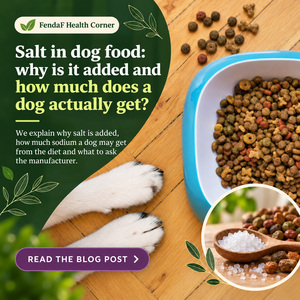
Salt in dog food: why is it added and how much does a dog actually get?
Reading time: about 6 min
For years I have questioned why some dry and wet dog foods contain separately added salt. Not because sodium is poisonous or unnecessary, but because meat and other ingredients already supply it. This matters even more with mixed feeding: a dog might eat kibble, wet food, fresh meat, table scraps and salty training treats in the same day.
My preference is for ingredients to meet nutritional needs wherever possible, with a clear reason for additions. There are three distinct questions: how much sodium the dog needs, how much comes from the complete diet, and why a manufacturer adds salt. None implies that salt is automatically harmful.
Dogs need sodium, but must it be added as salt?
Sodium and chloride are essential. Sodium supports fluid balance, nerves and muscles; chloride contributes to stomach acid. But these minerals exist naturally in food ingredients. A complete-food manufacturer must ensure enough of both. Added salt may be justified if the base ingredients fall short. If they do not, I would ask why it was included.
An ingredient list alone cannot tell us the total sodium level or whether an addition was necessary. Conversely, no listed salt does not mean no sodium.
What do sodium recommendations actually mean?
Small suggested daily salt quantities must not be confused with universal toxicity limits. Sodium requirements depend in part on dietary energy and the entire ration. Physiological needs, recommended formulation levels and harmful excessive intake are separate concepts.
FEDIAF’s 2025 guidelines give approximately 0.25–0.29 g sodium per 1,000 kcal for complete adult dog food, depending on the energy model. That is 250–290 mg sodium, not the same amount of added table salt. Sodium accounts for about 39% of NaCl, meaning 250 mg sodium corresponds mathematically to around 0.64 g salt. This is neither an instruction to add 0.64 g nor a maximum safe dose. Sodium may already come from ingredients.
When comparing foods, I would ask for total sodium in mg/1,000 kcal, and calculate the actual daily intake from how much the dog eats. If the recipe lists NaCl, ask the producer why it is added.
Why do manufacturers add salt to dry and wet dog food?
Dry kibble is commonly extruded, after which fats and flavouring materials may be used as surface coatings to improve palatability. However, seeing salt on a label does not prove that it was sprayed onto finished kibble. NaCl may have been mixed in before extrusion, sodium-containing components may appear in the coating, and processes vary. A label does not show the production stage.
Salt may balance minerals or enhance taste. Those purposes are different. I would ask the manufacturer for the finished product’s total sodium, whether the added NaCl corrects a measured nutritional shortfall or has another purpose, and when it is introduced in production. Without that information, definite claims about a specific bag are not justified.
“Dogs need sodium” is not an answer to “why did you add salt?” Likewise, the mere presence of the word “salt” cannot establish that a recipe is dangerously salty. Quantities, the whole diet and the purpose matter.
How much sodium does a dog get from kibble, wet food and raw meat?
All dietary sources add together. As an illustration, 100 g of kibble at 0.30% sodium provides 300 mg; 200 g of wet food at 0.12% provides 240 mg; and 150 g of raw meat at 0.07% adds 105 mg. Total: 645 mg sodium, equivalent mathematically to approximately 1.64 g of salt. These values are illustrative and are not laboratory data for Winner Plus or any particular food.
This is not 1.64 g of added salt and does not, by itself, prove danger. We need to combine all sources and compare with total daily calories. If energy intake is known, the amount can be expressed per 1,000 kcal. If sodium is not declared on the pack, ask the producer because “salt” in the ingredient line is insufficient for calculations.
Mixed feeding makes the justification for additional NaCl even more relevant. When kibble, wet food and fresh meat already contribute sodium, the need to add more depends on the actual recipe, not the slogans “salt is good” or “salt is bad”.
What about salty human food and treats?
I once used sausages and similar foods for puppy training, but later switched to treats formulated for dogs. Ossu usually spits out a piece of sausage or refuses it. That is his preference, not a biological test of sodium requirements. Human foods may contain considerably more added salt than regular dog food.
For example, 25 g of sausage labelled 1.8 g salt per 100 g provides 0.45 g salt; 25 g of cheese at 1.4 g per 100 g provides 0.35 g. These are arithmetic examples, not toxicity thresholds. A large dog may receive substantially more than 100 g of rewards during training. I would not want salty human foods to account for a major share of those rewards.
Dairy products also vary. I have compared kefir containing approximately 0.1 g salt per 100 g with cottage cheese containing 1 g. Check the actual label, serving size and the dog’s digestive tolerance.
When can salt become dangerous?
Acute salt poisoning differs from the moderate sodium content of everyday complete food. Large amounts of salt dough, pure salt, very salty food or seawater can be hazardous, especially without enough fresh drinking water. The Merck Veterinary Manual lists vomiting, diarrhoea, intense thirst, weakness, tremors, loss of coordination and seizures among possible signs.
If a dog has swallowed a large quantity of salt at once or shows neurological symptoms, call a veterinarian immediately. Do not induce vomiting at home or attempt to flush a serious poisoning out with large forced volumes of water: sudden shifts in fluid balance can be dangerous, and treatment requires professional guidance.
Do dogs with heart or kidney disease need a low-salt diet?
In some conditions and treatment plans sodium is particularly important, but the answer is not always “as little as possible”. With heart failure, kidney disease, fluid retention or diuretics, diet must be assessed alongside the diagnosis, blood pressure, kidney results, electrolytes and medication. Do not suddenly adjust a mineral without veterinary guidance.
Faddu’s cardiac treatment has shown me that fluid balance is not a simple switch. Medication and food need to work together, and a carefully phrased question to the veterinarian is more useful than acting on a single figure from the internet.
What should we ask when choosing dog food?
I still favour dry and wet foods that do not add salt merely out of habit or for taste. But to judge a specific food, I want to know total sodium and chloride, the contribution of ingredients, why anything is added, and how it fits with the rest of the ration. For mixed feeding, we must include meat, wet food and treats, not just one bag.
Ask the manufacturer for total sodium in mg/1,000 kcal rather than only reading the ingredient list. Add sodium from kibble, wet food, fresh meat and treats. If salt is added, ask how much and whether it covers a measured nutritional requirement or has another function.
In summary
Dogs require sodium and chloride, but they do not automatically require separately added table salt in dry or wet food. My question remains: why is NaCl added when ingredients already provide sodium? Some recipes may have a valid explanation, but “sodium is necessary” does not establish one. Knowing the total sodium from all daily foods is essential before making informed comparisons.
Sources
FEDIAF. Nutritional Guidelines for Complete and Complementary Pet Food for Cats and Dogs (2025).
Merck Veterinary Manual. Salt Toxicosis in Animals.
WSAVA. Global Nutrition Guidelines.
FendaF. How dangerous is salt water?
Further reading: FEDIAF (2025) recommendations for sodium and chloride, and literature on extrusion and coating. An ingredient label cannot establish when or how much salt a manufacturer added.
🐾 FendaF believes in informed choices
The purpose of the FendaF blog is not to tell you what you must do. Our aim is to share knowledge, introduce different evidence-based and integrative perspectives, and help you make more informed decisions for your pet.
Every animal is unique, and no article can replace a consultation, diagnosis or treatment provided by a veterinarian. If your pet has a health concern or you need individual advice, always contact a veterinarian.











Leave a Reply